
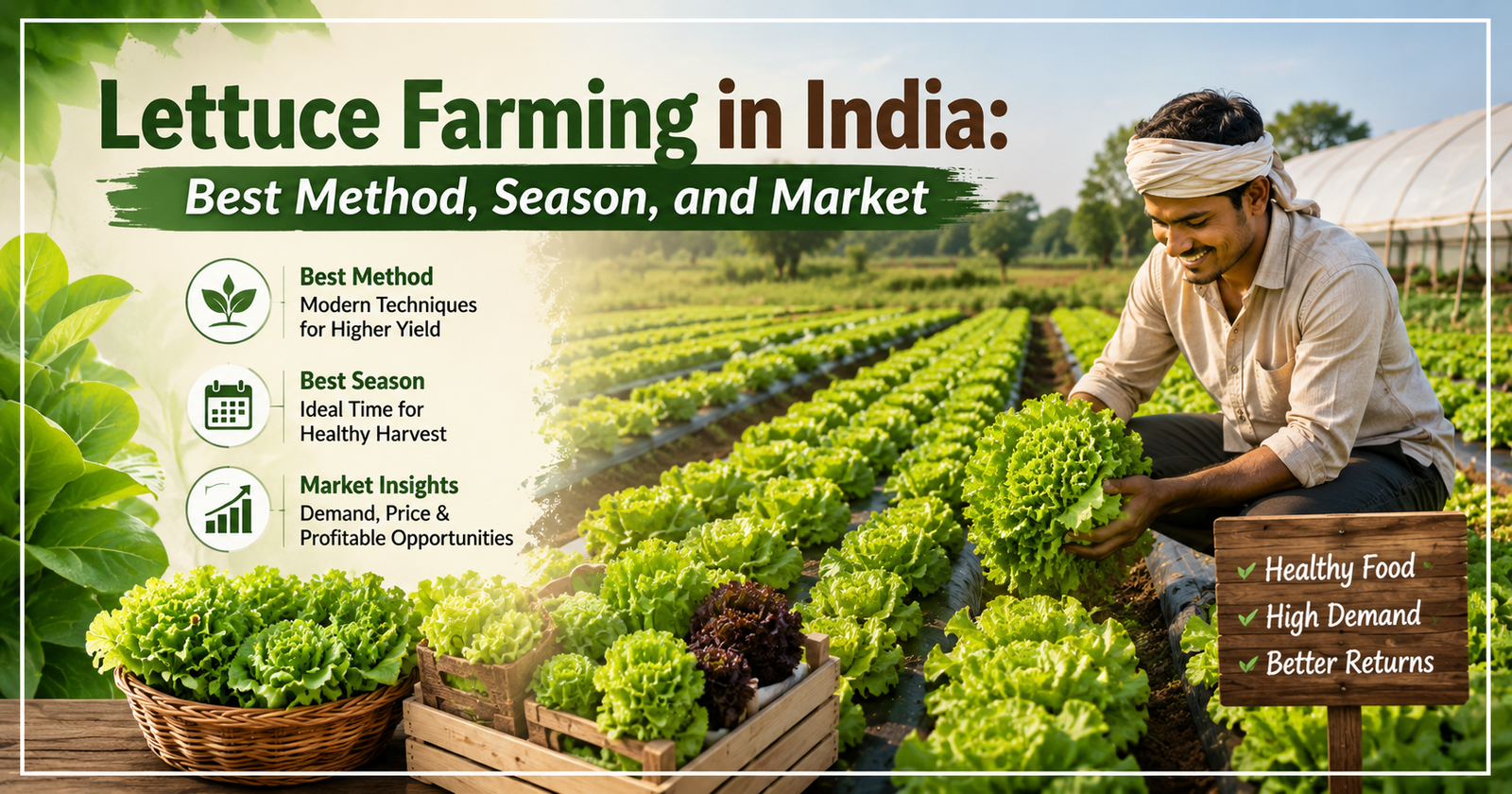
Lettuce Farming in India: Best Method, Season, and Market
Posted on June 12, 2026
A few years ago, lettuce was not a common word in many Indian vegetable markets. Farmers were more familiar with spinach, methi, coriander, cabbage, cauliflower, and traditional leafy greens. Lettuce was seen in hotel kitchens, burgers, sandwiches, salads, and premium grocery stores.
But the market has changed quietly.
Today, a small bunch of fresh lettuce can travel from a farm near a city to a cafe kitchen, a supermarket shelf, a salad bowl, or a home delivery box. It is no longer only an imported-looking vegetable. Lettuce farming in India is slowly becoming an opportunity for farmers who understand urban demand, freshness, quality, and timing.
Still, lettuce is not a crop that should be grown blindly. It looks simple, but it needs the right season, clean handling, proper water management, and a clear market. A farmer who treats this crop as both a farming activity and a business opportunity is more likely to succeed.
Why Lettuce Farming Is Growing in India
Lettuce farming is growing in India because people are adding salads and healthy foods to their diet. Restaurants, cafes, cloud kitchens, hotels, premium grocery stores, and online vegetable sellers are looking for fresh, clean, and attractive lettuce.
This demand is stronger in urban and semi-urban areas. Cities like Bengaluru, Mumbai, Pune, Delhi NCR, Hyderabad, Chennai, Ahmedabad, Kochi, and Goa have markets for lettuce because consumers are more familiar with salad vegetables.
For farmers, lettuce can be interesting because it is a short-duration crop. It does not take years like fruit trees. It can be harvested within weeks, depending on the variety and growing method. But a quick harvest does not automatically mean easy profit. Lettuce is delicate. If it wilts, turns yellow, or gets damaged during transport, buyers may reject it.
This is why lettuce farming should begin with the market, not with the seed.
Best Climate for Lettuce Farming in India
Lettuce is a cool-season leafy vegetable. It prefers mild temperatures and does not like extreme heat. In hot weather, lettuce can become bitter, grow slowly, or start flowering too early. When this happens, the plant produces fewer good-quality leaves.
In India, lettuce grows better during winter in the plains and during cooler months in many regions. In North India, the main lettuce growing season is usually from October to February. In the western and central parts of India, farmers can grow lettuce during the cooler season if temperature conditions are suitable. In hilly areas, lettuce can be grown for a longer period because the climate is naturally cooler.
For farmers in hot regions, open-field lettuce farming can be risky during summer. Protected cultivation, shade net, polyhouse, or hydroponic lettuce farming may help manage temperature and quality, especially near city markets.
The main lesson is simple: lettuce grows best when the weather is gentle. If the crop is forced into harsh heat, quality suffers.
Best Soil for Lettuce Cultivation
Lettuce prefers fertile, loose, well-drained soil with good organic matter. The soil should hold enough moisture but should not remain waterlogged. Since lettuce has shallow roots, regular moisture is important.
Before planting, farmers should prepare the land with compost or well-decomposed farmyard manure. The soil should be fine and clean because lettuce seeds are small and seedlings are delicate. Raised beds are often useful because they improve drainage and make harvesting easier.
For open-field lettuce farming in India, weed control is important. Lettuce grows close to the ground, so weeds compete for nutrients and reduce quality. Clean beds also help produce better-looking leaves, which matters in the market.
Best Method for Lettuce Farming
There is no single best method for every farmer. The best method for lettuce farming depends on climate, land, budget, water, labour, and market demand.
For small farmers near local markets, open-field lettuce farming during winter can be a practical start. It requires lower investment than hydroponics or polyhouse farming. Farmers can begin with a small area, test demand, and slowly expand.
For farmers near premium urban markets, protected cultivation can be more useful. A shade net house or polyhouse can help protect the crop from heavy rain, strong sunlight, pests, and sudden weather changes. It also helps maintain better leaf quality.
For entrepreneurs with limited land, hydroponic lettuce farming is another strong option. Lettuce is one of the most popular crops in hydroponic systems because it grows quickly, uses space efficiently, and is preferred by premium buyers. Hydroponic lettuce can be grown in NFT systems, grow beds, or soilless media (cocopeat).
However, hydroponics requires technical knowledge. Water quality, nutrient solution, pH, hygiene, and temperature control must be managed properly. It is not just putting plants in pipes. It is a farming system that needs daily observation.
Lettuce Varieties in India
Lettuce comes in different types, and has a different market. Loose-leaf lettuce, romaine lettuce, iceberg lettuce, butterhead lettuce, and oakleaf lettuce are some common types.
Loose-leaf lettuce is often easier for beginners because it grows faster and can be harvested as leaves. Romaine lettuce is popular in salads and has a crisp texture. Iceberg lettuce is commonly used in burgers and sandwiches, but it needs better management and market planning.
Before choosing a variety, farmers should speak to buyers. A cafe may want romaine. A burger outlet may prefer iceberg. A premium vegetable store may want colourful leaf lettuce. Growing the wrong variety can create a selling problem even if the crop grows well.
Nursery and Planting
Lettuce can be grown by direct sowing or transplanting, but many farmers prefer raising seedlings first for better crop growth. A good nursery helps produce healthy and uniform plants. Seedlings should be handled carefully because lettuce is delicate.
Spacing depends on the variety and purpose. Leaf lettuce may need less spacing, while head lettuce, like iceberg, needs more space to form proper heads. Overcrowding reduces air movement and can increase risk.
After transplanting, the crop needs gentle irrigation. Too much water can damage roots, while too little water can slow growth and affect leaf texture. Drip irrigation is useful because it provides controlled water and reduces wastage.
Harvesting Lettuce
Lettuce must be harvested at the right stage. If harvested too early, the yield may be low. If harvested too late, leaves may become tough or bitter. For leaf lettuce, farmers can harvest outer leaves or cut the plant depending on market demand. Head lettuce is ready for harvesting when the head is well-formed, firm, and suitable for market sale.
Morning harvesting is often better because leaves are fresh and crisp. After harvesting, lettuce should be handled gently, cleaned carefully, packed properly, and moved quickly to buyers. Cold storage or cool transport can improve shelf life, especially for premium markets.
This is where many farmers lose value. They grow good lettuce, but handle it like a rough vegetable. Lettuce needs soft handling. Its market price depends heavily on freshness and appearance.
Lettuce Market in India
The lettuce market in India is still developing, but demand is growing in selected segments. Hotels, restaurants, cafes, supermarkets, salad brands, burger chains, cloud kitchens, organic stores, and online grocery platforms are important buyers.
Farmers near cities have a better advantage because lettuce does not travel well over long distances without proper cooling. If the buyer is nearby, the farmer can supply fresher produce and reduce wastage.
Direct marketing can improve income. Instead of depending on wholesale mandis, farmers can connect with restaurants, vegetable subscription businesses, local stores, housing societies, and health-focused customers. But direct selling requires consistency. Buyers want regular supply, uniform quality, and clean packaging.
Before starting lettuce farming, farmers should ask three questions: Who will buy it? How much quantity do they need? What type of lettuce do they prefer?
Final Thoughts
Lettuce farming in India is not just about growing a foreign-looking leafy vegetable. It is about understanding a new market. The crop is delicate, but there is a real opportunity for farmers who are close to urban demand and willing to focus on quality.
The best method may be open-field farming for one farmer, shade net cultivation for another, and hydroponic lettuce farming for an urban entrepreneur. The best season may be winter in the plains, longer cool periods in hilly areas, or year-round production under controlled systems.
Lettuce rewards careful farmers. It rewards clean beds, good seeds, gentle irrigation, timely harvest, and fast selling. It does not reward careless handling or growing without buyers.
In the end, lettuce farming begins in the field, but profit begins in the market. A farmer who understands both can turn this leafy crop into a fresh and practical business opportunity.