
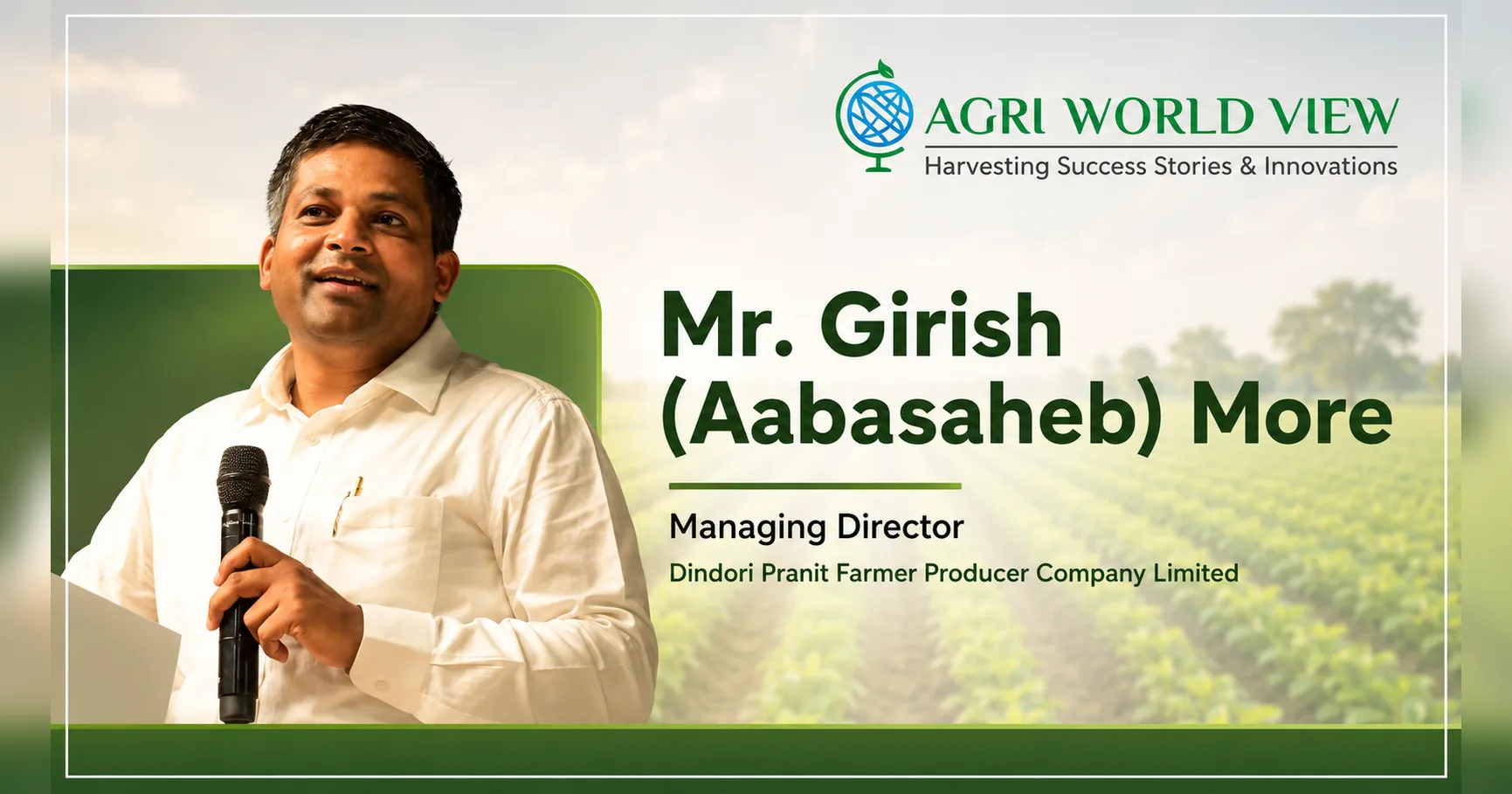
Aabasaheb More – A Life Dedicated to Agriculture, Service, Rural Transformation & Nation Building
Posted on July 20, 2026
“Empowering Farmers, Preserving Nature, Reviving Rural India.”
For over four decades, Shri Girish Shriram More, respectfully known as Aabasaheb More, has dedicated his life to transforming Indian agriculture through sustainable farming, farmer empowerment, indigenous cattle conservation, rural entrepreneurship, and value-based social reform.
His journey is not merely the story of an agricultural leader—it is the story of a visionary who transformed a grassroots movement into one of India’s largest farmer-centric service missions, inspiring millions of farming families across villages, states, and even international communities.
Deeply rooted in spirituality and guided by the timeless philosophy of “Seva, Sanskar and Sustainable Agriculture,” Aabasaheb has successfully blended traditional agricultural wisdom with modern scientific practices to create a practical and replicable model of rural development.
Today, his work has touched the lives of millions of farmers through more than 7,500 Seva Kendras, over 8,200 agricultural coordinators, thousands of volunteers, and an ever-growing network spanning 14 Indian states and other countries.
Humble Beginnings: Where the Journey Started
Born on 6 January 1984 in the agricultural heartland of Dindori, Nashik (Maharashtra), Aabasaheb was raised in a traditional farming family where agriculture was never viewed merely as an occupation—it was a sacred responsibility.
His childhood revolved around fields, livestock, seasons, and community life. Watching farmers work tirelessly despite uncertainty taught him one fundamental truth:
“The prosperity of a nation begins with the prosperity of its farmers.”
These formative years shaped his lifelong mission to restore dignity, profitability, and sustainability to Indian agriculture.
The Legacy of Service
Aabasaheb’s greatest inspiration came from his grandfather,
Param Pujya Shri Khanderao Appaji More (Dadasaheb),
whose life reflected extraordinary simplicity, discipline, and selfless public service.
Beyond managing agriculture, Dadasaheb devoted himself to helping villagers solve everyday problems. Through him, young Girish learned that leadership is measured not by authority, but by one’s ability to serve society.
Following Dadasaheb’s legacy, Param Pujya Gurumauli Annasaheb More expanded this spiritual movement through Dindori Pranit Seva Marg, inspiring lakhs of families towards spiritual discipline, social harmony, and selfless service.
Aabasaheb inherited this sacred tradition and transformed its values into practical action for agriculture, rural development, environmental conservation, and farmer welfare.
A Vision Beyond Farming
While actively working on the family farm alongside his father, Param Pujya Gurumauli Shri Shriram More, Aabasaheb closely witnessed the struggles faced by Indian farmers:
- – Rising cultivation costs
- – Soil degradation
- – Water scarcity
- – Declining indigenous seed diversity
- – Chemical dependency
- – Market uncertainty
- – Farmer indebtedness
- – Rural unemployment
Instead of accepting these problems as inevitable, he envisioned a holistic agricultural system where:
- – Farmers become economically self-reliant.
- – Agriculture protects nature.
- – Villages generate employment.
- – Indigenous cattle regain their importance.
- – Healthy food reaches every household.
- – Farming becomes profitable while remaining environmentally sustainable.
This vision eventually evolved into what is now known as the Dindori-Pranit Ideal Farming Model—an integrated, farmer-centric approach combining natural farming, scientific innovation, indigenous knowledge, entrepreneurship, and spiritual values.
Building One of India’s Largest Farmer Movements
Recognising that knowledge is the most powerful agricultural input, Aabasaheb devoted himself to farmer education.
Under his leadership, a nationwide grassroots network was developed, consisting of:
- – 7,500+ Village Seva Kendras
- – 8,200+ Agricultural Coordinators
- – Millions of connected farming families
- – 14 Indian states
- – 10 countries
- – Thousands of trained volunteers
This unique community-driven network enables farmers to receive practical guidance directly within their villages, making agricultural knowledge accessible to even the most remote communities.
Revolutionising Farmer Education
Unlike conventional classroom training, Aabasaheb introduced practical, field-based learning.
Through hundreds of training camps, demonstrations, seminars, workshops, and village outreach programmes, farmers receive hands-on guidance on:
- – Organic farming
- – Natural farming
- – Regenerative agriculture
- – Soil health restoration
- – Indigenous seed conservation
- – Water conservation
- – Integrated farming systems
- – Livestock management
- – Crop diversification
- – Farmer entrepreneurship
- – Digital agriculture
- – Climate-resilient farming
His philosophy is simple: Knowledge must reach the farmer before technology reaches the field.
Global Krushi Mahotsav – Connecting Farmers with Innovation
One of Aabasaheb More’s most significant contributions is the establishment and expansion of the Global Krushi Mahotsav, one of India’s largest farmer knowledge-sharing platforms.
Since its inception, this movement has organised:
- – 580+ Agricultural Mahotsavs and Farmer Gatherings
- – 980+ Farmer Training Camps
- – Participation from agricultural scientists, universities, innovators, entrepreneurs, policymakers, and progressive farmers.
The Mahotsav serves as a bridge between traditional wisdom and modern agricultural science, enabling farmers to learn directly from experts while sharing their own successful experiences.
The Dindori-Pranit Ideal Farming Model
Aabasaheb developed an integrated agricultural ecosystem that views farming as a complete cycle rather than isolated crop production.
The model combines:
- – Organic farming
- – Natural farming
- – Indigenous cattle conservation
- – Water management
- – Renewable energy
- – Seed sovereignty
- – Horticulture
- – Soil biology
- – Farmer-owned enterprises
- – Value addition
- – Rural entrepreneurship
To demonstrate these practices, 24 live model farms have been established, allowing farmers to observe successful techniques under real farming conditions before implementing them on their own land.
Champion of Indigenous Cattle Conservation
Recognising the inseparable relationship between livestock and sustainable agriculture, Aabasaheb has become a leading advocate for indigenous cattle conservation.
Through the innovative Mukt Sanchar Gotha concept and extensive work under the Pashu Gouvansh Vibhag, farmers receive guidance on:
- – Scientific cow care
- – Indigenous breeds
- – Organic manure production
- – Panchagavya-based agriculture
- – Dairy development
- – Integrated livestock management
His efforts have helped restore the importance of native cattle in sustainable farming systems.
Reviving India’s Seed Heritage
Aabasaheb strongly believes that seed sovereignty is the foundation of agricultural independence.
Through the Shakambhari Seed Bank, traditional and indigenous seed varieties are preserved, multiplied, and distributed to farmers, helping reduce dependence on commercial hybrid seed systems while protecting agricultural biodiversity.
Creating Rural Entrepreneurs
Understanding that farming alone may not always provide sufficient income, Aabasaheb promoted diversified rural livelihoods.
His initiatives support:
- – Farmer-Producer Companies
- – Self-Help Groups
- – Food processing
- – Value addition
- – Rural industries
- – Agri-based entrepreneurship
- – Digital marketing
- – Branding of farmer products
Through initiatives such as Satvik Krushidhan, KrushiMart, and KrushiYog, farmers receive opportunities to connect directly with consumers while improving profitability.
Digital Transformation of Agriculture
Believing that technology should empower even the smallest farmer, Aabasaheb has embraced digital platforms to expand agricultural education.
His initiatives have digitally trained 25,000+ farmers, while educational content reaches lakhs of viewers through dedicated online platforms and agricultural awareness campaigns.
Agriculture with Social Responsibility
For Aabasaheb More, rural development extends beyond agriculture.
His work includes:
- – Farmer family counselling
- – Marriage guidance through Vivah Sanskar Vibhag
- – Dowry-free social awareness
- – Women’s Self-Help Groups
- – Youth skill development
- – Environmental conservation
- – Tree plantation
- – Water conservation
- – Rural employment generation
- – Community health awareness
He firmly believes that prosperous villages require both economic and social transformation.
A Recognised Leader in Indian Agriculture
Over the years, Aabasaheb More’s contributions have earned numerous prestigious honours, including:
- – Krushi Bhushan Award (Government of Maharashtra)
- – Chhatrapati Shivaji Maharaj Krushi Ratna Award
- – Dr. Punjabrao Deshmukh Krushi Gaurav Award
- – Dalimb Ratna Award for research and innovation in pomegranate cultivation
- – Panchasutri Puraskar
- – Rashtriya Go-Kartutva Puraskar
- – Sambhaji Maharaj Jeevan Gaurav Puraskar
- – Several recognitions from agricultural, social, and educational institutions across India.
These awards acknowledge not only his personal achievements but also the collective impact of the nationwide farmer movement he has nurtured.
A Legacy That Continues to Grow
Today, Aabasaheb More stands among India’s foremost grassroots champions of sustainable agriculture and rural empowerment.
His mission extends beyond increasing crop yields—it seeks to restore harmony between farmers, nature, spirituality, and society.
By integrating ancient agricultural wisdom with scientific innovation, community participation, and value-based leadership, he has demonstrated that true agricultural progress is measured not merely by production but by healthier soils, stronger rural economies, empowered farmers, and a more sustainable future.
His life’s work serves as a powerful reminder that when farmers prosper, villages flourish; when villages flourish, the nation grows stronger.
“Service to Farmers is Service to Humanity.”
Through unwavering dedication, visionary leadership, and a lifelong commitment to rural India, Aabasaheb More continues to inspire millions toward a future that is prosperous, sustainable, self-reliant, and deeply rooted in India’s timeless agricultural heritage.