
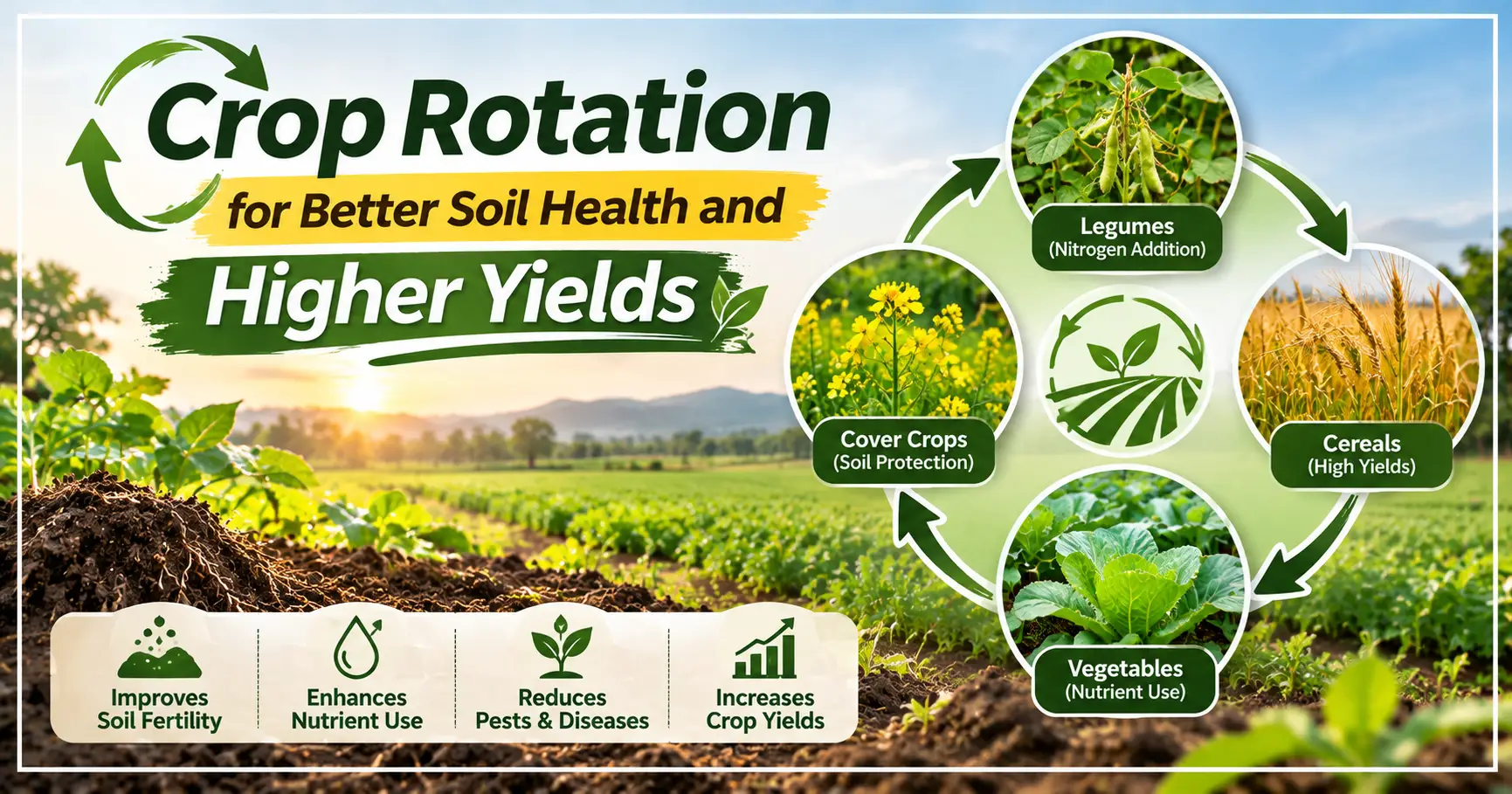
Crop Rotation: 8 Practical Systems for Better Soil Health
Posted on November 27, 2026
A productive harvest depends on more than the seed variety or fertiliser used during a single season. What happens to a field between harvests matters too. When the same crop is grown repeatedly in the same field, it can place recurring demands on particular nutrients and create favourable conditions for certain weeds, insect pests and diseases to build up.
Crop rotation offers a practical way to change that pattern. By growing different crops in a planned sequence, farmers can make more balanced use of soil resources, add diversity to the farming system and reduce some production risks. With a sequence suited to local conditions, crop rotation can support soil health on small family farms as well as larger commercial holdings.
What Is Crop Rotation?
Crop rotation is the practice of growing different crops on the same field in a planned sequence over two or more growing seasons. A farmer, for example, might grow maize in one season, follow it with a legume such as soybean or cowpea, and then plant wheat, sorghum or a suitable cover crop.
Different crops have different rooting patterns, nutrient requirements, growth periods and relationships with pests and diseases. A well-designed rotation can help keep the soil covered for more of the year, return plant residues to the field and interrupt the life cycles of some organisms that depend on particular crops.
How Crop Rotation Supports Soil Fertility and Yields
The benefits of crop rotation come from the way different crops use and influence the soil. No single rotation works everywhere, but a diverse sequence can contribute to a more resilient farming system in several ways.
1. Makes use of nutrients at different soil depths
Crops vary in their root depth and nutrient needs. Deep-rooted plants may access water and nutrients from lower soil layers, while shallow-rooted crops use more of the upper soil profile. Alternating crops with different rooting habits can help farmers make use of soil resources in a more varied way.
2. Includes legumes that can add nitrogen to the system
Legumes such as beans, peas, lentils, chickpeas and soybean can form partnerships with compatible soil bacteria that fix atmospheric nitrogen. Some of this nitrogen may benefit a following crop through roots, nodules and decomposing residues. The amount available depends on factors such as healthy crop growth, effective nodulation, soil conditions and how much biomass remains in the field.
3. Helps disrupt certain pest, disease and weed cycles
Some pests and diseases are closely associated with particular crops or plant families. Changing to a crop from a different family can make it harder for these organisms to find a continuous host. Crop rotation can also support weed management because crops differ in canopy cover, planting dates and cultivation practices. It is not a stand-alone solution, however; resistant varieties, field sanitation and other integrated pest management practices may still be needed.
4. Protects soil and supports organic matter
Cover crops, crop roots and retained residues help protect the soil surface from wind, heavy rain and direct sunlight. As roots and plant material break down, they contribute organic matter and provide food for soil organisms. Over time, this can support soil structure and water-related functions, especially when combined with other sound soil-management practices.
8 Practical Crop Rotation Options for Farmers
The following examples are starting points, not fixed prescriptions. Farmers should adjust crop choices and timing to local rainfall, irrigation, soil type, temperature, available labour, equipment and market demand.
Cereal – legume – cereal
Examples include maize followed by soybean and then wheat; rice followed by green gram (moong) and then maize; or sorghum followed by cowpea and then another cereal. The legume phase adds crop diversity and may contribute nitrogen to the system, while the cereal provides grain or fodder and uses nutrients differently.
Cereal – pulse – oilseed
A sequence such as wheat, chickpea and mustard, or maize, common bean and sunflower, spreads production across different crop types. Pulses provide a legume phase, while oilseeds offer another market option and have different rooting and nutrient-use patterns. This sequence is most suitable where the growing seasons and market access support all three crops.
Rice – legume – cereal or vegetable
In suitable areas, rice may be followed by a short-duration legume, maize or a vegetable crop. The next crop must fit the time available between seasons and the field’s drainage, soil-moisture levels and temperature conditions. Water availability and the turnaround time after rice harvest are especially important.
Maize – forage legume – wheat
Maize can be followed by a forage legume such as berseem, clover or another locally adapted species, and then wheat or a different cereal. The forage legume can provide livestock feed, ground cover and—where conditions support effective nitrogen fixation—a contribution of nitrogen to the system. This option can suit mixed crop-livestock farms. Avoid removing all plant biomass if building soil organic matter is also a goal.
Vegetables rotated across different plant families
Vegetable growers can plan sequences that move between plant families. For example, tomato may be followed by a leafy vegetable, then a legume and later a cucurbit such as pumpkin or cucumber. Related crops can share important pests and diseases, so they should not automatically be treated as different rotation crops. Tomato, chilli, brinjal and potato, for instance, are all members of the nightshade family; cabbage, cauliflower and broccoli belong to the brassica family.
Root crop – cereal – legume
Potato or another suitable root crop may be followed by a cereal and then a legume, depending on local climate, soil conditions and market needs. Where possible, use a suitable cover crop or manage residues to protect the field after harvest and reduce the period when the soil is bare.
Cotton – cereal – pulse
In suitable cotton-growing regions, cotton may be followed by a cereal such as wheat, maize or sorghum, and then a pulse such as chickpea or gram. Moving between crop families can help interrupt some pest and disease cycles. Manage cotton residues according to local pest-management recommendations; where residues can safely remain, retaining or incorporating them appropriately may also help protect soil.
Cover crop or green manure between cash crops
A short-duration cover crop can be grown between two main crops when the calendar and water supply allow. Examples include sunn hemp, cowpea, clover, vetch and other locally adapted legumes. These crops can cover bare soil, compete with weeds and add biomass. Choose a species and termination method that fit the next crop and do not allow the cover crop to become a source of unwanted seed or a water competitor.
How to Plan a Crop Rotation on Your Farm
- – Review the field’s history. List the crops grown over the past three to five years. Record recurring weed, pest and disease problems, as well as areas with poor crop performance.
- – Plan by plant family. Avoid repeatedly planting closely related crops that are affected by the same pests or diseases. Moving between different plant families can improve the break in the cropping sequence.
- – Include a suitable legume. Where it fits the climate and cropping calendar, consider a pulse, forage legume or leguminous cover crop. Healthy growth, effective nodulation and sensible residue management influence the nitrogen benefit.
- – Keep the soil covered. Retain suitable crop residues, grow cover crops or use organic mulch where appropriate. Soil cover can reduce exposure to wind and rain and help conserve moisture.
- – Use soil information to balance nutrients. A soil test, where available, can help identify nutrient needs. Replace nutrients removed in harvested produce and remember that crop rotation supports nutrient cycling but does not eliminate the need for balanced nutrient management.
- – Check water, labour and market requirements. A rotation must be practical as well as agronomically sound. Confirm that each crop fits the local season, irrigation supply, machinery, labour availability, storage and likely market demand.
Common Crop Rotation Mistakes to Avoid
- – Treating crops from the same plant family as completely different rotation options.
- – Choosing a sequence without checking the local growing season, water supply and field drainage.
- – Assuming that a legume will supply all the nitrogen a following crop needs.
- – Removing or burning residues without considering soil-cover needs and local pest-management advice.
- – Repeating a rotation without reviewing field history, soil-test results and changes in pest or disease pressure.
Conclusion: Build a Rotation That Fits Your Farm
Crop rotation is a long-term approach to keeping farmland productive. Alternating cereals with legumes, adding oilseeds or vegetables where suitable, and using cover crops between cash crops can increase diversity and support soil health. A well-planned sequence may also reduce pressure from certain weeds, pests and diseases and help farmers make more balanced use of nutrients and water.
Higher yields are possible, but rotation is only one part of successful crop production. Good seed, timely planting, balanced nutrition, effective water management and careful crop protection remain essential. The best rotation is the one that matches a farm’s soil, climate, water supply, equipment and market while protecting the land’s productive capacity for future seasons.
Frequently Asked Questions About Crop Rotation
What is the main purpose of crop rotation?
The main purpose is to grow different crops in a planned sequence so the field is not repeatedly exposed to the same crop-related nutrient demands, pests, diseases and weed pressures. It can also help maintain soil cover and support soil organic matter.
How does crop rotation improve soil fertility?
Different crops use nutrients and root through the soil differently. Legumes can fix atmospheric nitrogen when they form effective partnerships with compatible bacteria, and crop roots and residues can contribute organic matter. The benefits depend on crop growth and residue management.
Which crops are commonly used in crop rotation?
Common choices include cereals such as rice, wheat, maize and sorghum; legumes such as soybean, chickpea, cowpea and green gram; oilseeds such as mustard and sunflower; and locally suitable vegetables, forage crops and cover crops.
Can crop rotation control pests and diseases?
It can help reduce the build-up of some pests and diseases that depend on particular crops or plant families. However, it does not control every pest or disease and should be combined with other integrated pest management practices.
How many years should a crop rotation last?
There is no single ideal duration. A rotation may run over two or more seasons, depending on the crops, local climate, water availability, pest and disease history, and the farm’s production goals.