
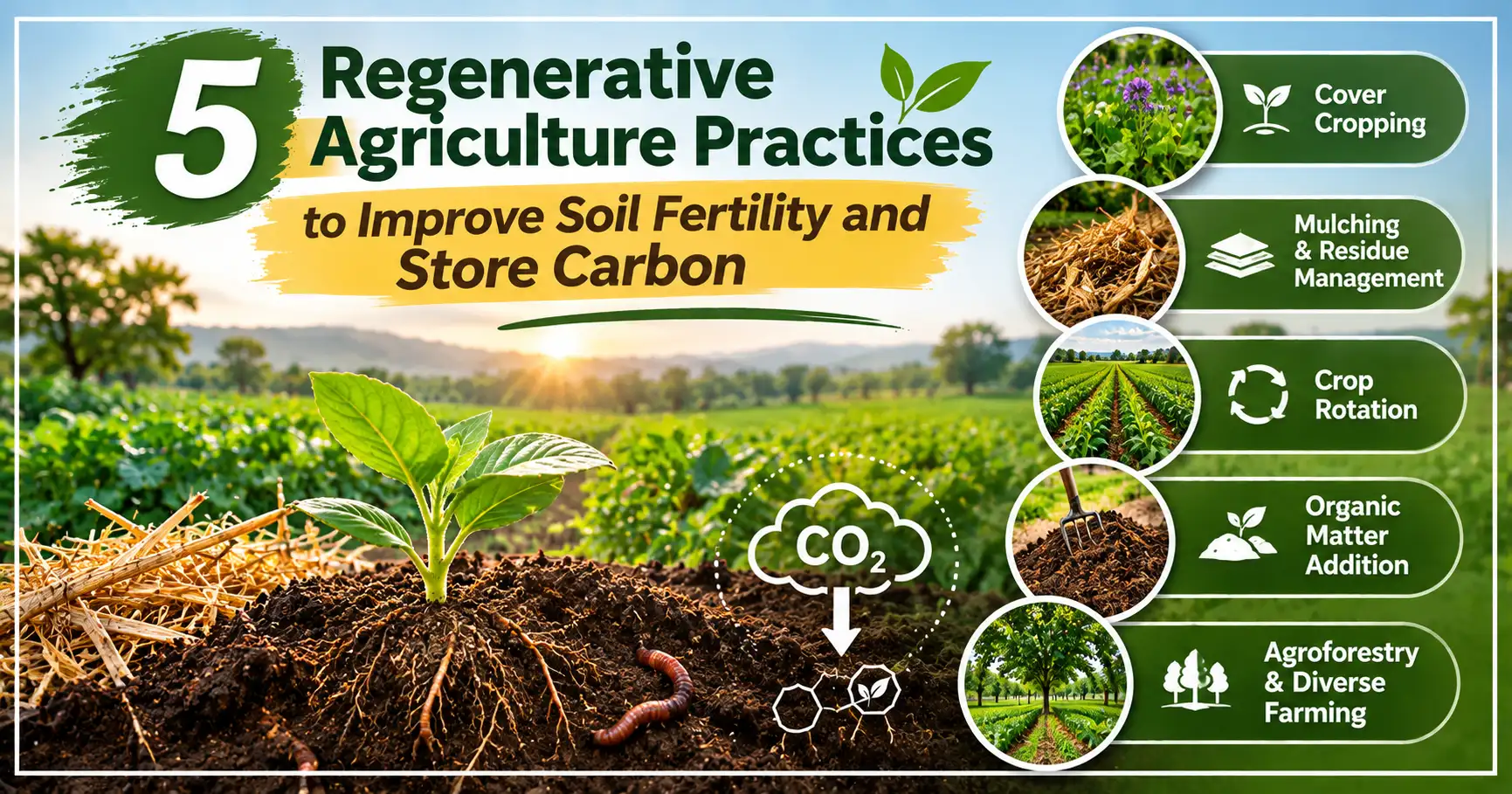
5 Regenerative Agriculture Practices to Improve Soil Fertility and Store Carbon
Posted on November 27, 2026
Healthy soil is one of the most important assets on a farm. It supports crop growth, stores water, cycles nutrients and provides a home for countless organisms that help keep agricultural ecosystems functioning. Yet continuous cultivation, intensive tillage, removal or burning of crop residues and poorly managed inputs can gradually affect soil structure and organic matter. Farmers may then face problems such as lower water-holding capacity, declining soil fertility and rising production costs.
Regenerative agriculture offers a practical way to address these challenges. Rather than focusing only on the next harvest, it places greater attention on rebuilding soil health and supporting the natural processes that sustain production over time. Its practices include keeping soil covered, reducing unnecessary disturbance, returning organic materials to the field, diversifying crops and integrating trees where suitable.
One potential benefit is an increase in soil organic carbon. Plants absorb carbon dioxide from the atmosphere through photosynthesis. Some of the carbon captured by plants reaches the soil through roots, fallen leaves and decomposing crop residues. A portion may remain stored in soil organic matter for years or longer, depending on soil conditions and management. The amount stored varies, so carbon gains should not be assumed or treated as automatic.
5 Regenerative Agriculture Practices for Healthier Soil
1. Cover Cropping and Green Manuring
Cover cropping is a straightforward way to protect farmland when the main crop is not growing. Instead of leaving fields bare after harvest, farmers can grow suitable cover crops to shield the soil surface, maintain living roots and add plant material to the field.
Leguminous options include cowpea, sunn hemp, dhaincha, green gram and clover, depending on the region and cropping calendar. Legumes can work with beneficial bacteria, including Rhizobium species, in root nodules to fix atmospheric nitrogen. The amount of nitrogen contributed depends on factors such as crop growth, effective nodulation, soil conditions and how the biomass is managed.
Well-managed cover crops can add organic matter, help protect soil from wind and water erosion, support soil organisms and improve soil structure and moisture retention. Growing a cover crop between two main cropping seasons can also increase the amount of carbon returned to the soil. Farmers should select species and termination timing carefully so that the cover crop does not compete with the next cash crop for water or nutrients.
2. Minimum Tillage and Crop Residue Management
Repeated ploughing can disturb soil structure and expose organic matter to conditions that speed up its decomposition. Minimum tillage and zero tillage aim to reduce unnecessary soil disturbance. These approaches can help preserve soil aggregates and reduce the number of field operations, although the best system depends on soil type, crop, weed pressure and available equipment.
After harvesting crops such as wheat, maize, soybean and cotton, farmers may be able to retain suitable crop residues in the field rather than burning or removing all of them. Residues act as a protective cover, reduce the direct impact of raindrops and help limit moisture loss from the soil surface. As they break down, they return plant-derived organic material to the soil.
Potential benefits include reduced erosion, better surface-moisture conservation, improved habitat for earthworms and microorganisms, and fewer repeated tillage operations. Residue management needs to be planned around the next crop, sowing equipment, pest and disease risks, and local recommendations. Keeping residues on the field is not a one-size-fits-all solution, but burning them unnecessarily can waste valuable organic material.
3. Compost, Farmyard Manure and Biochar Application
Soil needs organic inputs to maintain its structure and biological activity. Mature compost, well-decomposed farmyard manure (FYM) and vermicompost can return organic matter and nutrients to farmland. When applied at suitable rates, these materials can support soil microorganisms and help improve aggregation, water retention and nutrient-holding capacity.
Biochar is a different type of soil amendment. It is produced by heating suitable biomass under limited-oxygen conditions. Depending on the production process and feedstock, materials such as crop residues, coconut shells and clean wood waste may be used. Unlike ordinary compost, biochar can contain relatively stable forms of carbon that may persist in soil for long periods.
The quality of biochar matters. Poorly produced material may contain unwanted contaminants, and its effect on soil varies with feedstock, production temperature, soil type and application method. Compost, FYM and biochar should therefore be selected and applied according to soil needs and reliable technical advice. Used appropriately, these materials can contribute to soil improvement and, in the case of suitable biochar, longer-term carbon storage.
4. Crop Rotation and Intercropping
Growing the same crop repeatedly on the same land can contribute to nutrient imbalances and allow certain pests and diseases to build up. Crop rotation helps break this pattern by changing the crop grown on a field from one season to the next. A well-planned rotation can include crops with different nutrient needs, rooting patterns and growth cycles.
For example, a farmer might grow maize followed by mung bean (green gram), cotton followed by chickpea, or wheat followed by a suitable legume. The choice should reflect local climate, water availability, market demand and the recommended cropping calendar. Intercropping is another option: two or more crops are grown together in the same field. Cereal-legume combinations can use available resources in different ways, while legumes may contribute biologically fixed nitrogen when conditions support effective nodulation.
Crop rotation and intercropping can diversify root systems and crop residues, support nutrient cycling, encourage a wider range of soil organisms and help interrupt some pest and disease cycles. Good planning is essential, as crops grown together can also compete for light, water and nutrients if spacing and timing are poorly chosen.
5. Agroforestry and Integrating Trees with Agriculture
Agroforestry combines trees with agricultural crops and, in some systems, livestock. It can help farmers diversify production while improving the long-term management of their land. Suitable options may include fruit trees and other locally adapted species such as neem, karanj, Gliricidia and Subabul. The right choice depends on climate, soil, water availability, farm layout and market opportunities.
Tree roots can explore soil layers that annual crops may not reach, while fallen leaves and pruned branches add organic material to the soil surface. Trees can also provide shade, reduce wind speed and create habitat for birds, insects and other organisms. Their roots and above-ground biomass store carbon, and some agroforestry systems can also contribute to soil carbon storage.
Tree-crop combinations need careful design. Farmers should consider shade, root competition, water requirements, spacing, pruning and the effect of trees on nearby crops. Selecting species suited to local conditions and managing them well can make agroforestry a useful part of a diversified regenerative farming system.
Bringing the Five Practices Together
Regenerative agriculture is most effective when practices are selected as part of a system rather than treated as isolated activities. A farmer might grow a legume cover crop after harvesting the main crop, retain suitable residues, apply mature compost, follow a planned crop rotation and establish trees along field boundaries. Each practice can contribute in a different way: protecting the soil surface, adding organic material, supporting soil organisms or diversifying the farm.
There is no single package that will work equally well on every farm. Soil type, rainfall, temperature, irrigation, crop choice, labour and access to machinery all influence which practices are practical. Farmers can begin with one or two changes, observe the results and gradually add other measures as they gain experience.
How Farmers Can Monitor Soil Health
Soil improvement is a gradual process, so it helps to track changes rather than rely only on how a field looks after one season. Useful indicators include soil organic carbon, pH, electrical conductivity, nutrient levels, bulk density and water infiltration. Farmers can also observe soil cover, earthworm activity, crop performance and how quickly water enters the soil after rainfall or irrigation.
For meaningful comparisons, soil samples should be collected consistently, using the same sampling approach and comparable depths over time. A soil test can help identify nutrient or salinity issues that need attention. Carbon storage varies with soil, climate and management, and it can take time for measurable changes to appear. Testing and record-keeping help farmers judge whether the chosen practices are moving the field in the right direction.
Conclusion
Healthy soil is the foundation of productive and resilient agriculture. Regenerative agriculture offers practical ways to protect and rebuild this resource through cover cropping, reduced tillage, crop residue management, organic amendments, crop diversification and agroforestry. These practices can improve soil conditions and, when suited to local circumstances, contribute to building soil organic carbon.
The best results come from understanding the farm before choosing a practice. Start with the condition of the soil, the crops being grown and the resources available. Make changes step by step, monitor the field and adjust the approach as needed. The aim is not simply to produce more from the land today, but to leave the soil in better condition for the farmers who depend on it in the future.
Frequently Asked Questions
What are the main practices of regenerative agriculture?
Common practices include cover cropping and green manuring, minimum or zero tillage, crop residue management, applying suitable organic amendments, crop rotation, intercropping and agroforestry. The right combination depends on local farming conditions.
How does regenerative agriculture improve soil fertility?
Practices such as cover cropping, residue retention, compost application and crop rotation can add organic material, support soil organisms, improve soil structure and contribute to nutrient cycling. Results depend on how the practices are managed and on local soil conditions.
Can regenerative agriculture increase soil carbon?
It can contribute to increased soil organic carbon in some settings by returning plant material to the soil, reducing disturbance and integrating perennial vegetation. The amount and permanence of carbon storage vary with climate, soil type and management, so increases are not guaranteed.
What is the role of cover crops in regenerative farming?
Cover crops protect the soil surface, maintain living roots between main crops and add biomass. Leguminous cover crops may also contribute nitrogen through biological nitrogen fixation when suitable conditions support effective nodulation.
Is biochar the same as compost?
No. Compost is decomposed organic material that supplies organic matter and nutrients. Biochar is a carbon-rich material produced by heating biomass under limited oxygen. They have different properties and should be selected and used according to soil needs and product quality.