
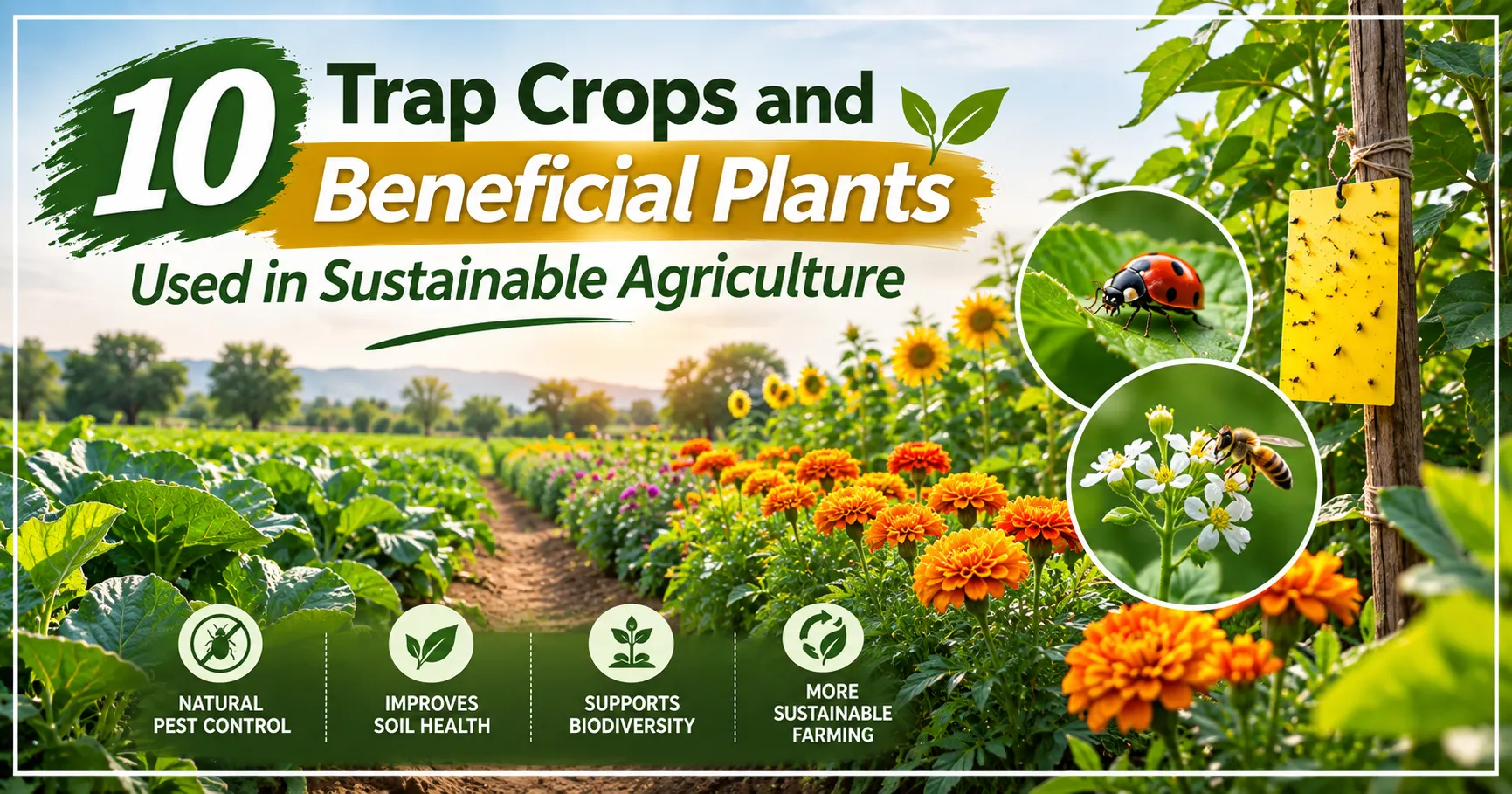
10 Trap Crops and Beneficial Plants Used in Sustainable IPM
Posted on November 27, 2026
Farmers do not need crop-protection advice that sounds promising in theory but is difficult to apply in the field. A useful pest-management practice must fit the crop, local pest pressure, season, available labour and market conditions. Trap cropping can be one practical part of an Integrated Pest Management (IPM) programme when it is planned and managed carefully.
The basic idea is to grow a selected plant that attracts a particular pest away from the main crop. This can give farmers a smaller, more visible area to monitor and manage. However, trap cropping is not a stand-alone solution, nor does every plant used around a field act as a true trap crop. The results depend on the target pest, crop combination, planting time and local conditions.
Some plants are better described as barrier crops, companion crops or insectary plants. Each has a different role in a diversified farm. Understanding these differences helps farmers choose plants for the right purpose instead of expecting one planting arrangement to control every pest.
What Is a Trap Crop?
A trap crop is a plant or crop strip deliberately grown to attract a particular insect pest away from the main crop that a farmer wants to protect. A pest may prefer the trap crop because of its smell, leaf texture, growth stage, flowering pattern or availability at a particular time. Once pests gather there, the farmer can inspect the area closely and take suitable action before the population spreads into the main crop.
A few related terms are worth understanding. A barrier crop is mainly used to make it harder for insects to enter or move through a main field. An insectary plant provides nectar, pollen or shelter for beneficial insects such as ladybird beetles, lacewings and parasitoid wasps. A companion crop may contribute to ground cover, soil fertility or farm income. These approaches can complement one another, but they are not identical.
Why Trap Cropping Matters in Sustainable Agriculture
Repeated calendar-based pesticide spraying can raise production costs and affect beneficial organisms. Repeated use of the same insecticide mode of action can also contribute to resistance. An IPM approach encourages farmers to observe what is happening in the field and choose management measures based on the pest and the level of risk.
When a suitable trap crop is used, pest activity may become easier to detect in a defined area. Other plants can add flowering resources, vegetative cover or structural diversity to the farm. These benefits depend on the crop combination and should be assessed locally; planting a border or companion crop does not automatically reduce pest damage.
10 Plants Used in Trap Cropping and Other IPM Strategies
1. African Marigold (Tagetes erecta)
African marigold is used in some vegetable IPM demonstrations, particularly in tomato systems. Its flowers can attract egg-laying by Helicoverpa armigera, commonly known as the fruit borer. In such arrangements, marigold acts as a trap plant that gives farmers a specific area to inspect.
Farmers should check the flowers and buds regularly for eggs and larvae. Infested plant parts should be removed and destroyed safely, following local agricultural guidance. The usefulness of the arrangement depends on planting time and the local crop-pest situation.
2. Indian Mustard (Brassica juncea)
Indian mustard is used in some cabbage-family vegetable systems because certain pests, including diamondback moth, may be attracted to it. A properly timed mustard strip can concentrate pest activity in a smaller area that is easier to inspect.
The strip needs to be established so that it is attractive when the main crop is vulnerable. Inspect leaves for eggs and larvae. If the mustard is left unmanaged, it may support pest multiplication rather than help protect the main crop. Farmers should follow locally validated recommendations for the crop combination and planting schedule.
3. Castor (Ricinus communis)
Castor is used in selected IPM systems as a border or trap plant, including for monitoring and attracting caterpillar pests such as Spodoptera litura. It can provide a designated area where farmers can look for pest activity and take timely action.
Inspect leaves for egg masses and young larvae. Castor seeds are highly toxic if swallowed, so the plant must be handled responsibly and kept away from children and livestock. Do not allow the border to become an unmanaged source of pests.
4. Okra (Abelmoschus esculentus)
Okra may be planted as a border or trap crop around cotton and other crops because it can attract certain insect pests, including some bollworms. It may also provide a harvest, but that does not remove the need for regular crop monitoring.
Check flowers, shoots and fruits for eggs and larvae. If okra is planted too close to the main crop or is not monitored, it can become another host for pests. Its use should be based on guidance from a local agricultural university or extension service.
5. Sorghum or Jowar (Sorghum bicolor)
Sorghum is commonly used as a border, windbreak or companion crop in diversified farming. In particular crop arrangements, it can influence insect movement and add structure to the field environment. Its role should not be overstated: sorghum is not a reliable trap crop for every maize pest.
Where stem borers or other pests are a concern, farmers should select the variety and planting arrangement according to local conditions and validated recommendations. Consider its intended role before planting, whether as a border, windbreak or part of a specific IPM design.
6. Cowpea (Vigna unguiculata)
Cowpea is useful in mixed farming because it fixes atmospheric nitrogen through root nodules, provides ground cover and can produce an additional harvest. It can contribute to crop diversification and may fit selected intercropping or border arrangements.
Cowpea should not be described as a specific trap crop for all maize or groundnut pests. Unless a local IPM recommendation identifies a target pest and a proven arrangement, it is more accurate to describe cowpea as a companion or diversification crop.
7. Sunflower (Helianthus annuus)
Sunflower can be planted along field edges or in strips to provide flowers that attract pollinators and other insects. In some situations it may also attract particular pests, but the response varies with pest species and location. For this reason, sunflower is often better considered a flowering or habitat plant than a universally effective trap crop.
Watch the plants for caterpillars and sucking insects. A flowering border should not be allowed to become a source of infestation. Its role should be judged by field observations and local recommendations.
8. Napier Grass (Cenchrus purpureus)
Napier grass is widely known as a fodder crop and can form a tall, permanent border. It is also used as a companion plant in suitable push-pull systems for managing cereal stem borers. In these systems, the crop arrangement is planned so that an intercrop helps push pests away from the main crop while an attractive border plant draws them away.
Push-pull is a specific crop-management strategy, not simply the act of planting Napier grass around a field. Results depend on the crop, target pest and locally validated design. Farmers should seek technical guidance before adopting the arrangement.
9. Buckwheat (Fagopyrum esculentum)
Buckwheat flowers can provide nectar and pollen for beneficial insects, including some parasitoids and predators. This can make the plant useful as an insectary option in suitable climates and seasons.
Buckwheat should not be presented as a proven trap crop for onion thrips. In onion systems, a maize border has been studied as a physical barrier against migrating adult thrips. The distinction matters: providing food for beneficial insects and acting as a pest barrier are different functions.
10. Radish (Raphanus sativus)
Radish can be included in diversified vegetable planting and may attract certain insects, including flea beetles in some brassica production settings. Its suitability depends on the pest species, local conditions and planting time. It can also provide an edible harvest.
If used as a trap strip, keep the area manageable and inspect leaves frequently. Heavily infested plants should be removed when recommended by local agricultural guidance. Do not assume radish will attract or control the same pests in every location.
How to Use Trap Crops Effectively
- – Identify the pest first. Confirm which insect is causing the damage. Similar symptoms can also result from diseases or nutrient problems, so avoid choosing a trap crop based only on the appearance of damaged leaves.
- – Plan the planting time. A trap crop often needs to be planted before the main crop, or at a carefully planned time in relation to it. If it becomes attractive after the main crop’s vulnerable stage, it may offer little protection.
- – Keep the layout practical. Use a border or limited strip where appropriate. Consider shade, root competition, irrigation, machinery movement and the space needed for harvesting.
- – Monitor both crops. Inspect the trap crop and the main crop once or twice a week, and more often when pest pressure is high. Record pest numbers and visible crop damage so that decisions are based on field observations.
- – Act before pests spread. Remove infested plant parts or manage the trap crop according to local recommendations. A heavily infested trap crop should not be left standing without a clear management plan.
- – Protect beneficial insects. Avoid unnecessary broad-spectrum insecticide sprays, particularly on flowering plants. If treatment is required, use only a locally registered product according to its label and seek advice on protecting pollinators and natural enemies.
Conclusion
Trap crops can make pest management more targeted, but no single plant works in every field or against every insect. Marigold, mustard, castor and okra have recognized uses in selected crop-pest combinations. Cowpea, sunflower and buckwheat can contribute to crop diversification or beneficial-insect habitat, while sorghum and Napier grass may be useful in particular border or push-pull systems. In onion systems, maize has been studied as a barrier against migrating adult thrips.
The practical lesson is to identify the pest, select a plant for a clearly defined purpose, establish it at the right time and monitor it consistently. When trap cropping and other field practices are combined within an IPM programme, farmers can make better-informed crop-protection decisions and avoid relying on routine pesticide applications alone. Local agricultural university and extension recommendations remain important because results can vary by crop, pest and region.
Frequently Asked Questions
What is the main purpose of a trap crop?
A trap crop is grown to attract a particular pest away from the main crop. Farmers can then monitor the trap area and take suitable action before pests spread.
Are all border crops trap crops?
No. A border crop may act as a physical barrier, provide habitat or serve another purpose. It is a true trap crop only when it is deliberately used to attract a target pest away from the main crop.
Which plants are used as trap crops?
Plants such as marigold, mustard, castor and okra have uses in selected crop-pest combinations. Other plants, including sorghum, cowpea, sunflower, Napier grass, buckwheat and radish, may serve as companion, barrier, habitat or trap plants depending on the system.
Can trap crops replace pesticides completely?
No. Trap cropping is one possible component of Integrated Pest Management. Farmers still need to monitor fields and use other suitable measures when required.
How often should farmers inspect trap crops?
The source article recommends inspecting both the trap crop and the main crop once or twice a week, and more frequently when pest pressure is high.