
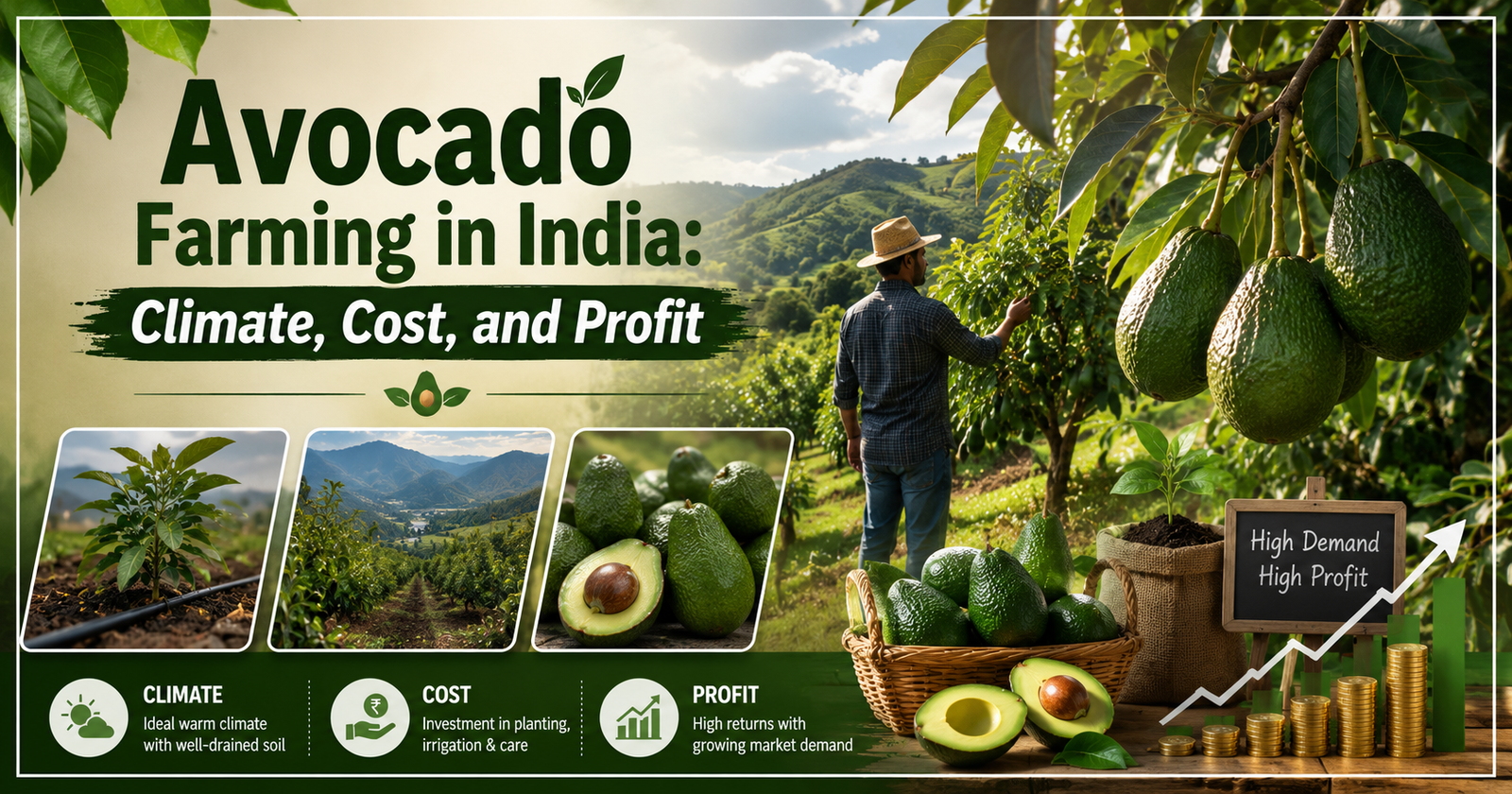
Avocado Farming in India: Climate, Cost, and Profit
Posted on June 12, 2026
The first time many Indian farmers hear about avocado farming, the fruit feels slightly unfamiliar. It is not as common as mango, banana, guava, or coconut in traditional Indian markets. In many places, people still know it as butter fruit, while in cities, it has become popular in salads, smoothies, sandwiches, and health-focused diets.
Avocado farming in India can be an attractive option for farmers who want to grow a crop with rising market demand. The fruit sells at premium prices in urban markets, hotels, cafes, supermarkets, and online grocery platforms. But avocado is not a crop that should be planted only because the market price looks high. It needs a suitable climate, well-drained soil, the right variety, long-term investment, and a clear plan for selling the fruit.
Avocado cultivation in India is a long-term farming decision. It can become profitable, but only when the farmer understands the crop before planting it.
Why Avocado Farming Is Getting Attention in India
India’s food habits are changing. Urban consumers are becoming more interested in healthy fats, premium fruits, imported-style diets, and fresh produce. Avocado has found a place in this new market because of its creamy texture, nutritional value, and use in modern recipes.
This growing demand has encouraged many farmers to explore avocado farming as a business opportunity. In cities like Bengaluru, Mumbai, Pune, Delhi, Hyderabad, Chennai, Ahmedabad, and Kochi, avocado is no longer seen only as an exotic fruit. It is slowly becoming part of premium household consumption, restaurant menus, and health-conscious food choices.
Still, avocado farming is different from growing short-duration vegetables or regular fruit crops. It is an orchard crop. The returns do not come immediately. The plant needs time to establish, flower, fruit, and reach commercial yield. That is why the first step is not planting. The first step is understanding whether the farm is suitable.
Suitable Climate for Avocado Farming in India
Climate is the foundation of avocado cultivation in India. Avocado grows best in tropical to warm temperate conditions. Avocado grows best in moderate temperatures with enough rainfall or irrigation. It should also be protected from extreme heat, frost, and waterlogged soil.
In India, avocado farming is more suitable in selected parts of Karnataka, Tamil Nadu, Kerala, Maharashtra, and the North-Eastern states. Some hilly and semi-hilly regions with suitable temperature and drainage conditions can also support avocado plantation.
The ideal temperature for avocado farming is generally around 20°C to 35°C. The crop does not perform well in areas with severe frost or very hot, dry winds. Young plants are especially sensitive and need protection during the early stage.
Rainfall is useful, but excess standing water can damage the plant. Avocado roots are sensitive to poor drainage. If the field holds water after heavy rain, the roots may suffer, and the plant may become weak. This is one of the most important points farmers must remember before starting avocado farming in India.
Best Soil for Avocado Farming
Good soil helps avocado trees grow well for many years, while poor soil can cause problems from the early stage of planting. Avocado prefers well-drained soil with good organic matter. Slightly acidic soil is often considered suitable for better growth.
Red soil, lateritic soil, sandy loam, and well-drained, fertile soils can support avocado cultivation when managed properly. Heavy clay soil, waterlogged land, and low-lying fields are risky unless drainage is improved.
Before planting avocado, soil testing is a smart step. Soil testing helps farmers assess the soil’s pH, organic carbon content, nutrient status, and any needed improvements before planting. Since avocado is a long-term crop, land preparation should not be rushed. Proper drainage channels, organic manure, mulching, and irrigation planning can make a big difference in the early years.
Avocado Varieties in India
Variety selection plays a major role in avocado farming profit in India. A farmer should not plant random seedlings and expect high-quality commercial fruits. The quality of planting material decides the future of the orchard.
In India, improved avocado varieties such as Arka Supreme and Arka Coorg Ravi have gained attention for commercial cultivation. Good varieties can offer better fruit quality, pulp recovery, yield potential, and market acceptance.
Farmers should also understand pollination. Avocado varieties are often grouped into A-type and B-type flowering patterns. Planting compatible varieties can improve fruit set. This is why it is better to buy grafted plants from reliable nurseries and take guidance from horticulture experts before planting.
Planting and Spacing in Avocado Farming
Avocado trees need enough space to grow properly. Spacing depends on variety, soil, climate, and management system. Wider spacing is useful for strong-growing trees, while closer spacing requires proper pruning and orchard management.
Before planting, pits should be prepared with topsoil, farmyard manure, compost, and required soil amendments. Planting is usually done when soil moisture is favourable, especially around the monsoon season in suitable regions.
Young avocado plants need care. They should be protected from strong sunlight, wind, grazing animals, and water stress. Mulching around the plant can help conserve moisture and reduce weed competition.
The first few years are mostly about plant establishment. Farmers should not expect full returns immediately.
Avocado Farming Cost in India
The cost of avocado farming in India depends on several factors, including land condition, plant quality, spacing, irrigation, fencing, labour, manure, fertilisers, and regular maintenance. There is no single fixed cost for every farmer because each farm has different requirements.
The main expenses include grafted plants, pit preparation, organic manure, drip irrigation, fencing, labour, mulching, plant protection, and annual maintenance. If the farm already has irrigation and fencing, the initial cost may be lower. If the land needs full development, the investment will be higher.
Before starting avocado farming on one acre, farmers should calculate the total cost. The first year usually involves higher costs for land preparation, plants, irrigation, fencing, and planting. Farmers also need to spend on maintenance until the trees begin producing fruit for sale.
During the first few years, farmers can grow short-duration intercrops to earn extra income while the avocado trees are still small. However, intercrops should not compete heavily with avocado plants for water, sunlight, and nutrients.
Avocado Yield and Profit in India
Profit from avocado farming in India depends on fruit yield, fruit quality, market price, selling method, and regular maintenance costs. Grafted plants may start bearing earlier than plants, but full commercial yield usually improves as the tree matures.
A mature avocado tree can produce good fruit under proper management. However, profit should not be calculated only on the highest market price. Avocado prices can fluctuate depending on season, supply, quality, and demand.
Farmers should calculate profit based on low, average, and high market prices to get a realistic idea of earnings. This gives a more realistic idea of possible returns. Packaging, transport, commission, grading, damage, and payment delays should also be included in the calculation.
Direct marketing can improve avocado farming profit. Farmers can sell to premium fruit stores, hotels, cafes, restaurants, online grocery sellers, organic stores, or direct consumers. But direct selling works well only when farmers can provide consistent quality, harvest at the right time, use proper packaging, and stay in regular contact with buyers.
Market Potential of Avocado in India
Avocado demand in India is increasing, but the market is still new and not developed in many regions. This means there is opportunity, but also risk. In metro cities, demand is stronger because consumers are more aware of avocado uses. In smaller markets, customers may still need education about ripening, taste, and usage.
Farmers who want to enter avocado farming should study nearby markets before planting. They should check whether buyers are available, what price they offer, what fruit size they prefer, and whether they want a regular supply.
Risks in Avocado Farming
Like every high-value crop, avocado farming has risks. The main risks include unsuitable climate, poor drainage, wrong variety, poor-quality planting material, slow returns, pest issues, and poor post-harvest handling.
Harvesting at the right maturity stage is also important. If the avocado is harvested too early, the fruit may not ripen properly. If it is handled roughly, damage can reduce market value. Avocado is a premium fruit; appearance, size, and quality matter in the market.
Farmers should start with proper guidance and avoid converting the entire farm at once without testing the crop. Starting with a small area can help understand plant behaviour, climate suitability, and market response.
Final Thoughts
Avocado farming in India can be a profitable opportunity, but it is not a quick-money crop. It needs the right climate, well-drained soil, good varieties, patient investment, and strong market planning.
For farmers in suitable regions, avocado cultivation can become a good source of income. For farmers in unsuitable areas, it can become an expensive experiment. The difference lies in planning before planting.
The best way to look at avocado farming is simple: do not start only because the fruit sells at a high price. Start when the land, climate, water, variety, cost, and market all support the decision.
In farming, profit does not come from excitement alone. It comes from patience, preparation, and the ability to choose the right crop for the right place.