
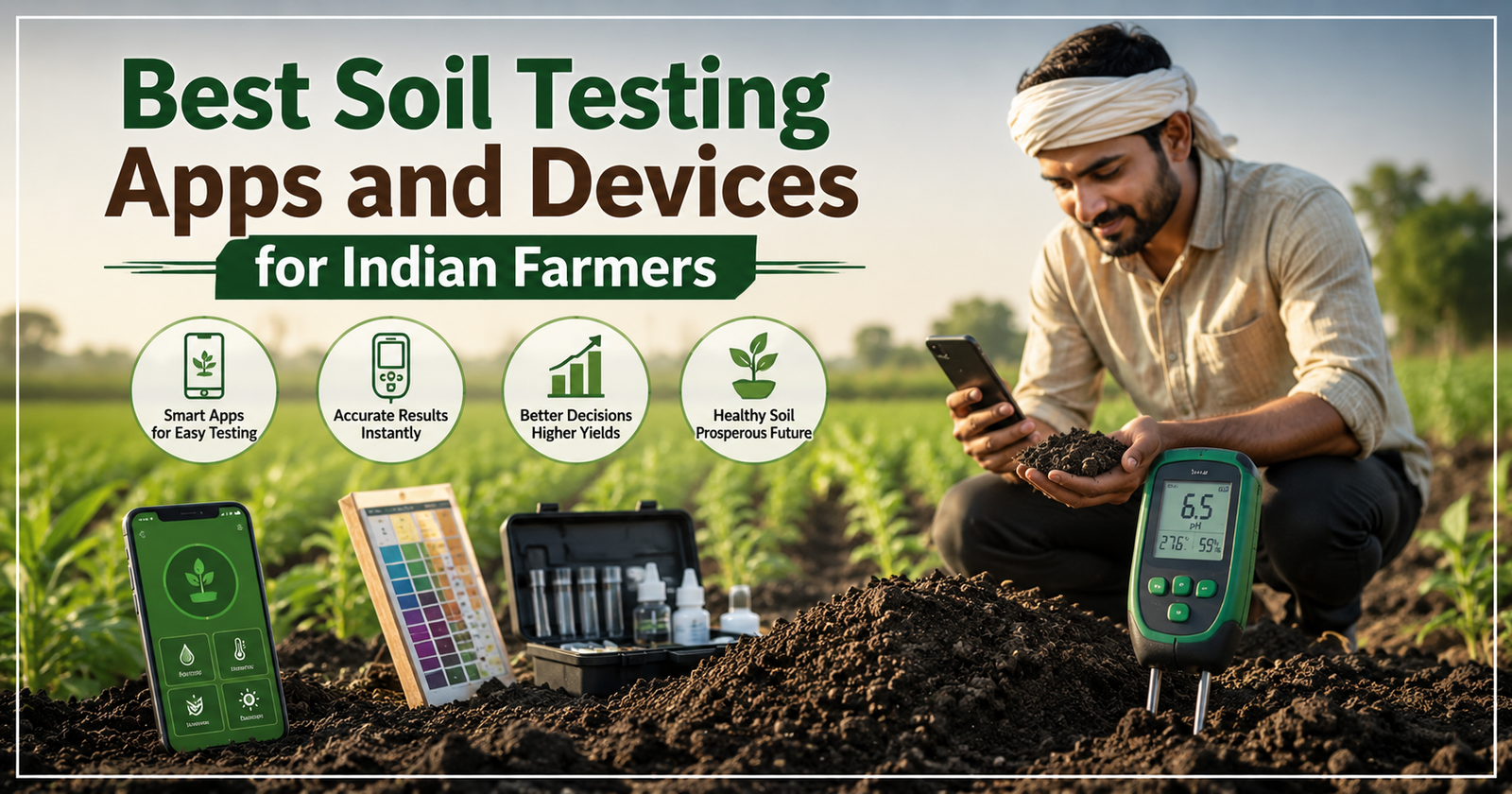
Best Soil Testing Apps and Devices for Indian Farmers
Posted on June 8, 2026
The soil of Punjab’s wheat belt used to smell of pure life. But to one veteran farmer, the earth lately felt like a tired worker forced to run on endless cups of strong tea. For a decade, whenever his crops looked pale, he did what many others in the village did: he added another bag of urea to the field.
Then came the summer of 2026. Despite spending heavily on chemical fertilisers, his cotton yields dropped sharply, and the soil turned into a hard, crusty layer that struggled to absorb water.
One evening, his college-educated daughter knelt in the field, scooped up a handful of dry soil, and looked at her father. “Bapu,” she said softly, “if a person is sick, we don’t guess the medicine. We test the blood. Why are we treating our land any differently?”
She was talking about soil testing for agriculture, the simple process of checking the exact nutrient levels and health condition of the land. For generations, checking soil health meant packing soil into plastic bags, sending it to a distant government laboratory, and waiting for a report that often arrived after the sowing season had already passed.
Today, a quiet digital revolution is unfolding across rural India. With smartphone apps and portable smart devices, farmers are becoming more informed decision-makers. They are learning to understand what their soil truly needs instead of guessing and applying fertilisers blindly.
Chapter 1: The Diagnostics in Your Pocket
Top Soil Testing Apps
The soil sample did not go to a distant lab first. Instead, the first step began with a smartphone. Thanks to India’s growing digital agriculture ecosystem, farmers now have access to soil information through apps.
1. The Soil Health Card App: The Government’s Digital Eye
The official Soil Health Card app is a digital extension of the Government of India’s Soil Health Card programme.
For many farmers, this app can be a useful starting point. By using location-based and available government soil data, the app can help farmers access information about soil health in their area. It provides a breakdown of soil parameters (nitrogen, phosphorus, potassium, micronutrients, soil pH, and electrical conductivity).
The real value of the app is not only in showing numbers. It helps farmers understand what kind of fertiliser their land may actually need. Instead of applying urea, DAP, or zinc sulphate by guesswork, farmers can follow more balanced recommendations and reduce unnecessary fertiliser use.
This can help prevent over-fertilisation, save input costs, and support better soil health over time.
2. Plantix: The All-in-One Digital Crop Doctor
While the Soil Health Card app provides soil-related information, Plantix helps farmers observe what is happening in the crop itself.
Plantix works through image-based diagnosis. Farmers can take a photo of a crop leaf, stem, or affected plant part, and the app helps identify diseases or nutrient deficiencies. This makes it useful for daily field monitoring.
For example, if young crop leaves start turning purple at the edges, the issue may not always be a pest attack. This problem may occur when the plant lacks phosphorus or when unsuitable soil pH affects nutrient absorption. A visual crop diagnosis app can help farmers avoid buying the wrong pesticide and guide them toward the right corrective action.
For smallholder farmers, this kind of quick guidance can save money and reduce crop damage.
3. IFFCO Kisan App: The Cooperative Guardian
The IFFCO Kisan app connects farmers with farming information, expert support, and agriculture-related updates. Backed by one of India’s major fertiliser cooperatives, the app serves as a bridge between field-level farming challenges and expert advice.
Farmers can use the app to access information on crops, fertilisers, weather, market prices, and advisory services. If a farmer is confused by soil test values, expert guidance can help convert technical numbers into practical field recommendations.
This is especially useful because many soil reports are difficult for farmers to understand. A report may mention pH, EC, organic carbon, nitrogen, phosphorus, potassium, and micronutrients, but the farmer needs to know one thing clearly: what should be applied, how much should be applied, and when it should be applied.
Apps like IFFCO Kisan help make this information easier to understand.
Chapter 2: The Lab in a Pocket
Portable IoT Soil Testing Devices
Mobile apps are useful for data, guidance, and quick observation. But true precision farming often requires real-time soil testing directly in the field. This is where Indian agritech startups and research-backed technologies are making a difference.
Portable soil testing devices are bringing soil analysis closer to farmers by making on-farm testing easier and faster. Instead of waiting days or weeks for a report, farmers, FPOs, cooperatives, and custom hiring centres can now test soil samples much faster.
The next morning, an agriculture officer arrived at the farm carrying a small, rugged briefcase. Inside it was a glimpse of the future of Indian farming.
4. Bhu-Vision: IoT Soil Bioanalyser
Bhu-Vision, also known as KRISHI-RASTAA, is an IoT-based soil testing platform designed to make soil analysis faster, easier, and more accessible for farmers.
This device reduces the need for slow traditional chemical testing by using modern techniques to analyze key soil parameters. A small soil sample is mixed with reagent fluid, placed inside the compact device, and the results are sent digitally to a connected app.
Within a short time, farmers can receive soil health information covering key parameters such as nutrients, pH, and other soil indicators. This reduces delays and helps farmers make timely fertiliser decisions before sowing or during crop planning.
For individual farmers, buying such a device may be expensive. But for FPOs, cooperatives, custom hiring centres, agri-service providers, and village-level entrepreneurs, it can become a useful business and service model.
5. Shool Portable Soil Scanner
For regular monitoring, farms are also using portable soil scanners and sensor-based probes.
A soil scanner is pushed directly into the field to measure important indicators such as soil moisture, temperature, and electrical conductivity. These readings help farmers understand whether the soil has enough moisture, whether irrigation is needed, and whether salt levels are becoming a concern.
Electrical conductivity is especially important in areas where over-irrigation or poor-quality water can slowly increase soil salinity. When salt levels rise, crop roots struggle to absorb water and nutrients properly. Farmers may think the crop needs more fertiliser, but the real problem may be soil salinity.
Instant readings from such devices can help farmers manage irrigation more carefully and protect long-term soil productivity.
6. Agri-IoT NPK Sensor Probes
For advanced farms, especially high-value horticulture and drip irrigation systems, IoT-based NPK sensor probes are becoming increasingly useful.
These sensor probes are placed in the root zone and connected to a battery-powered transmitter or cloud-based system. They can track nutrient trends such as nitrogen, phosphorus, and potassium levels over time.
For large vegetable farms, polyhouse farms, fruit orchards, and commercial horticulture units, this data can help improve fertigation. Instead of applying nutrients blindly, farmers can adjust fertiliser application based on what the crop and soil actually need.
This approach is especially valuable where every input matters and the crop value is high.
Chapter 3: The Economic Math of Healthy Soil
Sitting on a string cot with a cup of hot tea, the farmer looked at the instant data generated by the portable testing device. The numbers were clear: the soil had excess nitrogen because of years of urea application, but it was low in organic carbon and zinc.
This is where soil testing becomes more than a technical activity. It becomes an economic decision.
Let us look at how these modern digital tools compare for an everyday Indian farmer trying to balance input cost, crop health, and productivity:
| Tool / Device Name | Type | Key Parameters Tracked | Time for Results | Best Suited For | Cost Bracket |
| Soil Health Card App | Mobile App | 12 government soil parameters | Instant access to available data | Every smallholder farmer in India | Free |
| Plantix App | Mobile App | Visual nutrient deficiencies, pests, and diseases | Few seconds | Daily field monitoring and crop scouting | Free |
| Shool Scanner | Handheld Probe | Moisture, temperature, and salt EC | Instant | Irrigation management and salinity checks | Low to Medium |
| Bhu-Vision / IoT Bioanalyser | Portable Lab Device | Core soil nutrients, pH, and other indicators | Around 30 minutes | FPOs, cooperatives, custom hiring centres, and agri-service providers | High device cost, low per-test cost |
| IoT NPK Sensors | Fixed Field Probes | Continuous NPK trends | Real-time streaming | High-value horticulture and drip irrigation farms | Medium to High |
The calculation was clear. By using soil testing tools, farmers can reduce unnecessary fertiliser purchases, apply nutrients more accurately, and improve crop health. More importantly, balanced fertiliser use can help rebuild soil strength instead of exhausting it season after season.
Epilogue: The Healing of the Land
Six months later, the field looked dramatically different. The wheat stalks stood tall, strong, and deep green. No extra bags of urea had been added blindly. Instead, based on soil testing and app-based recommendations, the field received compost, soil amendments, and targeted micronutrients where needed.
As the farmer ran his fingers through the soil, it felt softer and more alive. It held moisture better. Earthworms had started appearing again. The hard crust was slowly disappearing. The land was breathing once more.
Digital soil testing equipment for farmers is not about replacing traditional agricultural wisdom. It is about giving better information.
In an era of unpredictable climate, rising input costs, and pressure on farm profits, farmers who listen to their soil will have a stronger future. The land already speaks. Soil testing helps farmers understand the language.