
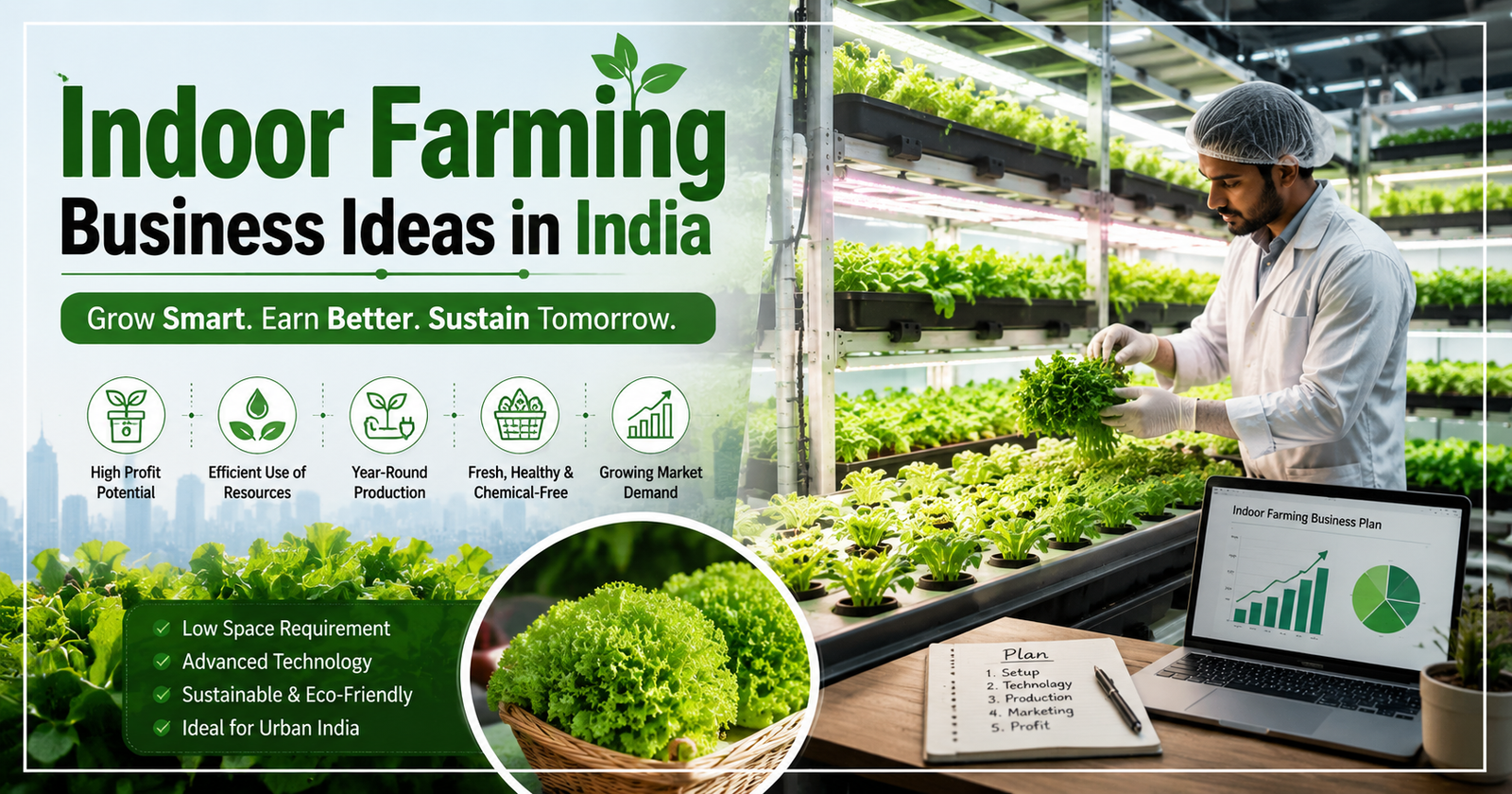
Indoor Farming Business Ideas in India
Posted on June 8, 2026
On the terrace of a small building in Pune, a young farmer once stood with two questions in his mind. The first was simple: “Can farming happen without owning acres of land?” The second was more serious: “Can this become a real business?”
Below him, the city was moving as usual. People were ordering salads, restaurants were looking for fresh herbs, families were asking for chemical-free vegetables, and dairy farmers were struggling with fodder shortages. Somewhere between these needs, a new kind of farming was quietly growing in India.
It did not always need open fields. It did not always depend on perfect rainfall. It could begin inside a room, on a terrace, in a shed, inside a polyhouse, or even in a small rented space. This is where indoor farming in India begins to feel less like a futuristic idea and more like a practical business opportunity.
For anyone planning to enter agriculture with limited land, indoor farming business ideas in India can open a new path. The real opportunity is not just in growing crops. It is in growing what urban markets, restaurants, health-conscious families, and local businesses already need.
The Rise of Indoor Farming in India
Traditional farming has always been close to Indian life. But today, farming is meeting a new kind of customer. People want fresh vegetables, clean greens, pesticide-free produce, exotic herbs, mushrooms, microgreens, and nutritious fodder. At the same time, land is becoming expensive, water is limited in many areas, and weather uncertainty affects outdoor crops.
This is why the indoor farming business in India is slowly gaining attention. It gives farmers and entrepreneurs more control over water, light, nutrition, temperature, and crop quality. It is not a magic shortcut, but it can be a smart model when planned properly.
The best indoor farming business does not start with expensive technology. It starts with one clear question: “Who will buy what I grow?”
Hydroponic Farming Business in India
Hydroponics is one of the most popular indoor farming ideas today. In hydroponic farming, plants grow without soil. Their roots receive nutrients through water-based systems. This method is suitable for urban entrepreneurs because it does not require large farmland. It can be started on a terrace, in a greenhouse, inside a polyhouse, or in any controlled growing space.
Leafy vegetables are often the first choice. Lettuce, spinach, basil, mint, coriander, kale, bok choy, and parsley are commonly grown in hydroponic systems. These crops are popular among cafes, cloud kitchens, hotels, supermarkets, and health-focused consumers.
For example, an indoor farmer can supply fresh lettuce to salad brands or produce basil and mint to restaurants that need fresh herbs. This is where the hydroponic farming business in India becomes more than growing plants. It becomes a supply business.
However, the farmer must understand nutrient management, water quality, crop cycles, and market pricing. Hydroponics can produce clean and consistent crops, but the system must be managed carefully every day.
Vertical Farming Business
Vertical farming helps people grow more crops in less space by using vertical or stacked growing systems. Instead of growing crops only on the ground, vertical farming uses stacked layers, racks, towers, or vertical structures.
For Indian cities like Mumbai, Bengaluru, Ahmedabad, Delhi, Pune, Hyderabad, and Chennai, this model can be useful because space is costly. A small indoor setup can grow microgreens, leafy vegetables, herbs, and some specialty crops.
The vertical farming business works well when the produce is high-value and fast-moving. Growing wheat or rice indoors does not make sense for most small entrepreneurs. But growing microgreens, lettuce, basil, edible flowers, or premium salad greens can create better margins.
The beauty of vertical farming is that it changes how we look at space. A room that once stored old furniture can become a small farm. A terrace can become a production unit. A shop corner can become a live green display.
Microgreens Business in India
Microgreens are tiny plants harvested at an early stage. They may look small, but they are one of the most interesting indoor farming business ideas in India. They are used by chefs, nutritionists, cafes, premium grocery stores, and health-conscious families.
Mustard, radish, sunflower, broccoli, fenugreek, coriander, beetroot, pea shoots, and amaranth microgreens can be grown in trays. The crop cycle is short, and the setup does not always require a huge investment.
A microgreens business in India can be started from a spare room, as long as the grower maintains hygiene, uses proper packaging, and manages delivery carefully. The challenge is not only production. The real challenge is customer education. Many people still do not understand how to use microgreens. So the seller must also become a storyteller.
A simple box of microgreens can be sold better when the customer understands how to add it to sandwiches, salads, soups, dal, poha, khichdi, or smoothies. In this business, content, branding, and customer relationships matter as much as farming.
Mushroom Farming Business
In a small village near Nashik, a farmer once turned an unused shed into a mushroom unit. He did not have much land, but he had a clean room, basic training, and patience. Within months, that shed became more valuable than a small open field.
Mushroom farming is one of the most practical indoor farming business ideas in India because it can be done in controlled spaces. Oyster mushrooms, button mushrooms, and milky mushrooms are popular options depending on region, climate, and market demand.
Mushrooms need humidity, cleanliness, proper substrate, and temperature control. They do not need sunlight like regular plants. This makes them suitable for indoor production.
The market is also growing because mushrooms are used in restaurants, hotels, home cooking, soups, pizzas, snacks, and health-focused diets. Mushroom farming can provide an additional income for rural youth, women entrepreneurs, self-help groups, and small farmers.
Indoor Herb Farming
Sometimes the best business is not the biggest crop. It is the crop that people need fresh and frequently.
Herbs like basil, mint, parsley, coriander, thyme, oregano, rosemary, and lemongrass can be grown in indoor or protected setups. Restaurants and premium kitchens prefer fresh herbs because dried herbs cannot always deliver the same flavour.
Indoor herb farming can be a good business for entrepreneurs near urban food markets. The key is consistency. A restaurant does not want herbs once in a while. It wants them every week, in clean condition, at a predictable quality.
This is why herb farming should be planned with buyers first. Before setting up 500 trays, it is better to speak with cafes, chefs, organic stores, and local delivery customers.
Hydroponic Fodder Farming
Indoor farming is not only for vegetables and restaurants. It can also support dairy farming.
Hydroponic fodder farming can help dairy farmers produce fresh green fodder when regular fodder is limited or not easily available. Maize, barley, or similar grains can be sprouted in controlled conditions to produce green fodder within a short cycle.
For farmers with limited land, this can help reduce pressure on open-field fodder cultivation. It is especially useful in areas where land is scarce or green fodder availability changes seasonally.
This business can work in two ways. A dairy farmer can produce fodder for personal use, or an entrepreneur can supply fresh hydroponic fodder to nearby dairy farms. This business works well only when there is enough local demand, affordable grain, sufficient water, and regular buyers.
Indoor Exotic Vegetable Farming
India’s urban food market is changing. Hotels, restaurants, premium households, and online grocery platforms are using more exotic vegetables than before. Lettuce, cherry tomato, zucchini, coloured capsicum, broccoli, pak choi, kale, and cucumber can create opportunities under protected or soilless farming systems.
Indoor farming needs careful planning because it can involve higher costs and requires some technical knowledge. But the market can also be stronger when connected with the right buyers.
For example, a grower near Bengaluru or Gurgaon may supply premium salad greens to cafes, while someone near a tourist city may supply exotic vegetables to hotels. The business model should always follow the market.
Final Thoughts
Indoor farming in India is not about replacing traditional farmers. It creates new opportunities for people who have limited land, access to urban markets, an interest in farming technology, or a plan to build a controlled farming business.
The best indoor farming business ideas in India are those that match the available space, the grower’s crop knowledge, and the presence of confirmed buyers. Hydroponics, vertical farming, microgreens, mushroom farming, indoor herbs, hydroponic fodder, and exotic vegetables all have potential. But none of them should be started blindly.
The farmer on the Pune terrace eventually learned this lesson. He did not begin by building the biggest setup. He began with a few trays, a few customers, and a notebook full of observations. Slowly, he understood what grew well, what sold fast, and what customers wanted again.
That is how indoor farming becomes a business.
Not by growing everything. But by growing the right thing, for the right market, in the right way.