
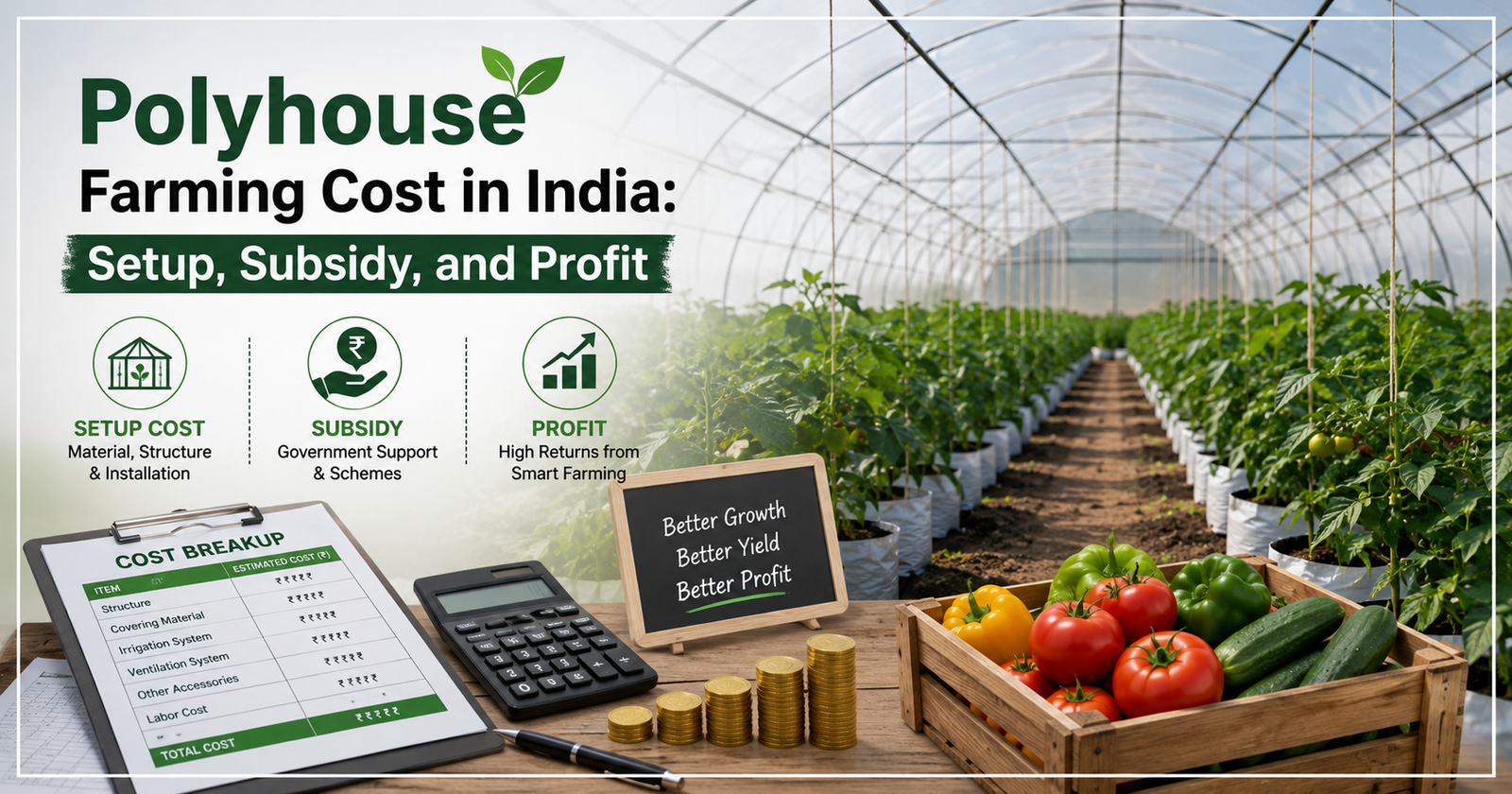
Polyhouse Farming Cost in India: Setup, Subsidy, and Profit
Posted on July 10, 2026
Before starting protected cultivation, most farmers first want to understand the cost of polyhouse farming in India. A polyhouse can help farmers grow vegetables, flowers, and high-value crops in a controlled environment. It protects crops from heavy rain, strong sunlight, wind, insects, and weather changes.
For Indian farmers, this method is useful because it protects crops from weather changes. In many states, farmers face problems such as unseasonal rain, high temperatures, pest attacks, and low market prices during peak season. A polyhouse cannot solve every problem, but it can help farmers produce better quality crops and supply them when market demand is high.
At the same time, polyhouse farming needs proper planning. The setup cost is high, subsidy approval can take time, and profit depends on crop selection, market demand, technical knowledge, and regular maintenance.
What Is Polyhouse Farming?
Polyhouse farming is a method of growing crops inside a protected structure covered with polythene sheets. The structure allows farmers to control temperature, humidity, irrigation, and pest entry to some level.
There are different types of polyhouses in India. A naturally ventilated polyhouse is commonly used by many farmers because it is more affordable than a fully automatic structure. A fan-and-pad polyhouse is more advanced and can control temperature, but it also costs more.
Polyhouses are used for crops (such as capsicum, cucumber, tomato, broccoli, muskmelon, parsley, celery) and flowers (such as gerbera, carnation, rose, and orchid). MIDH guidelines also list several of these high-value fruits and vegetables for assistance under protected cultivation.
Polyhouse Farming Cost in India
The cost of polyhouse farming in India depends on the size, structure type, material quality, automation level, drip and fogger systems, crop, and location. The cost in remote areas and places with poor transport access can be higher.
As per MIDH Operational Guidelines 2025, the cost norm for a fan and pad system ranges from ₹1,800 per sq. m. for up to 500 sq. m., ₹1,600 per sq. m. for more than 500 sq. m. up to 1008 sq. m., and ₹1,500 per sq. m. for more than 1008 sq. m. up to 2500 sq. m. The guidelines also mention that rates are 15% higher in NE and Himalayan states, scheduled areas, vibrant villages, the Andaman & Nicobar, and Lakshadweep.
For a naturally ventilated tubular or rectangular structure, the cost norm is ₹1,200 per sq. m. for up to 500 sq. m., ₹1,050 per sq. m. for more than 500 sq. m. up to 1008 sq. m., and ₹1,000 per sq. m. for more than 1008 sq. m. up to 2500 sq. m.
A small polyhouse may cost a few lakhs, while a larger commercial project may go into ₹30 lakh to ₹60 lakh or more. For one acre, the total cost may change based on the design and equipment. The official NHB cost table also shows a revised cost ceiling of ₹55 lakh per acre for high-value vegetables under polyhouse, including add-on components in project mode.
Farmers should remember that official cost norms may differ from actual market prices or vendor quotations. Local vendor rates, steel prices, plastic sheet quality, automation, labour charges, and transport can increase or reduce the final cost.
Main Setup Requirements
A polyhouse setup includes many parts. The main structure is usually made of GI pipes or other approved material. The covering sheet should be strong and suitable for the local weather. The side net protects the crop from insects while allowing airflow.
A proper drip irrigation system is very important. Many farmers also use foggers, sprinklers, fertigation units, mulching sheets, crop support systems, and trays. If the farmer chooses automation, the cost will increase, but management becomes easier.
Before setting up a polyhouse, farmers should check soil quality, water quality, electricity availability, drainage, road access, and nearby market demand. A good structure in the wrong location can still create losses.
Polyhouse Subsidy in India
Government subsidies give major support to farmers because the initial investment in protected cultivation is high. Under MIDH, activities such as greenhouses, shade net houses, plastic mulching, rain shelters, plastic tunnels, and anti-bird or anti-hail nets are promoted to help farmers reduce setup costs.
As per MIDH guidelines, farmers can get up to 50% assistance for polyhouse, hybrid, and retractable structures. This support is available for a maximum area of 2,500 sq. m. per beneficiary. If the structure is built on a smaller area, the subsidy is calculated proportionally.
Subsidy rules can differ by state, category, project size, and available budget. Some states may give additional support. Farmers should always confirm the latest subsidy details from their district horticulture office, state horticulture department, or official scheme portal before starting construction.
One important point to remember is that subsidies are usually not released immediately. Many farmers may face delays due to paperwork, inspections, bank processing, technical approval, or fund availability. So, farmers should not plan only on subsidy money. They should arrange working capital for construction, crop input, labour, and maintenance.
Common Problems Indian Farmers Face
Many Indian farmers enter polyhouse farming after hearing success stories. But not every project becomes profitable. Some common problems include poor-quality structure, wrong crop selection, no market tie-up, lack of technical knowledge, and weak pest management.
Another big issue is bank loan approval. Some farmers struggle because they don’t have proper land records, a quotation, a DPR, margin money, or a repayment plan. In some cases, vendors promise a subsidy but do not guide the farmer.
Water quality is also a serious issue. Salty or hard water can affect crop growth and fertigation. Before investing, farmers should test water and soil. If the water is not suitable, the cost of filters, treatment, or alternative water sources may increase.
Electricity cuts can also affect operations, especially in fan and pad systems. Farmers in areas with power problems should plan backup options.
Profit from Polyhouse Farming
Profit from polyhouse farming depends on crop, yield, market price, quality, season, and management. Capsicum, cucumber, tomato, gerbera, and carnation are popular crops for polyhouse farming. However, farmers should not choose a crop only because others are growing it.
For example, if many farmers in the same area grow the same crop at the same time, prices may fall. But if a farmer supplies good-quality produce during off-season demand, profit can improve.
A well-managed polyhouse can produce higher yields and better-quality crops than open-field farming. However, the running costs are also higher. Seeds, nutrients, labour, plant protection, plastic replacement, drip maintenance, packaging, and transport must be counted.
Farmers should calculate profit after reducing all costs, not only by looking at sales. Net profit is more important than gross income.
How to Reduce Risk
Start with a practical size instead of investing in a very large project at once. Take training from a trusted agriculture university, horticulture department, or experienced grower. Visit successful and failed polyhouse farms before finalizing the project.
Choose a reliable vendor who uses good-quality materials and provides proper after-sales support. Do not select a vendor only because they offer the cheapest quotation.
Before planting, identify buyers. These can include local markets, supermarkets, hotels, vegetable traders, exporters, or direct customers. Farmer-Producer Organizations can also help with better marketing.
Conclusion
Polyhouse farming cost in India is high, but it can be a good opportunity when planned properly. It helps farmers grow high-value crops with better protection and quality. Subsidy can reduce the burden, but farmers should understand the rules, waiting time, and documentation process.
The best approach is simple. Check local demand, confirm subsidy, prepare a clear budget, test soil and water, choose the right crop, and receive expert guidance. Polyhouse farming can be profitable, but only when the farmer treats it like a serious business, not just a one-time construction project.