
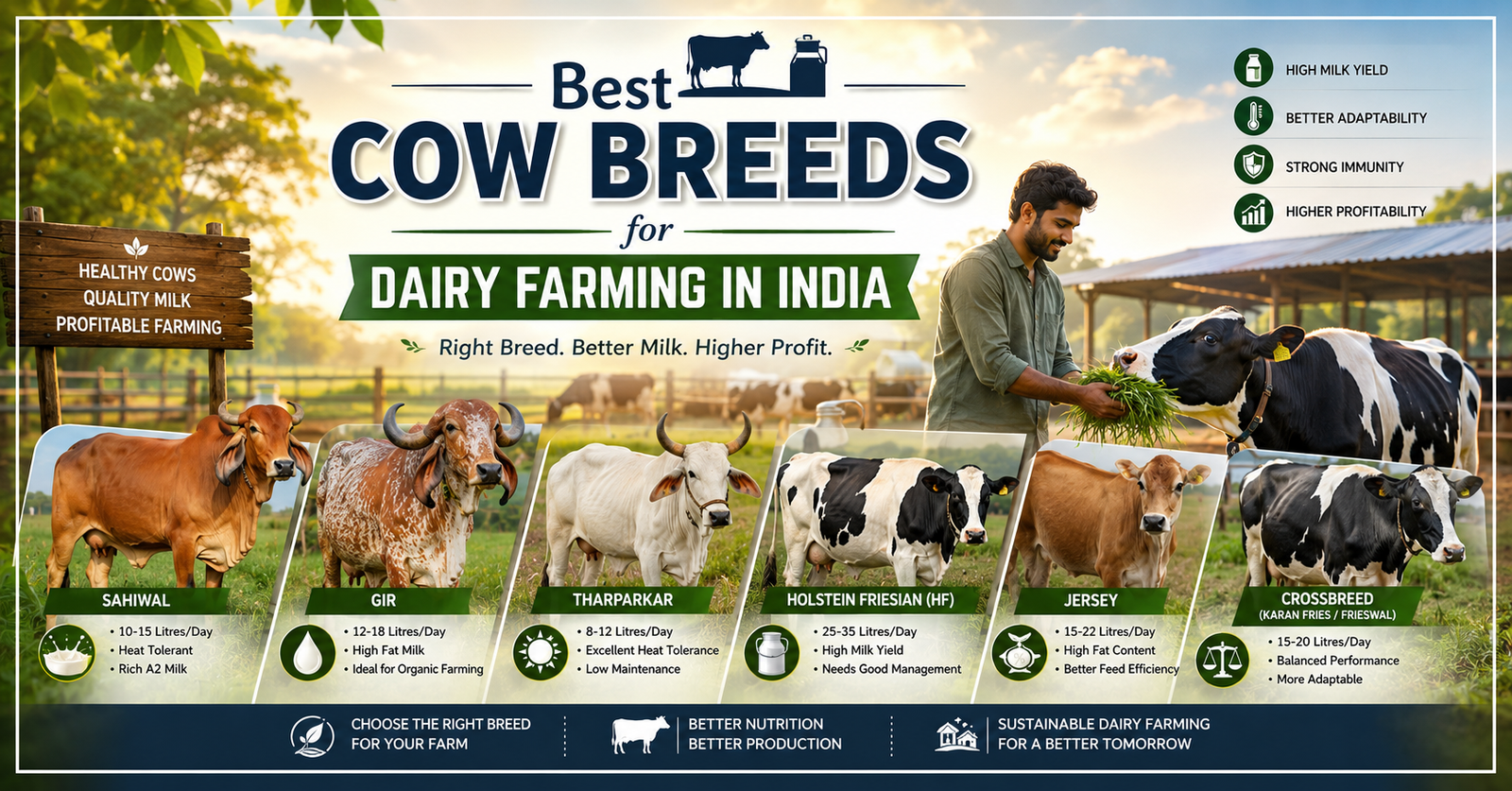
Best Cow Breeds for Dairy Farming in India
Posted on June 8, 2026
The morning mist over Anand, Gujarat, always smells of crushed green fodder and warm, sweet milk. For a third-generation farmer, this daily ritual began long before the sun pierced the horizon. Standing at the edge of the barn, watching the herd ruminate in the quiet twilight, one old piece of advice still echoed clearly: “A dairy farm doesn’t run on luck. It runs on the heartbeat of the right cattle.”
India’s dairy revolution, famously known as Operation Flood, transformed the nation into the world’s largest milk producer. Yet, for an individual farmer stepping into commercial dairy farming, the choices can feel overwhelming. Should you chase the massive milk volumes of western giants, or trust the resilient, ancient bloodlines of the soil?
The answer is never a straight line. It is a story written in the sweat of the farmer, the heat of the Indian summer, and the genetic marvels of nature.
Chapter 1: The Guardians of the Soil (Top Indigenous Breeds)
Walking down the central aisle of the barn, the first stop is often beside a beautiful, mahogany-red cow with a prominent hump and an almost regal posture. This is the Sahiwal, one of India’s most respected indigenous dairy breeds.
-
The Sahiwal: The Golden Child of Indian Dairying
Originating from the dry regions of Punjab, the Sahiwal is widely celebrated as the best indigenous cow breed in India for milk production. Many farmers underestimate this breed at first, but the Sahiwal often proves that nature knows best.
Sahiwal cows are valued for their good milk production and strong resistance to tick-borne diseases. In the brutal heat of May, when temperatures soared past 45°C, the exotic cows gasped for breath. The Sahiwal, however, stood unbothered under the shade, her sleek coat reflecting the harsh sunlight. Her milk is thick, sweet, and bursting with the highly sought-after A2 beta-casein protein.
-
The Gir: The Curved Horns of Prosperity
Further down the line stands a cow with a massive, domed forehead and long, pendulum-like ears that look like folded leaves. This is the Gir cow, hailing from the rugged forests of Gujarat.
In recent years, the Gir cow has achieved legendary status among organic dairy farming enthusiasts. Farmers across India are choosing Gir cattle because they produce high-quality milk and adapt well to local conditions with relatively lower stress. A well-managed Gir cow can easily yield 12 to 15 litres of milk per day, with exceptional individuals crossing 20 litres. For many dairy farmers, Gir milk is not just a commodity; it is the raw ingredient for premium Vedic A2 ghee, which can fetch a much higher price than regular commercial butterfat in urban markets.
-
The Red Sindhi and Tharparkar: The Desert Survivors
Many experienced dairy farmers also trust the Red Sindhi and the Tharparkar for their resilience and adaptability.
The Red Sindhi, easily mistaken for the Sahiwal due to its deep red coat, is a powerhouse of fertility and adaptability. It can thrive on low-quality roughage and still deliver steady milk yields ranging from 1,700 to 2,600 litres per lactation.
The Tharparkar, on the other hand, is a masterpiece of survival. Hailing from the white sands of the Thar Desert, this dual-purpose breed changes its coat colour from pristine white in the blistering summer to a darker grey in the winter to regulate body temperature. It is the ultimate insurance policy for farmers in arid regions where water is scarce and green pasture is a luxury.
Chapter 2: The Foreign Heavyweights (Top Exotic Breeds)
If indigenous cows are the soul of traditional farming, exotic breeds are the high-octane engines of modern, urban commercial demand. At the far end of many advanced dairy sheds, climate-controlled misting fans often run at full speed. This is where the heavy milkers stand.
-
The Holstein Friesian (HF): The Absolute Volume King
Towering over many other breeds is the massive, black-and-white patched Holstein Friesian cow.
If the goal is pure milk volume to feed rapidly growing urban hubs, the Holstein Friesian has no equal. Under optimal management, an HF cow in India can produce 25 to 30 litres of milk every day, with some exceptional commercial operations recording even higher yields.
However, this high milk production comes with higher management costs. HF cows are not naturally suited to extreme tropical heat, so they need careful housing, proper dairy farm management, high-quality feed, balanced total mixed rations, and cooling systems to protect them from heat stress. Without these conditions, their milk yield can drop quickly.
-
The Jersey: The Balanced Perfection
Standing next to the HF giant was a smaller, deer-like cow with large, gentle eyes and a fawn-colored coat. This was a Jersey cow.
For farmers who want foreign milk yields without the extreme management headaches of the HF, Jersey is the perfect middle ground. Originating from the UK, Jerseys adapt far better to the Indian climate than their black-and-white counterparts. They produce 15 to 20 litres of milk per day. Crucially, Jersey milk boasts a significantly higher butterfat content (often exceeding 5%), making it highly profitable under the traditional Indian cooperative pricing system, which pays farmers based on fat and Solids-Not-Fat (SNF) metrics.
Chapter 3: The Indian Compromise (The Crossbred Revolution)
Pure exotic cows often produce high milk volumes but may struggle in Indian climatic conditions. Pure indigenous cows are strong and adapt well to Indian conditions, but their milk yield may not always be high enough for commercial dairy farms that need larger volumes. To balance both needs, Indian scientists at institutes like the National Dairy Research Institute (NDRI) developed crossbred cattle as a middle path.
Enter crossbred cows, the true workhorses of the modern Indian dairy industry.
Scientists developed breeds like Karan Fries and Frieswal by crossing high-yielding Holstein Friesian or Jersey cattle with hardy Indian breeds such as Sahiwal or Tharparkar. These crossbred cattle were developed to give better milk production while adapting more easily to Indian farming conditions. They inherit the high-yield genetics of their exotic line, producing around 15-18 litres per day, along with the heat tolerance and stronger immune systems of their indigenous line. For a mid-sized commercial dairy farmer looking to maximise profitability without investing heavily in climate-controlled infrastructure, these crossbreeds represent the sweet spot of profitable dairy farming.
Chapter 4: Decoding the Economics of the Manager
As the sun fully rises, the real work of dairy farming moves from the shed to the records. Feed costs, milk receipts, veterinary expenses, electricity bills, and labour charges all tell the truth. Picking a breed is not just about admiring its beauty; it is about balancing a complex equation of inputs versus outputs.
Let us look at how these major breeds stack up side-by-side in a typical Indian commercial scenario:
| Cow Breed | Breed Category | Average Daily Yield (Litres) | Fat Content (%) | Climate Resilience | Best Suited For |
| Sahiwal | Indigenous (Desi) | 10 – 15 | 4.5% – 5.0% | High | Premium A2 Milk Markets & Low-input Farms |
| Gir | Indigenous (Desi) | 12 – 18 | 4.6% – 5.2% | High | Organic Farms & Value-added Products (Ghee) |
| Holstein Friesian (HF) | Exotic | 25 – 35 | 3.5% – 4.0% | Low | High-tech Commercial Farms with Cooling Systems |
| Jersey | Exotic | 15 – 22 | 5.0% – 5.5% | Medium | Fat-based Pricing Models & Sub-tropical Regions |
| Karan Fries / Frieswal | Crossbred | 15 – 20 | 4.0% – 4.5% | Medium-High | Progressive Commercial Dairies seeking Balance |
The numbers reveal an important point: while an HF cow may bring in the largest total volume of milk, Gir and Sahiwal cows often require less spending on expensive veterinary medicines, high-end concentrated feeds, and electricity for cooling fans.
Epilogue: Writing Your Own Dairy Success Story
As tractors begin to roll into the courtyard, loaded with freshly harvested green maize, the lesson becomes clear.
There is no single “best” cow breed for dairy farming in India. The perfect choice depends on your resources, your geography, and your business strategy. If you have strong infrastructure and want to dominate the urban fluid milk supply, the Holstein Friesian or a high-grade crossbreed may be the right choice. If you are operating in harsh terrain with limited capital, or if you want to enter the lucrative, health-conscious organic market, native breeds like Sahiwal and Gir can protect your investment like no other.
For young dairy entrepreneurs, the message is simple: listen to the land first. Understand what you can feed your animals, how you will keep them cool, and what market you want to serve.