
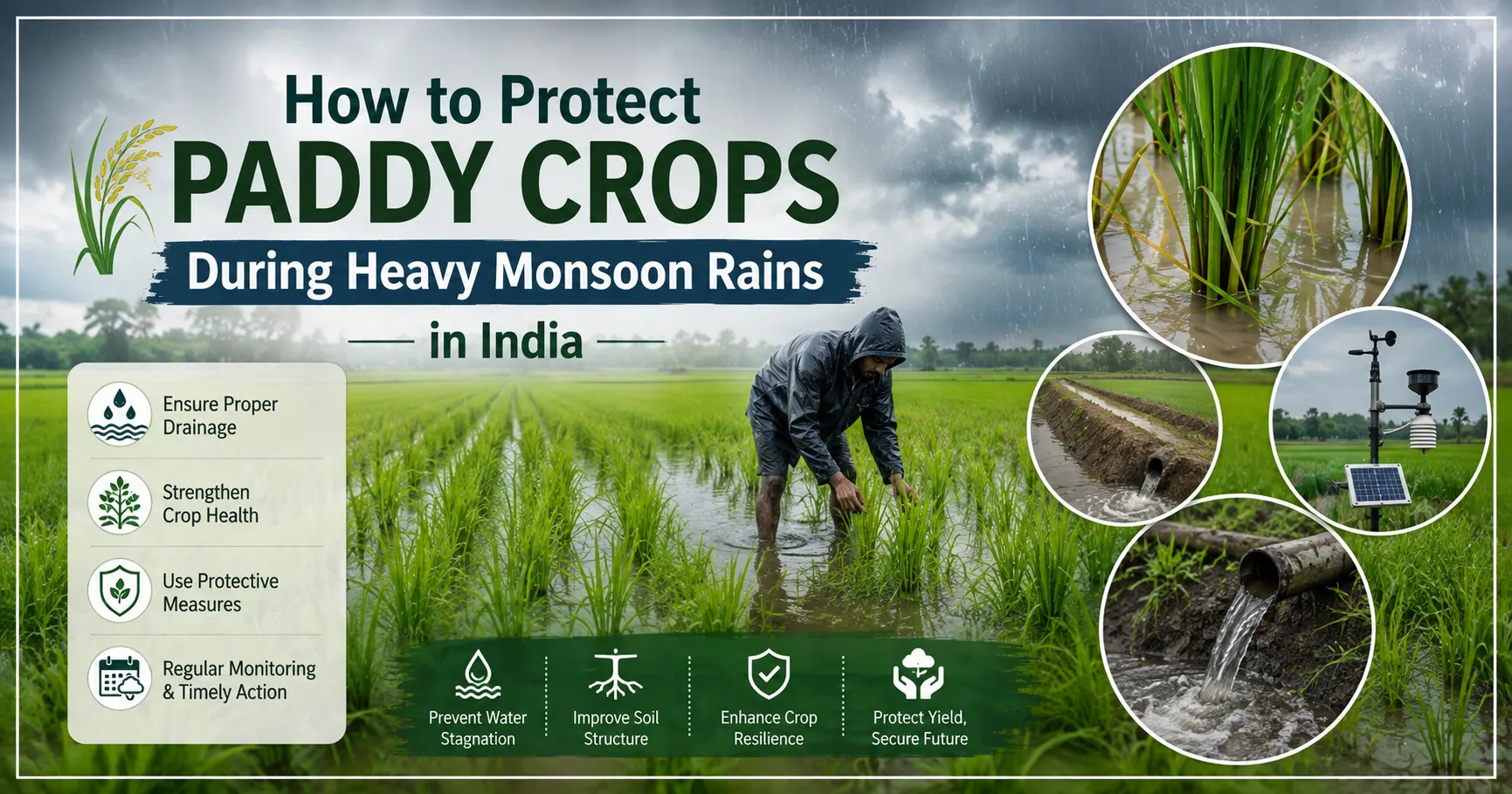
How to Protect Paddy Crops During Heavy Monsoon Rains in India
Posted on August 14, 2026
The monsoon is essential for paddy cultivation in India, but too much rain in a short period can quickly turn from a benefit into a problem.
Paddy (dhan) needs plenty of water, which is why many people assume that heavy rainfall cannot harm a rice crop. In reality, prolonged waterlogging, complete submergence, strong winds, poor drainage, and repeated downpours can seriously affect plant health and final yield.
The risk is particularly high in low-lying fields and areas where rainwater cannot drain.
For farmers in West Bengal, Odisha, Assam, Bihar, Uttar Pradesh, Chhattisgarh, Jharkhand, Telangana, Andhra Pradesh, Tamil Nadu, Punjab, Haryana, and other rice-growing regions, protecting paddy during the monsoon requires careful water management and regular field monitoring.
There is no way to control the rain, but farmers can prepare their fields and respond quickly when heavy rainfall is forecast.
Here is a practical guide to protecting paddy crops during heavy monsoon rains in India.
Why Can Too Much Rain Damage Paddy?
Rice is better adapted to wet conditions than many other crops, but it does not mean the plant can tolerate unlimited water under all circumstances.
Normal shallow standing water in a managed paddy field is very different from a crop being completely submerged after several days of heavy rain.
Excessive water can reduce oxygen availability around the roots, interfere with normal plant growth, wash away or redistribute nutrients, encourage certain diseases, and physically damage plants.
Heavy rain accompanied by wind can also cause lodging, where plants bend or fall over.
The impact depends on several factors, including:
- – Rice variety
- – Crop growth stage
- – Depth of water
- – Duration of flooding or submergence
- – Water temperature and quality
- – Soil type
- – Drainage conditions
- – Plant health before the rain
Young seedlings, recently transplanted plants, and crops approaching flowering or maturity can respond differently to the same rainfall event.
This is why farmers should avoid using one fixed solution for every situation.
1. Improve Field Drainage Before Heavy Rain Arrives
Good drainage is one of the most important ways to reduce damage during intense monsoon rainfall.
Farmers should inspect field drainage channels (paani nikalne ki naali) before the rainy period (make sure water has a clear path out of the field when necessary).
Blocked outlets, weeds, soil, crop residue, and other materials can slow drainage.
Pay particular attention to low-lying sections of the field where water naturally collects.
Where practical, farmers can create or maintain drainage channels around and within the field according to local field conditions.
However, drainage water should be managed responsibly (so that it does not cause erosion or unnecessarily damage neighbouring fields).
Practical tip: Inspect drainage before the rain, not after the field is already flooded.
2. Monitor Water Depth in the Paddy Field
Too much water can harm paddy, especially during continuous heavy rain. Farmers should regularly check how quickly water is building up in the field.
If plants are becoming deeply submerged, drain excess water where possible and follow local crop recommendations. Young plants are especially sensitive to complete submergence.
Also inspect field bunds (medh) to prevent uneven water levels. Good water management means maintaining suitable water depth, not simply keeping the field flooded.
3. Strengthen and Maintain Field Bunds
Field bunds, commonly called medh, play an important role in paddy cultivation.
They help retain and control water inside the field.
Before periods of heavy rainfall, inspect the bunds for weak sections, cracks, rat holes, erosion, and places where water may break through. Early repairs can help prevent uncontrolled water flow.
At the same time, farmers need a controlled outlet for excess water. Completely sealing a field without providing a safe way for excess rainwater to leave can create another problem during very heavy rainfall.
4. Follow Local Weather Forecasts
Weather information has become an increasingly useful farm-management tool.
Farmers no longer have to rely only on looking at the sky or following traditional weather signs. District-level forecasts and agricultural advisories can provide useful warnings about heavy rainfall.
Before expected rain, farmers may be able to:
- – Clear drainage channels
- – Postpone irrigation
- – Adjust fertilizer application
- – Delay pesticide spraying
- – Secure equipment
- – Inspect bunds
- – Prepare for rapid drainage
The India Meteorological Department (IMD), state agricultural departments, agricultural universities, and local advisories can provide weather-related information.
A forecast will not always be perfect, but knowing that heavy rain is likely gives farmers valuable time.
5. Avoid Fertilizer Application Immediately Before Heavy Rain
Timing fertilizer application during the monsoon is important.
If heavy rain is expected shortly after fertilizer is applied, nutrients may be lost, moved away from the root zone, or become less efficiently available to the crop depending on the nutrient, soil, and field conditions.
Farmers should therefore check the weather forecast before applying fertilizer.
Nitrogen management requires particular attention in paddy cultivation.
Instead of automatically applying another dose immediately after heavy rain, inspect the crop and follow local recommendations. The correct response depends on crop stage, previous fertilizer application, soil conditions, and the extent of rain or flooding.
Unnecessary fertilizer application increases production costs and can also contribute to environmental losses.
A soil test, crop observation, and local agricultural advice can support better nutrient decisions.
6. Watch for Nutrient Deficiency After Prolonged Rain
Heavy and continuous rainfall can affect nutrient availability.
After water levels return to manageable conditions, inspect the crop for unusual yellowing, weak growth, or other symptoms.
However, yellow leaves do not automatically mean nitrogen deficiency.
Waterlogging, root stress, disease, nutrient imbalance, and other factors can create similar symptoms.
This is why farmers should avoid immediately applying urea simply because the crop looks pale after heavy rain.
Allow the field to recover where appropriate, assess the plants, and follow recommendations from a local agricultural expert or Krishi Vigyan Kendra (KVK) if the cause is unclear.
7. Monitor Paddy Diseases During Humid Weather
Warm temperatures, high humidity, cloudy conditions, and prolonged leaf wetness can favour several rice diseases.
Farmers should inspect the field regularly after periods of continuous rain.
Depending on the region, variety, and conditions, paddy may face diseases such as:
Rice blast: Can affect leaves, nodes, and panicles.
Sheath blight: Often appears on the leaf sheath and can spread under favourable humid conditions.
Bacterial leaf blight: Can cause leaf symptoms and may become serious in susceptible crops under favourable conditions.
Other diseases may also occur depending on the region and season.
The important point is early identification.
Do not spray a fungicide or bactericide simply because it has been raining. First, identify the problem.
Using the wrong crop protection product wastes money and may create unnecessary environmental and resistance risks.
If symptoms are unclear, farmers can share clear photos of the affected plants with their local KVK, agricultural extension officer, or crop adviser.
8. Check Pest Activity After Rain
Heavy rainfall can reduce the activity of some pests, but humid conditions and dense crop growth may favour others.
Farmers should continue field scouting rather than assuming that rain has solved the pest problem.
Check different parts of the field, particularly areas with dense plant growth, excess moisture, or previous pest activity.
Integrated Pest Management (IPM) should be preferred wherever practical.
This includes regular monitoring, correct identification, cultural practices, biological approaches where appropriate, and responsible use of approved pesticides when economic thresholds and recommendations justify treatment.
Avoid calendar-based spraying without checking the crop.
9. Reduce the Risk of Paddy Lodging
Lodging occurs when rice plants bend or fall over, often because of wind, rain, weak stems, excessive plant height, or other factors.
In everyday language, farmers may describe this as dhan ka gir jana.
Lodging becomes particularly concerning as the crop develops panicles and becomes heavier.
Once a mature crop falls over, harvesting becomes more difficult. Grain quality and yield can also be affected depending on the timing and severity.
Balanced nutrition is one part of lodging management. Too much nitrogen can make paddy plants grow taller and weaker, increasing the risk of lodging.
Variety selection, planting density, crop nutrition, water management, and weather all play roles.
If the crop has already lodged, avoid walking through the field unnecessarily because additional movement can increase damage.
10. Be Careful With Spraying During Rainy Weather
Spraying immediately before rain can waste both product and money.
Rain may wash a crop protection product from plant surfaces before it has had sufficient time to perform as intended.
Farmers should check the product label and weather forecast before application.
Wind conditions also matter.
Spraying during strong winds increases drift and may carry the product away from the target crop.
After several days of rain, farmers may want to spray as soon as the weather clears. However, the decision should still consider the product instructions, crop condition, field access, expected rain, and wind.
Never increase the pesticide dose simply because rainfall occurred unless the approved label or a qualified agricultural recommendation.
11. Protect Recently Transplanted Paddy
Recently transplanted paddy (ropai ke baad ka dhan) requires particular attention during very heavy rainfall.
Young seedlings may not yet be firmly established. Fast-moving or deep water can uproot, bury, displace, or completely submerge them.
After the water recedes, inspect the field.
Look for:
- – Missing plants
- – Damaged seedlings
- – Uneven plant population
- – Sediment deposited over plants
- – Areas where seedlings have been washed away
Where agronomically appropriate and within the suitable establishment period, missing areas may need gap filling using healthy seedlings.
The decision depends on how much of the field has been affected and the crop’s age.
12. What to Do If the Paddy Field Becomes Flooded
If a paddy field is flooded after heavy rain, farmer safety should come first. Avoid entering deep or fast-moving water. Once conditions are safe, check how much of the crop is submerged and drain excess water through available channels.
After the water recedes, do not assume the crop is completely lost. Some rice varieties can recover from short-term flooding. Give the plants time to recover, then check for new growth and surviving plants.
If flooding is severe or lasts for several days, contact the local agriculture department or Krishi Vigyan Kendra (KVK) before applying extra fertilizer or crop protection products.
13. Choose Paddy Varieties According to Local Flood Risk
Variety selection can make a significant difference in areas that experience regular flooding.
Farmers in flood-prone regions should ask agricultural universities, KVKs, and state agriculture departments about rice varieties recommended for their local conditions.
Some varieties have been developed with greater tolerance to temporary submergence or other environmental stresses.
However, a flood-tolerant variety is not automatically the best choice everywhere.
Yield potential, grain quality, crop duration, market preference, disease resistance, and local growing conditions also matter.
Use certified seed and select varieties recommended for the agro-climatic zone rather than buying seed only because a particular variety is popular online.
14. Keep the Field and Drainage Areas Clean
Weeds and excessive vegetation around channels can restrict water movement.
Before and during the monsoon, inspect drainage routes and remove obstructions where necessary.
Weed control is important because weeds compete with paddy for nutrients, light, and space. During heavy rains, farmers should wait for suitable weather and field conditions before carrying out weed-control activities.
Avoid dumping removed weeds or crop residue into drainage channels, as this can create blockages during the next heavy rain.
15. Check the Crop Carefully After the Rain Stops
The work is not finished when the rain stops.
Walk through the field once it is safe and assess different sections rather than looking only from the road or field boundary.
Check for:
- – Standing water
- – Damaged bunds
- – Blocked drains
- – Lodged plants
- – Missing seedlings
- – Yellowing
- – Disease symptoms
- – Pest activity
- – Root or stem damage
- – Sediment deposits
- – Uneven crop growth
Take photographs of damaged areas if needed. These can be useful when seeking advice or documenting losses. Do not rush to apply several fertilizers and pesticides together in an attempt to “recover” the crop.
Identify the actual problem first.
What Should Farmers Do Before, During, and After Heavy Rain?
A simple three-stage approach can make monsoon management easier.
Before Heavy Rain
- – Check the local weather forecast.
- – Clean drainage channels (paani ki naali) and inspect field bunds (medh).
- – Avoid unnecessary irrigation when significant rainfall is expected.
- – Plan fertilizer and crop protection applications around the weather forecast.
- – Make sure water has a controlled outlet if rainfall becomes excessive.
During Heavy Rain
- – Avoid entering flooded fields, particularly where water is deep or moving quickly.
- – Observe water levels from a safe location.
- – Do not apply fertilizers or pesticides during unsuitable weather.
- – Keep people, livestock, pumps, electrical equipment, and machinery away from unsafe floodwater.
After Heavy Rain
- – Drain excessive standing water where appropriate.
- – Inspect the crop for submergence damage, lodging, disease, and missing plants.
- – Check whether bunds and drainage channels require repair.
- – Wait for suitable field conditions before conducting major operations.
- – Seek local agricultural advice before applying corrective fertilizer or pesticides if the crop has suffered significant stress.
Where Can Indian Farmers Get Reliable Monsoon Advice?
For local recommendations, farmers can use information from the India Meteorological Department (IMD) and agricultural advisories.
The nearest Krishi Vigyan Kendra (KVK) can also provide valuable crop-specific guidance.
State agriculture departments and agricultural universities regularly publish advisories covering rainfall, pests, diseases, fertilizers, crop varieties, and other seasonal issues.
Farmers should prefer these sources over unverified WhatsApp forwards or social media recommendations.
A farming technique that works in Punjab may not necessarily be appropriate for a rain-fed paddy field in Assam, Odisha, or Chhattisgarh.
Can Heavy Monsoon Rain Completely Destroy Paddy?
Not always.
The damage depends on several factors, including water depth, how long the crop stays underwater, the growth stage, rice variety, water flow, temperature, and the overall health of the plants.
A short period of excess water may cause limited damage in some situations, while prolonged complete submergence can be much more serious.
Farmers should therefore assess the field after water recedes rather than making an immediate decision to abandon the crop.
If large areas have been affected, contact local agricultural authorities for recommendations on crop recovery, replanting possibilities, or alternative crops where appropriate.
Long-Term Ways to Make Paddy Fields More Monsoon-Ready
Heavy rainfall cannot be prevented, but farm design and planning can reduce vulnerability.
Farmers in repeatedly affected areas can consider improving field drainage, maintaining bunds, levelling fields, choosing locally suitable varieties, improving soil health, and developing safe water outlets.
Farm ponds and water-harvesting structures may also provide opportunities to manage water more effectively in suitable locations.
A farmer may have too much water in July and too little in August.
Good water management means draining excess water when needed while conserving rainwater for drier periods.
Final Thoughts
Paddy (dhan) depends heavily on the Indian monsoon, but excessive rainfall can create serious challenges for farmers.
The most important protection is good drainage, strong field bunds (medh), weather monitoring, balanced nutrient management, and regular crop inspection.
Before heavy rain, prepare the drainage system and avoid poorly timed fertilizer or pesticide applications. During extreme weather, farmer safety should come first. Once the rain stops, inspect the field carefully and identify the actual problem before taking corrective action.
Do not assume that every yellow plant needs urea or that every spot on a leaf requires pesticide spray.
For serious flooding, disease outbreaks, or crop damage, seek location-specific advice from the nearest Krishi Vigyan Kendra (KVK), agricultural university, or state agriculture department.
Indian farmers cannot control when or how heavily the monsoon arrives. But careful preparation and timely field management can reduce avoidable losses and give the paddy crop a better chance of recovering after difficult weather.