
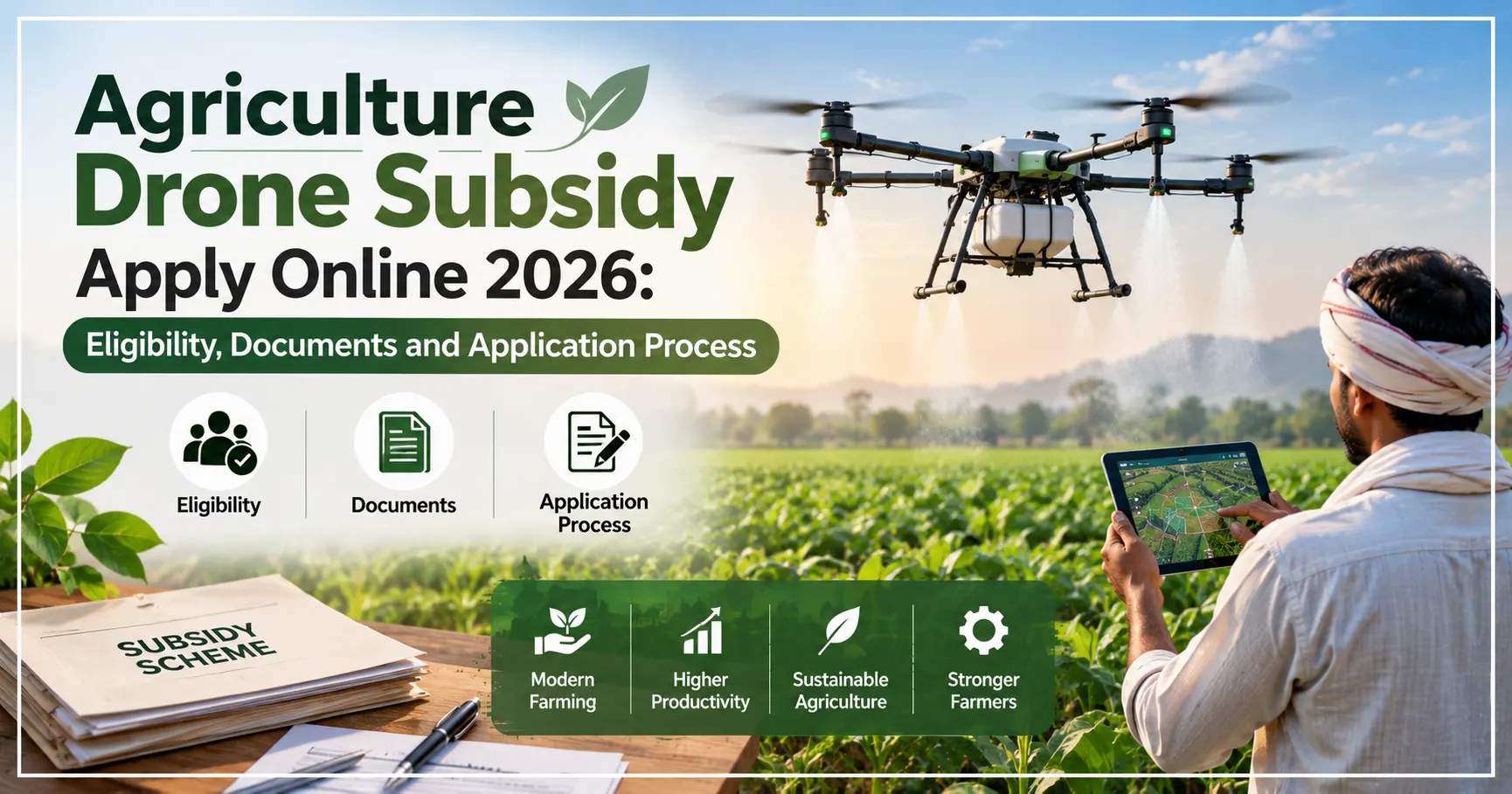
Agriculture Drone Subsidy Apply Online 2026: Eligibility, Documents and Application Process
Posted on September 14, 2026
Agricultural drones are changing the way farmers spray crops, apply liquid fertilisers, monitor fields, and manage labour-intensive farm work. A drone can help cover a larger area in less time and reduce direct exposure to chemicals.
However, an agricultural drone is a costly machine. This is why many farmers search online for agricultural drone subsidies, eligibility requirements, and government support for Kisan drones in 2026.
The first thing to understand is that there is no single application process that is identical across India. Support for agricultural machinery is available through Central and State Government schemes. The subsidy amount, eligibility, application dates, approved drone list, and required documents may vary by state and financial year.
For 2026–27, farmers should use only official agriculture department portals, the Government of India’s farm mechanisation platform, or their state agriculture department website. Avoid agents who promise a “guaranteed drone subsidy” in exchange for advance payment.
This guide explains how agriculture drone subsidy applications generally work, who may be eligible, which documents are commonly required, and how to apply online safely.
What Is an Agriculture Drone?
An agriculture drone is an unmanned aerial vehicle used for farm-related work. It is commonly used for:
- – Spraying pesticides and bio-pesticides
- – Applying liquid fertilisers
- – Spraying micronutrients
- – Crop monitoring
- – Field mapping
- – Crop health observation
- – Supporting precision agriculture services
- – Providing drone spraying services to other farmers
The most common farm-use drones are spraying drones. These carry a tank, battery, pump, nozzles, and flight-control system. The operator uses a remote controller and follows approved operating procedures.
An agriculture drone should not be treated like an ordinary farm implement. It involves aviation rules, safe chemical handling, trained operation, battery management, and regular maintenance.
Is Agriculture Drone Subsidy Available in 2026?
Agriculture machinery subsidies are offered through government mechanisation schemes. However, availability depends on your state, district targets, budget allocation, and the latest scheme notification.
The Government of India’s Digital Platform for Farm Mechanization and Technology provides state-linked information for farm machinery support. Its portal shows that fresh applications are generally required for the relevant financial year, and states can set scheme components, timelines, and state-specific top-up support.
This means a farmer who was waitlisted in the previous year may need to submit a new application when the 2026–27 portal opens. Waiting-list rules vary by state, so always check the latest notice before applying.
Agriculture drone support may be offered through:
- – State agriculture mechanisation schemes
- – Sub-Mission on Agricultural Mechanization-related components
- – Custom Hiring Centre programmes
- – Farmer Producer Organisation support
- – Self-Help Group support
- – Women farmer group initiatives
- – Agriculture department demonstration programmes
- – State-specific drone schemes
- – Agricultural service entrepreneur programmes
The scheme name and benefit structure can vary. In some states, the focus may be on individual farmers. In some, drones may be supported for Custom Hiring Centres, FPOs, SHGs, rural entrepreneurs, or drone service providers.
Namo Drone Didi Scheme: Who Is It For?
Namo Drone Didi is a Government of India initiative designed to support selected Women Self-Help Groups. The purpose is to help these SHGs provide drone rental and spraying services to farmers.
It is important to understand that this is not a general direct-purchase scheme for every individual farmer. Selected women’s SHGs receive financial support and training to operate drones as a service business in their local area.
The programme has aimed to provide drones to selected women’s SHGs for rental services to farmers. Individual farmers looking to buy a drone should check their state agriculture department’s mechanisation portal instead of assuming that Namo Drone Didi applies to them.
Who Can Apply for an Agriculture Drone Subsidy?
Eligibility depends on the current state scheme, but the following categories may be considered under different agriculture drone programmes:
- – Individual farmers
- – Women farmers
- – Small and marginal farmers
- – Scheduled Caste and Scheduled Tribe farmers
- – Farmer Producer Organisations
- – Farmer Producer Companies
- – Self-Help Groups
- – Cooperative societies
- – Custom Hiring Centres
- – Rural entrepreneurs
- – Agriculture graduates or agri-service providers
- – Krishi Vigyan Kendra-linked groups
- – Registered agricultural societies
- – Panchayat-level farm machinery groups
A scheme may give preference or an additional subsidy to certain categories, such as women farmers, SC/ST farmers, FPOs, SHGs, or farmers in priority districts. Always check the official notification for your state to confirm final eligibility.
In some cases, an individual farmer may be eligible only if they meet minimum landholding, farmer registration, or income-related conditions. In other cases, the drone may be approved only for a group-based custom hiring model.
Common Eligibility Conditions
While conditions vary by state, applicants are commonly expected to meet requirements such as:
- – Must be an Indian citizen and resident of the concerned state
- – Must be registered as a farmer on the state agriculture portal
- – Must have Aadhaar-linked identity details
- – Must have an active bank account in the applicant’s name
- – Must not have received subsidy for the same machine under another scheme, where restricted
- – Must purchase only an approved drone model from an authorised dealer
- – Must follow the purchase timeline mentioned in the approval letter
- – Must allow physical verification of the drone and documents
- – Must comply with applicable drone operating rules
- – Must use the drone for agricultural work or approved farm service activities
For FPOs, SHGs, societies, or Custom Hiring Centres, additional registration and organisation documents may be required.
Documents Required for Agriculture Drone Subsidy Application
Required documents may vary depending on the state and its application portal. However, applicants should keep the following documents ready before applying online.
Basic Farmer Documents
- – Aadhaar card
- – Mobile number linked with Aadhaar or farmer registration
- – Passport-size photograph
- – Bank passbook or cancelled cheque
- – PAN card, if required by the scheme
- – Farmer registration number
- – Land ownership document or land record
- – Land lease document, if lease cultivation is accepted
- – Caste certificate, if applying under SC/ST or reserved category
- – Residence proof, if required
Drone Purchase and Technical Documents
- – Quotation from an authorised drone dealer
- – Drone make and model details
- – Product specification sheet
- – Dealer registration details, where required
- – GST invoice after purchase
- – Serial number of the drone
- – Battery and charger details
- – Warranty document
- – Training certificate or pilot-related document, if required
- – Insurance document, if required by the scheme or lender
Documents for Groups and Organisations
FPOs, SHGs, cooperatives, and Custom Hiring Centres may also need:
- – Registration certificate
- – PAN card of the organisation
- – Bank account details of the organisation
- – Resolution authorising the purchase
- – List of members
- – Project report or business plan
- – GST details, if applicable
- – Loan sanction letter, if buying through bank finance
- – Custom hiring centre registration details
Keep scanned copies in PDF or JPG format. Make sure the names on Aadhaar, bank account, land record, and application form match. Name mismatches are a common reason for application delay.
How to Apply Online for Agriculture Drone Subsidy
The online application process may differ in each state, but the overall steps are usually similar.
Step 1: Check the Official Scheme Notification
First, visit your state agriculture department website or farm mechanisation portal. Look for current notifications under headings such as:
- – Agriculture mechanisation
- – Farm machinery subsidy
- – Kisan drone subsidy
- – Drone scheme
- – Custom Hiring Centre
- – FPO machinery support
- – Agricultural equipment assistance
Check whether applications are open, which category is eligible, and whether the drone is listed as an approved implement.
Do not rely only on YouTube videos, WhatsApp messages, or old blog posts. Subsidy windows may open and close quickly.
Step 2: Register on the Official Portal
If you are applying for the first time, you may need to create a farmer account. Enter details, including name, Aadhaar number, mobile number, district, village, bank account, and land information.
Some state systems verify Aadhaar or farmer registration details. If your Aadhaar mobile number is inactive, update it before starting the application.
Step 3: Select the Correct Scheme and Drone Category
After logging in, choose the correct scheme. If the portal provides a separate option for an agriculture drone or Kisan drone, select it.
Read the scheme instructions before clicking submit. Check:
- – Whether you are applying as an individual, group, FPO, SHG, or entrepreneur
- – Whether the drone category is eligible
- – Whether a dealer quotation is required before approval
- – Whether the subsidy is front-end or back-end
- – Whether bank finance is mandatory
- – Whether the scheme has a district-wise target or lottery system
Step 4: Upload Required Documents
Upload clear and readable documents. Blurry bank passbook images, incomplete land records, or incorrect caste certificates can delay verification.
Before submitting, recheck your bank account number and IFSC code. Subsidy payments are generally transferred through a Direct Benefit Transfer process after approval and verification.
Step 5: Submit the Application and Save the Reference Number
After submission, download or take a screenshot of the application acknowledgement. Save the application number, password, and registered mobile number.
You may need the application number later to track your status, respond to corrections, or attend physical verification.
Step 6: Wait for Selection or Approval
Selection methods differ by state. Some schemes use first-come, first-served applications, while others use district targets, priority categories, or computerised lottery systems.
Submitting an application does not mean the subsidy has been approved. Wait for the approval letter, allotment message, or portal status update before paying the full amount to a dealer.
Step 7: Purchase Only After Approval
This step is very important. Many schemes require farmers to purchase the machine only after receiving approval. If you buy the drone before approval, you may become ineligible for subsidy.
Purchase the exact approved make and model from an authorised dealer. Keep the original invoice, payment screenshot and proof, warranty card, serial number, and any installation or delivery report.
Step 8: Physical Verification and Subsidy Release
After purchase, the agriculture department may verify the drone, documents, and serial number. For group-based projects, officials may also check whether the Custom Hiring Centre or service unit is functioning.
After verification, the subsidy may be deposited into the beneficiary’s bank account, adjusted against the loan amount, or processed under the state scheme rules.
How Much Subsidy Is Available for Agriculture Drones?
There is no single subsidy percentage that applies across India in 2026. The actual benefit depends on the state, beneficiary category, programme, approved cost, and budget limit.
Some state schemes provide support as a percentage of the approved cost. Others set a maximum subsidy ceiling. Group-based schemes may offer a different support pattern from individual farmer schemes.
This is why farmers should check the official subsidy calculator or latest scheme notice instead of relying on a fixed percentage in an old article.
The Government of India’s farm mechanisation portal includes a subsidy calculator where users can select the State or Union Territory, scheme, gender, farmer category, farmer type, implement, and dealer price to view applicable assistance details when available.
Important Drone Rules Farmers Must Follow
Receiving a subsidy does not remove the need to follow drone regulations. Agricultural drones are regulated aircraft, and safe operation matters.
Before buying or operating a drone, check the current requirements on the Digital Sky platform and DGCA website. Drone operators may need to follow rules on registration, approved flying areas, pilot training, flight safety, and drone model compliance.
Farmers should also ensure that:
- – The drone is operated by a trained person
- – Spraying is done according to approved agricultural drone procedures
- – Nearby people, animals, homes, power lines, and roads are kept safe
- – Chemicals are mixed and handled safely
- – Wind speed and weather conditions are suitable
- – Batteries are charged, stored, and transported safely
- – The drone is not flown in restricted or prohibited areas
- – The operator follows local administration and aviation instructions
A drone should never be used for spraying near schools, crowded areas, airports, defence locations, or other restricted zones.
Common Reasons Why Applications Get Rejected
Agriculture drone subsidy applications may be rejected or delayed for reasons such as:
- – Scheme application period has closed
- – Wrong scheme or beneficiary category selected
- – Incomplete documents
- – Incorrect bank account details
- – Mismatch in Aadhaar and bank records
- – Land record not accepted under the scheme
- – Applicant already received subsidy for the same equipment
- – Drone purchased before approval
- – Purchase from an unapproved dealer
- – Wrong drone model or missing serial number
- – Failure during physical verification
- – No available target or budget in the district
If your application is rejected, check the exact reason on the portal or contact the district agriculture office. Do not pay money to an unofficial agent to “fix” the application.
Final Thoughts
Agriculture drones can help farmers save time, improve spraying efficiency, and build a rural farm-service business. But a drone subsidy should be approached as a formal government process, not as a quick online offer.
For 2026, the safest route is to register on the official state agriculture or farm mechanisation portal, read the current notification, upload correct documents, and purchase only after approval. Farmers should consider whether applying through an FPO, SHG, Custom Hiring Centre, or service group is more practical than purchasing a drone.
The right drone, proper training, and a dependable local customer base are just as important as the subsidy. When all three are in place, an agriculture drone can become a useful tool for modern farming and an additional source of rural income.