
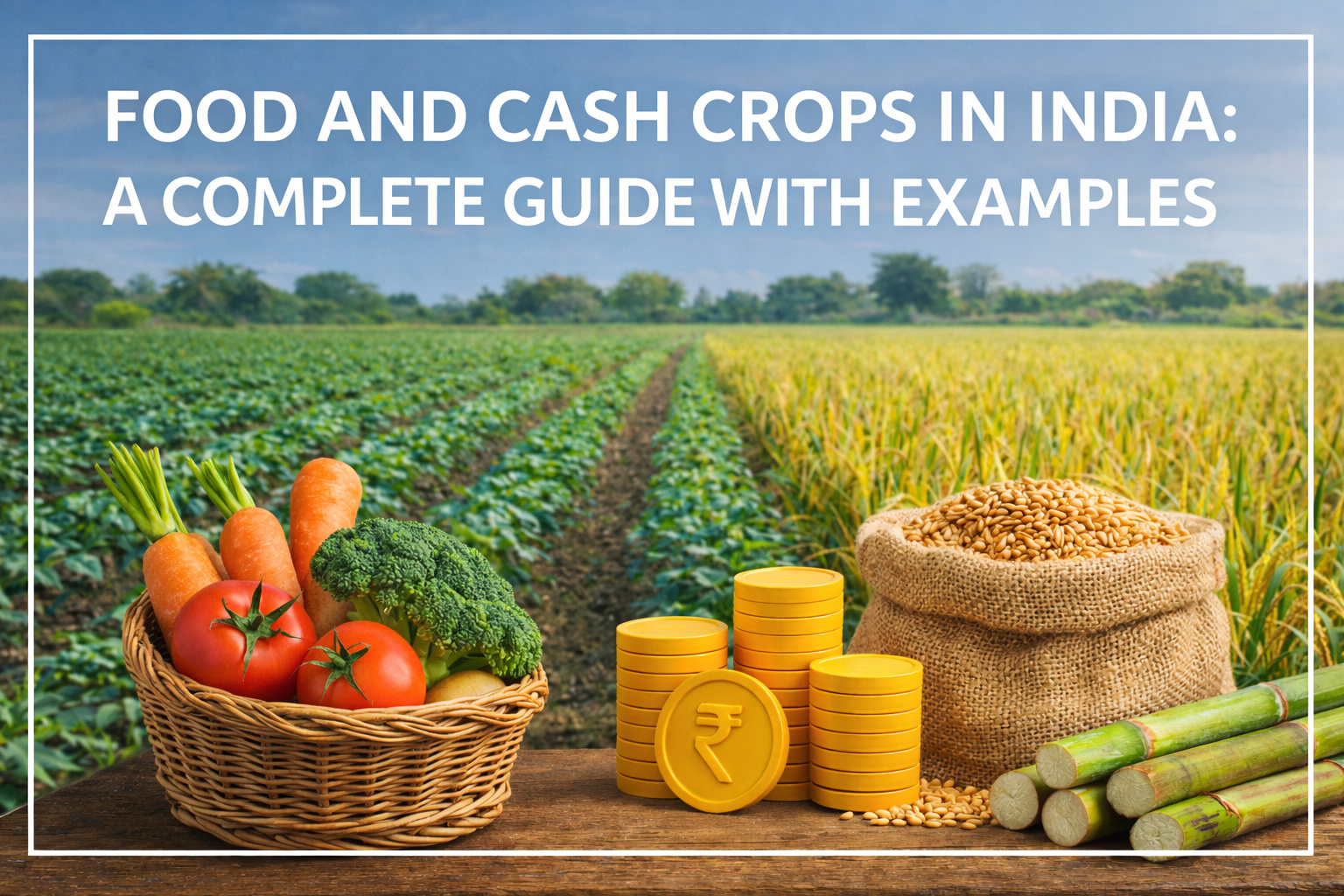
Food and Cash Crops in India
Posted on February 27, 2026
The agricultural world provides a living for more than half of the population in India, and Indian farmers grow every type of food grain. India is a diverse country where people of different castes, religions, and colors live differently. In the same way, crops also have their diversity and their own season where they are grown, cultivated, and irrigated.
Crops are one of the essential substances for the existence of humans, as we cannot live without the food that we get from the crops. Every living being directly or indirectly depends on crops for its survival. Let us understand the major crops of India.
Rabi Crops: Rabi crops are also known as winter crops in India. Some of them are mustard, sesame, wheat, and barley. The main states for the production of rabi crops are Punjab, Haryana, Himachal Pradesh, and Jammu and Kashmir.
Kharif Crops: Kharif crops are also known as monsoon crops in India, which include paddy, turmeric, soybean, millets, and cotton. Some major regions for growing these crops are Odisha, Andhra Pradesh, Tamil Nadu, and Kerala.
Cash Crops: Cash crops are those crops that are sold in national and international markets to generate revenue. These crops are either consumed directly or utilized as raw materials by the manufacturing industry. Some examples of cash crops are coffee, tea, cotton, sugarcane, oilseeds, and spices.
Food Crops: Food crops are grown for human consumption. Several food crops are grown in the country, including rice, wheat, millets, maize, and pulses.
Promoting the cultivation of cash crops and food crops is necessary on a large scale to improve the economy. Let us understand more about it.
Cash Crops
Cash crops are commercial crops sold in markets to generate more revenue. The price of cash crops is entirely dependent on the supply and demand requirements of developed countries. Cash crop cultivation can generate more revenue for farmers with high profit margins and help them to improve their standard of living. Let us learn about more examples of cash crops.
Tea
India is one of the world’s second-largest producers of tea as well as the largest consumer.
Tea requires a temperature of 20-30 degrees to grow better and rainfall of 150-300 cm.
Tea grows in the tropical and subtropical climates of India.
The top tea-producing states in India are Assam, West Bengal, Tamil Nadu, and Kerala.
Sugar cane
Sugarcane is the primary source of gur, Kandsari, and sugar and is one of the major cash crops and a member of the bamboo family.
It is that crop that takes a long time to mature, about 10-15 months.
The best time for harvesting is during a brief, chilly, dry weather season.
Some of the major states for production are Uttar Pradesh, followed by Maharashtra, Karnataka, Tamil Nadu, Bihar, Gujarat, Haryana, and Punjab.
Jute
Jute is one of the most profitable cash crops grown in India.
It needs a temperature between 240 and 350 degrees Celsius and a relative humidity of 80 to 90 percent.
Jute must be grown and processed with a plentiful supply of inexpensive labor. It is grown in five states—West Bengal, Bihar, Assam, Andhra Pradesh, and Odisha.
Food Crops
Food crops are grown for human consumption. Some of the major crops include pulses, millets, maize, rice, and wheat. In India, horticulture plays an important role, and these crops are important to meet the dietary needs of the country’s population and provide a significant source of income for farmers.
Some of the main food crops grown in India are as follows:
Rice
Rice is grown at different altitudes and climates in India, with growing seasons across the country.
Rice is grown in many parts of India, but the common states are Telangana, Bihar, West Bengal, Punjab, and Uttar Pradesh.
To promote and enhance rice production, the National Food Security Mission was established in 2007-2008.
The government has also started several programs to give farmers access to loans, insurance, and marketing assistance.
Wheat
Wheat is mainly sown in winters and harvested in the spring months.
The seeds are sown between October and December and take 7-8 months to mature.
It is basically grown in important states of Punjab, Haryana, Uttar Pradesh, Bihar, and Madhya Pradesh.
To encourage farmers to use different methods and boost their production, the government offers different subsidies on seeds, fertilizers, and pesticides.
Maize
Maize is grown during two seasons, which are rainy and winter.
The majority of the maize area, 83%, is dedicated to kharif maize and 17% to rabi maize.
Maize is grown in different parts of India, but mostly in Maharashtra, Tamil Nadu, Karnataka, and Andhra Pradesh.
India is the fourth-largest country in terms of maize cultivation.
During the 2018-2019 season, maize cultivation in India reached 9.2 million hectares, as reported by DACNET in 2020.
The government has launched different schemes to promote the cultivation of hybrid and high-yielding maize varieties.
The government is encouraging farmers to adopt modern techniques to increase their yield.
Pulses
Pulses include crops such as beans, lentils, and chickpeas, and are grown during Kharif, Rabi, and Zaid in the agricultural areas.
Rabi crops need a mild cold climate during the sowing period, and during their vegetative to pod stages, they require a cold climate.
Pulses are mainly grown in Karnataka, Maharashtra, Madhya Pradesh, and Rajasthan.
The “Pulse Promotion Programme” has been launched by the government to expand the availability of pulses to consumers at affordable costs, also increasing their productivity and production.
Millets
Millets are usually small-seeded grasses that are grown as cereal crops in different parts of the world.
They are usually grown during the rainy season and require a good amount of water for germination and growth.
Millets have a unique photosynthetic pathway known as C₄, which allows them to efficiently use water and sunlight to produce energy.
The Millet Mission was launched by the government of Karnataka in 2018, and its main aim is to increase the area under millet cultivation and promote the consumption of millets.
Conclusion
Cash crops and food crops both play an essential role in improving the economy of India. Cash crops are important for farmers as they have high market value and can lead to immediate profit-making, whereas food crops are basic needs for human beings. Cash crops have huge global demand and are exported in large quantities. Different types of crops help farmers to boost their income and have a high profit margin.