
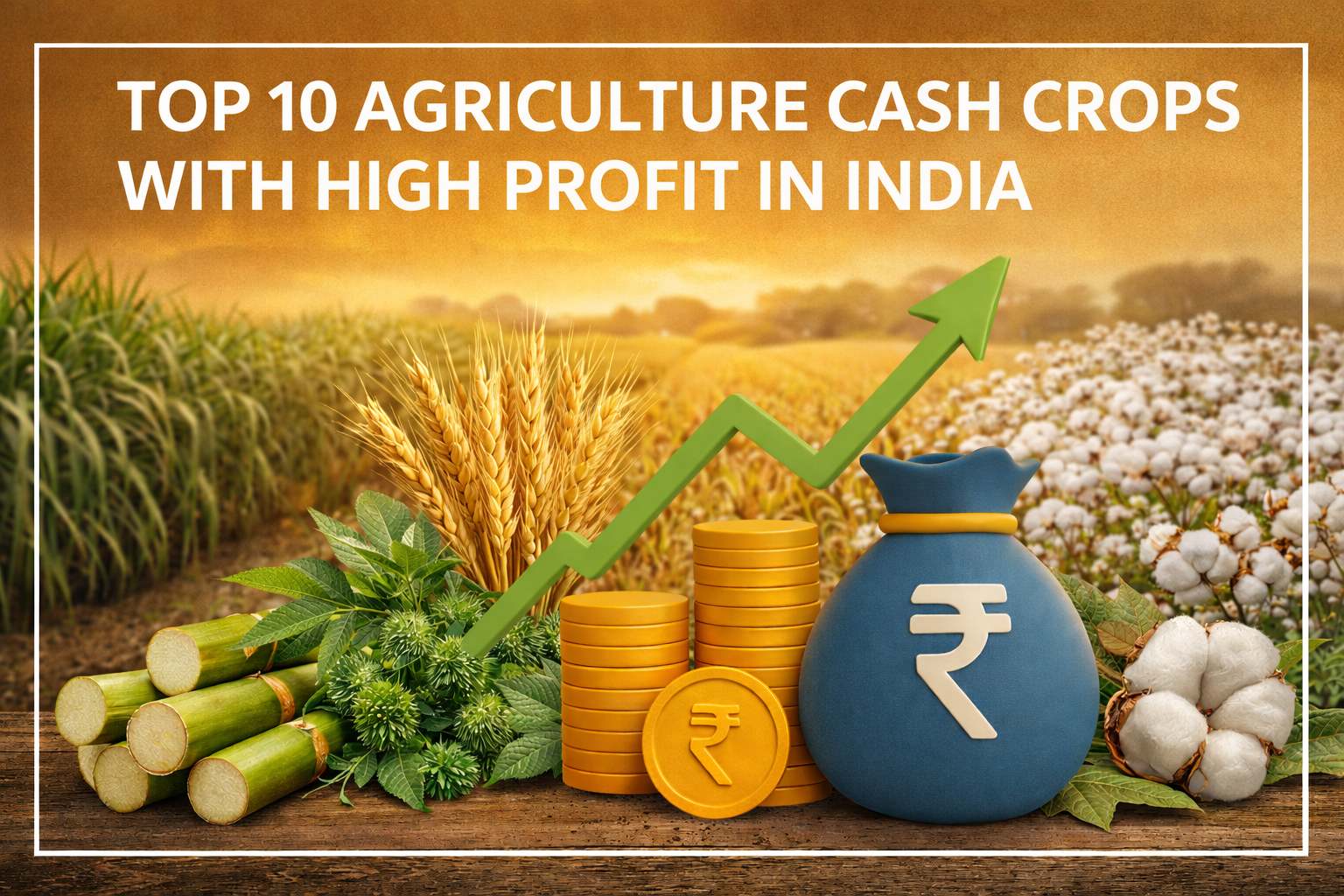
Top 10 Agriculture Cash Crops with High Profit in India
Posted on February 12, 2026
Indian agriculture is no longer limited to subsistence farming. Today, many farmers are shifting their focus from traditional staple crops to high-profit cash crops that offer better market returns. Rising demand from domestic consumers, food processing industries, export markets, and the wellness sector has created strong opportunities for those willing to plan strategically.
Cash crops are primarily grown for sale rather than personal consumption. Their profitability depends on market demand, climate suitability, yield, input costs, and proper post-harvest management. While no crop guarantees instant success, informed decisions can significantly improve farm income.
Here are ten agricultural cash crops in India known for their high-profit potential when cultivated with proper planning.
1. Cotton
Cotton is one of India’s major commercial crops, especially in states like Gujarat, Maharashtra, and Telangana. It is widely used in the textile industry, which has both strong domestic demand and export potential.
With improved hybrid varieties and better pest management practices, cotton can generate substantial income. However, farmers must carefully manage water use and pest control to maintain profitability.
2. Sugarcane
Sugarcane remains a reliable cash crop in states such as Uttar Pradesh, Maharashtra, and Karnataka. It supplies sugar mills, ethanol production units, and jaggery industries.
Although it requires significant water and a longer growing period, sugarcane offers relatively stable returns due to structured procurement systems. Many farmers prefer it because of assured buying from mills.
3. Basmati Rice
Unlike regular rice grown for household consumption, basmati rice is largely export-oriented. Punjab, Haryana, and parts of Uttar Pradesh are key growing regions.
Basmati commands premium prices in international markets. Quality, grain length, aroma, and proper post-harvest handling are crucial for maximizing returns. Export demand often determines pricing trends.
4. Spices (Turmeric, Cumin, Coriander, Cardamom)
India is known as the land of spices. Crops like turmeric, cumin, and coriander are cultivated widely, while cardamom thrives in specific climatic regions (like Kerala).
Spices offer excellent export potential and relatively high value per acre. However, market prices can fluctuate based on global supply. Proper storage and grading help improve selling prices.
5. Tea
Tea plantations in Assam, West Bengal, and parts of South India are significant contributors to India’s agricultural exports. It requires specific climatic conditions and long-term investment.
Once established, tea can provide a consistent income for many years. Branding and quality grading further increase profitability, especially in premium markets.
- Coffee
Coffee cultivation in Karnataka, Kerala, and Tamil Nadu supports both domestic and export markets. Indian coffee is valued for its unique flavor profile.
Profit margins depend on global prices and yield quality. Shade-grown coffee and specialty varieties often fetch higher returns. Value addition through roasting and branding can further enhance income.
7. Rubber
Rubber cultivation is concentrated in Kerala and some northeastern states. It is primarily used in manufacturing industries, including automotive and industrial products.
Rubber trees require time to mature, but once they begin yielding latex, they provide a steady income for years. Market prices may vary depending on international demand.
8. Medicinal and Aromatic Plants
With rising demand for herbal products and natural wellness solutions, crops like Ashwagandha, Aloe Vera, and Tulsi have gained popularity.
These crops often require lower chemical inputs and can be grown under contract farming arrangements. Profitability depends heavily on securing buyers before cultivation.
9. Oilseed Crops (Mustard, Groundnut, Soybean)
Oilseeds are essential for edible oil production. Mustard is common in North India, while soybean dominates parts of Madhya Pradesh and Maharashtra.
India imports large quantities of edible oil, so domestic production has a strong demand. Improved varieties and better oil extraction practices increase returns.
10. Fruits (Pomegranate, Banana, Mango)
Horticulture crops offer high profit per acre compared to cereals. Pomegranate and banana are especially popular for commercial farming due to strong export and domestic demand.
Fruit cultivation requires careful management of irrigation, pests, and post-harvest handling. Cold storage and proper packaging significantly impact profitability.
What Determines Profitability?
While these crops are known for high-profit potential, actual income depends on multiple factors:
- – Climate suitability
- – Soil quality
- – Irrigation facilities
- – Market demand
- – Government support
- – Access to storage and transportation
A crop profitable in one region may not perform well in another. Therefore, local research and feasibility studies are essential before large-scale cultivation.
Importance of Market Linkage
Cash crops are market-driven, unlike food grains that may have government procurement systems; many cash crops depend on private buyers or export markets.
Farmers can improve income by:
- – Joining Farmer-Producer Organizations (FPOs)
- – Exploring contract farming
- – Adopting value addition
- – Focusing on grading and packaging
- – Monitoring market trends regularly
Direct market connections reduce dependency on middlemen and increase price realization.
Risk and Diversification
High-profit crops often carry a higher risk. Market price fluctuations, weather changes, or export restrictions can impact income.
Diversification is a practical strategy. Instead of relying on one crop, farmers can combine cash crops with food crops or horticulture. This approach balances risk and ensures steady cash flow.
Crop insurance and government schemes also provide financial protection in uncertain seasons.
Long-Term Perspective
Switching to cash crops should not be a short-term decision based only on current high prices. Farmers should evaluate:
- – Long-term market demand
- – Investment capacity
- – Labor availability
- – Water resources
- – Infrastructure support
Sustainable profitability comes from consistent planning rather than chasing temporary price spikes.
Conclusion
Cash crops play a vital role in improving farmer income and strengthening India’s agricultural economy. From cotton and sugarcane to spices and horticulture, each crop offers unique opportunities when cultivated under the right conditions.
However, profitability is not guaranteed by crop selection alone. It depends on smart planning, market awareness, cost control, and risk management. Farmers who combine traditional knowledge with modern practices are more likely to succeed in the competitive agricultural landscape.
For reliable agricultural insights, updated crop trends, and practical farming guidance, platforms like AgriWorldView serve as valuable knowledge partners. With informed decisions and continuous learning, Indian farmers can turn high-potential cash crops into sustainable and rewarding ventures.