
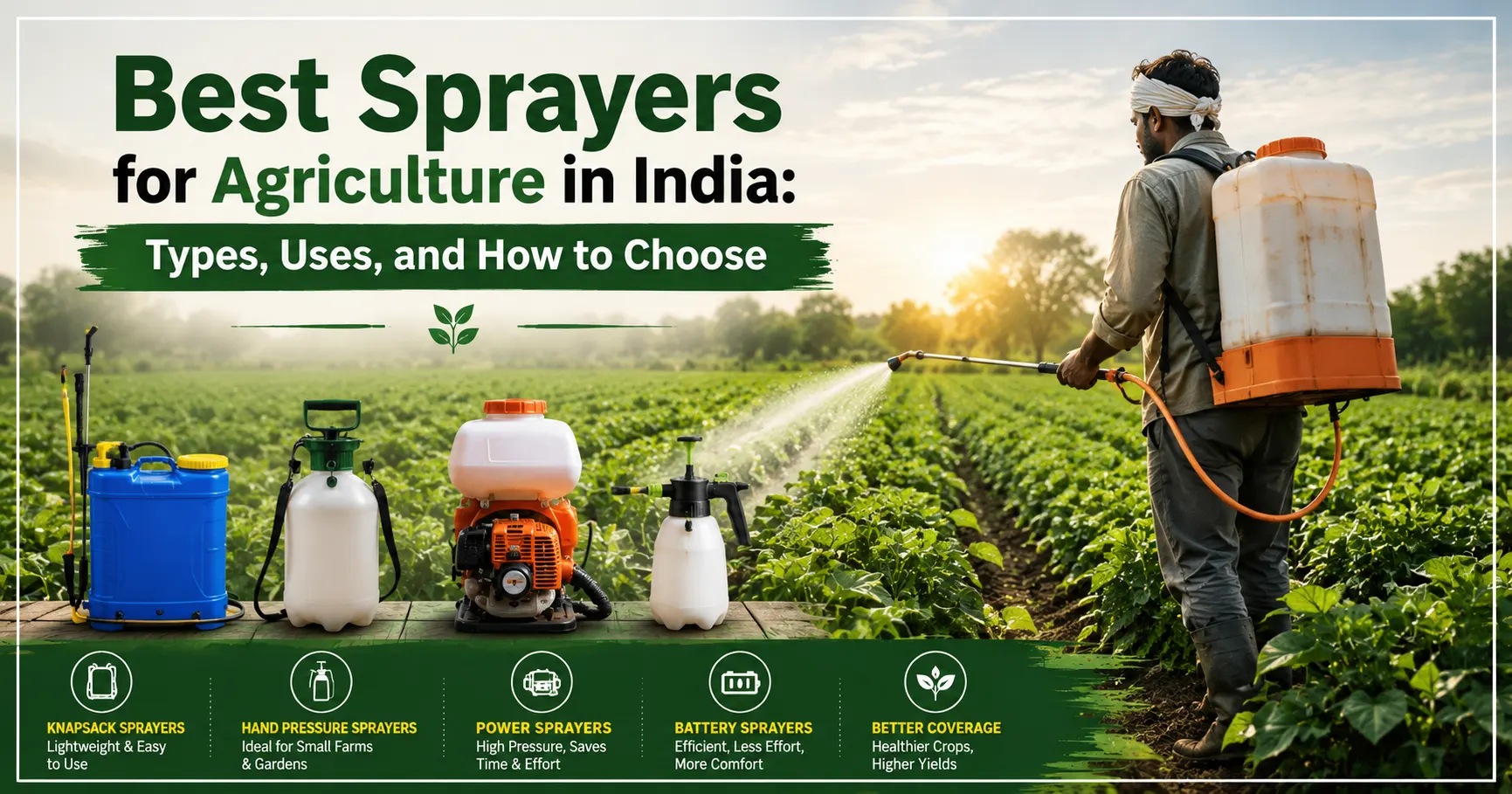
Best Sprayers for Agriculture in India: Types, Uses, and How to Choose
Posted on August 10, 2026
Spraying is an important part of crop management for many Indian farmers. Whether growing cotton in Gujarat, wheat in Punjab, paddy in West Bengal, soybean in Madhya Pradesh, sugarcane in Uttar Pradesh, or vegetables in Maharashtra, farmers often need an effective way to apply crop protection products and other approved agricultural inputs.
For decades, farmers have used manually operated spray pumps. Today, the market offers everything from simple hand sprayers and battery-operated knapsack models to petrol-powered machines, tractor-mounted systems, and agricultural drones.
But which agricultural sprayer is best?
There is no single answer. A farmer with two acres of vegetables has very different requirements from someone managing 50 acres of wheat. Crop height, field size, spraying frequency, labour availability, budget, and the product being applied all influence the decision.
This guide explains the main types of agricultural sprayers available in India, where each one works best, and what farmers should check before buying.
1. Hand Compression Sprayer
A hand compression sprayer is one of the simplest options available to Indian farmers and home growers.
These sprayers usually have a small tank that is pressurised manually. The operator pumps the handle to build pressure and then sprays the liquid through a nozzle.
Because of their limited capacity, hand sprayers are generally not practical for spraying large agricultural fields. However, they are useful for nurseries, kitchen gardens, small vegetable plots, and spot treatment.
They can also be convenient when only a small number of plants need attention rather than an entire field.
The biggest advantages are simplicity and low maintenance. There is no battery to charge and no petrol engine to maintain.
Best for: Nurseries, kitchen gardens, small vegetable plots, individual plants, and spot spraying.
Common Indian name: Hand spray pump (haath ka spray pump)
Main advantage: Simple, affordable, and easy to carry.
Keep in mind: Limited tank capacity and unsuitable for large fields.
2. Manual Knapsack Sprayer
The manual knapsack sprayer is one of the most familiar agricultural spraying tools in rural India.
As the name suggests, the tank is carried on the operator’s back like a backpack. The farmer uses a hand lever to pump and spray the liquid onto crops.
These sprayers commonly come with tank capacities suitable for small-scale field operations and are widely used because they do not require electricity, batteries, or fuel.
A manual knapsack sprayer can be a practical choice for farmers with smaller landholdings or those who spray only occasionally.
The main limitation is physical effort. Carrying a filled tank while continuously operating the lever can become tiring, particularly in hot weather or over a large field.
Best for: Small farms, vegetables, pulses, cotton, and general crop spraying.
Common Indian name: Spray pump, hand pump, or peeth wala spray pump.
Main advantage: Affordable and independent of fuel or electricity.
Keep in mind: Requires continuous manual effort.
3. Battery-Operated Knapsack Sprayer
Battery-operated sprayers have become a popular alternative to traditional manual pumps in India.
Instead of repeatedly operating a lever, an electric pump powered by a rechargeable battery creates the required spraying pressure.
This makes spraying less physically demanding.
For farmers who regularly spray vegetables, cotton, chilli, groundnut, pulses, or other crops, a battery sprayer can offer a good balance between price and convenience.
Many models use tanks of around 12-20 litres, although capacity varies by manufacturer. Some machines also offer adjustable pressure, multiple nozzle options, battery indicators, and different spray patterns.
Battery quality is particularly important. A low-quality battery may lose capacity, leaving the farmer unable to finish spraying the field.
Best for: Small and medium farms, vegetables, cotton, chilli, pulses, and frequent spraying.
Common Indian name: Battery spray pump or battery pump.
Main advantage: Requires much less manual pumping.
Keep in mind: Battery life, charging time, replacement cost, and local service availability.
4. Solar-Powered Agricultural Sprayer
Solar sprayers offer another option for farmers who want to reduce dependence on manual pumping or grid electricity.
These systems generally use solar energy to charge or operate a battery-powered spraying system.
Solar sprayers can be particularly useful in rural areas where electricity supply is unreliable, but sunlight is readily available.
However, farmers should evaluate these machines carefully. The quality of the solar panel, battery, pump, controller, and overall construction can vary considerably between products.
A solar sprayer should not be purchased simply because “solar” appears on the label. Farmers should compare actual battery capacity, charging performance, pressure, warranty, spare parts, and service support.
Best for: Small and medium farms, remote agricultural areas, and farmers interested in reducing dependence on conventional charging.
Common Indian name: Solar spray pump.
Main advantage: Can use solar energy for charging.
Keep in mind: Performance depends heavily on the battery and solar system.
5. Petrol Power Sprayer
When more spraying pressure and faster operation are required, a petrol-powered sprayer can be a practical option.
These machines use a small petrol engine to operate the pump. They provide stronger and more consistent spray pressure than manual or battery sprayers.
Power sprayers are often useful for crops where farmers need greater spray reach or need to cover a larger area.
Depending on the machine configuration, they may be used in orchards, vegetable farms, cotton fields, plantations, and other agricultural applications.
The main disadvantages are fuel cost, engine noise, maintenance, and additional weight.
Best for: Orchards, vegetables, cotton, plantations, and medium-sized agricultural operations.
Common Indian name: Petrol spray pump or power sprayer.
Main advantage: Higher and more consistent spraying pressure.
Keep in mind: Petrol consumption and engine maintenance increase operating costs.
6. HTP Sprayer
HTP sprayers are commonly used where farmers need high-pressure spraying over a larger area.
They generally refer to a high-pressure pump system. The unit may be operated using an engine or motor and connected to a tank and long spray hose.
These sprayers are frequently used in orchards and horticultural operations because the higher pressure can help the spray reach plants or trees more effectively when the equipment and nozzle are correctly selected.
A long hose also allows the operator to move through the field while keeping the main pumping unit in one location.
HTP sprayers are more powerful than basic knapsack models, but they also require more investment and maintenance.
Best for: Orchards (bagicha), horticulture, vegetables, and larger spraying jobs.
Common Indian name: HTP pump or high-pressure spray pump.
Main advantage: Strong pressure and the ability to work with longer hoses.
Keep in mind: Requires a suitable engine or motor, maintenance, and proper pressure adjustment.
7. Portable Mist Blower
A mist blower is useful where fine droplets and greater spray reach are required.
Unlike a conventional sprayer that mainly relies on liquid pressure, a mist blower uses high-speed air to carry droplets towards the crop.
Best for: Orchards, vineyards, plantations, and dense crops.
Common Indian name: Mist blower or petrol spray machine.
Main advantage: Good spray reach and coverage in dense vegetation.
Keep in mind: Drift management, fuel use, machine weight, and correct protective equipment.
8. Tractor-Mounted Sprayer
For larger farms, carrying a sprayer on the back is inefficient.
A tractor-mounted sprayer provides a much larger tank and uses the tractor to move the spraying system through the field.
Depending on the model, the pump may operate through the tractor’s PTO (Power Take-Off). The system can be fitted with different spray arrangements for field crops or specialised applications.
The larger tank reduces the number of refilling stops, while mechanised movement allows more land to be covered.
However, tractor-mounted sprayers require sufficient field access. They may not be suitable for very small plots, narrow crop spacing, wet fields, or locations where a tractor cannot move easily.
Best for: Medium and large farms, wheat, cotton, soybean, pulses, and commercial agriculture.
Common Indian name: Tractor spray machine or tractor-mounted spray pump.
Main advantage: Larger capacity and faster field coverage.
Keep in mind: Requires a tractor and sufficient space to operate.
9. Boom Sprayer
A boom sprayer is one of the more efficient options for uniform spraying across large, relatively open fields.
The “boom” is a long horizontal structure fitted with multiple nozzles. As the tractor or vehicle moves through the field, the nozzles spray a wide strip in one pass.
This design can improve uniformity and reduce the number of passes required compared with a single-nozzle system.
Boom sprayers can be particularly useful for crops planted across large, accessible fields.
However, nozzle selection, boom height, operating pressure, tractor speed, and calibration all matter. Incorrect settings can lead to uneven application, missed areas, or overlapping spray.
Best for: Large fields, cereals, pulses, soybeans, cotton, and commercial farms.
Common Indian name: Boom spray machine or tractor boom sprayer.
Main advantage: Wide and relatively uniform field coverage.
Keep in mind: Calibration and correct operating speed are essential.
10. Agricultural Drone Sprayer
Agricultural drones, commonly called Kisan Drones in India, represent a newer approach to crop spraying.
Instead of a worker walking through the field or a tractor driving between crops, the drone flies above the field and applies the approved agricultural product from the air.
This can reduce direct worker exposure during spraying and allows operations in places where ground equipment may be difficult to use.
Drones can also cover agricultural land relatively quickly under suitable conditions. They may be particularly useful where labour is difficult to find or when entering the crop with a tractor could cause damage.
However, purchasing a drone is considerably more expensive than buying a knapsack sprayer. Farmers also need to consider training, batteries, maintenance, regulatory requirements, operating procedures, and whether the product being applied is approved for the intended method of application.
For many small farmers, hiring a drone spraying service may make more financial sense than buying a drone.
Best for: Precision spraying, larger farms, Farmer Producer Organisations (FPOs), custom hiring businesses, and difficult-to-access fields.
Common Indian name: Kisan Drone or drone spray machine.
Main advantage: Fast operation with less need for workers to walk through the treated field.
Keep in mind: Higher investment, training, regulations, weather limitations, and service availability.
Which Agricultural Sprayer Is Best for Your Farm?
The right sprayer depends primarily on how much land needs to be covered and what is being grown.
For a small vegetable plot or nursery, a hand or manual knapsack sprayer may be enough.
A farmer managing several acres and spraying regularly may find a battery-operated sprayer more comfortable and practical.
For orchards such as mango (aam), pomegranate (anar), guava (amrud), citrus, or other fruit crops, a power sprayer, HTP sprayer, or mist blower may provide better reach depending on tree size and application requirements.
Medium and large-field crop farms may benefit from tractor-mounted or boom sprayers.
Agricultural drones can be useful when speed, difficult field access, labour availability, or crop damage from ground machinery becomes a concern.
What to Check Before Buying an Agricultural Sprayer
Indian farmers should compare more than tank capacity and price.
Tank capacity: A larger tank means fewer refills but also adds weight. This is particularly important with backpack models.
Pump pressure: The required pressure depends on the application, nozzle, crop, and sprayer type. More pressure is not automatically better.
Nozzle quality: The nozzle controls the spray pattern and droplet characteristics. Different applications may require different nozzle types.
Battery: For electric sprayers, check the battery capacity, charging time, operating time, warranty, and replacement options.
Engine: Petrol sprayer buyers should compare engine reliability, fuel consumption, servicing requirements, and spare-parts availability.
Weight: A 16-litre backpack sprayer becomes considerably heavier after filling. Farmers should consider operator comfort, not just machine weight when empty.
Spare parts: Nozzles, hoses, pumps, batteries, seals, switches, and lances eventually need replacement. Local availability can be more valuable than saving a small amount on the initial purchase.
Service network: Buying from a recognised dealer or manufacturer with service support can reduce downtime during the crop season.
Correct Nozzle Selection Is Just as Important as the Sprayer
Farmers often spend significant time comparing spray pumps but pay less attention to the nozzle.
That can be a mistake.
The nozzle affects spray pattern, flow rate, droplet size, and ultimately how the product reaches the target.
A nozzle suitable for one application may not be appropriate for another. The correct selection depends on the crop, target, product label, required water volume, operating pressure, and environmental conditions.
Worn-out nozzles can also deliver an incorrect amount of liquid.
Farmers should therefore inspect nozzles regularly and replace damaged or excessively worn components.
How to Use Agricultural Sprayers Safely
Sprayers are often used for pesticides, herbicides, and fungicides, so safe handling is essential. Always follow the product label, wear suitable PPE, avoid spraying in strong winds, and keep chemicals away from people, animals, and water sources. Clean the sprayer after use and never reuse empty pesticide containers. If exposure occurs, follow the label instructions and seek medical help if needed.
Battery Sprayer vs Manual Sprayer: Which Is Better?
For many small Indian farmers, this is one of the most practical comparisons.
A manual sprayer is generally simpler and does not depend on charging. It may also cost less and have fewer electrical parts that can fail.
A battery sprayer, however, reduces the physical effort required for pumping. This can make a noticeable difference when spraying several tanks in one day.
If electricity or charging facilities are readily available and the farmer sprays frequently, a good-quality battery model can be worth considering.
For occasional spraying or areas where charging and battery replacement are difficult to access, a manual model remains a practical choice.
Some sprayers even provide both battery and manual operation, giving the farmer a backup if the battery runs out.
How Much Sprayer Capacity Does an Indian Farmer Need?
Choose sprayer capacity based on farm size and usage. For backpack sprayers, larger tanks can become too heavy. Bigger fields may need trolley, tractor-mounted, or boom sprayers. Always follow the product label and calibrate the sprayer before use.
Sprayers and the Future of Indian Farming
Agricultural spraying in India is gradually moving from manual labour towards more efficient and precise systems.
Battery-operated sprayers have already made mechanised spraying more accessible to small farmers. Tractor-mounted machines and boom sprayers support larger operations, while drones are introducing a completely different approach to aerial application.
In the future, technologies such as GPS, sensors, automated section control, variable-rate application, smart nozzles, and drones may help farmers apply agricultural inputs more precisely.
However, India’s farming sector will continue to need affordable equipment.
A small farmer does not necessarily need the most advanced machine. A reliable battery sprayer costing a fraction of a large mechanised system may provide all the functionality required for that farm.
Technology is useful when it solves a real farming problem, not simply because it is new.
Final Thoughts
The best agricultural sprayer in India depends on farm size, crop type, and spraying needs. Manual and battery sprayers suit smaller farms, while petrol, HTP, tractor-mounted, and boom sprayers are better for larger or more demanding applications. Kisan Drones are also becoming useful for precision spraying.
Before buying, compare tank capacity, pressure, nozzle options, maintenance spare parts, and operating costs. The best spray pump (dawai chhidakne ki machine) is one that is reliable, easy to maintain, suitable for the crop, and safe to use.