
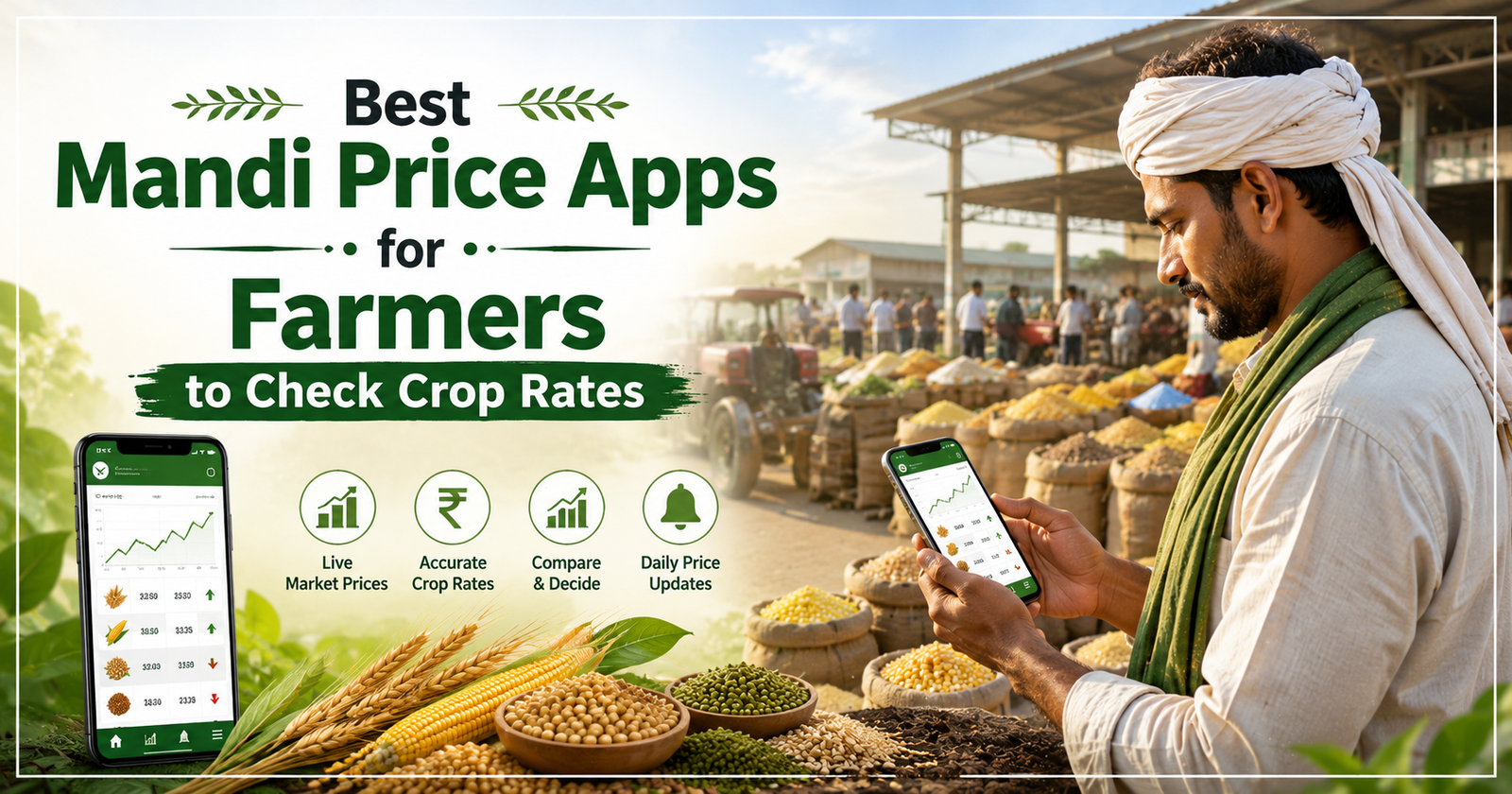
Best Mandi Price Apps for Farmers to Check Crop Rates
Posted on June 12, 2026
Before leaving for the mandi, a farmer often stands near the tractor or tempo with one question in mind: “Should I sell today or wait?”
The crop is ready. The bags are packed. The labour cost is already paid. But the price is still uncertain. In many Indian villages, crop selling has always depended on phone calls, local traders, neighbours, and yesterday’s mandi news. Sometimes the farmer gets the right price. Sometimes he reaches the mandi only to find that the rate has fallen by morning.
Farmers can use mandi price apps before deciding when and where to sell. A simple mobile phone can now show crop rates, mandi bhav, arrivals, and market trends before the farmer even leaves home.
For Indian farmers, checking crop prices is not just about curiosity. It is about bargaining power. It helps them decide where to sell, when to sell, and whether the current market rate is fair. The best mandi price apps for farmers are not only digital tools. They are small decision-making partners in the farmer’s pocket.
Why Farmers Need Mandi Price Apps Today
A farmer may grow wheat, cotton, soybeans, onions, tomatoes, groundnuts, paddy, chana, maize, mustard, or vegetables. But growing the crop is only one part of the journey. Selling at the right price is equally important.
Many farmers still depend on the nearest local mandi because transport cost, time, and storage are practical concerns. But even when selling locally, knowing the mandi rate helps the farmer speak with confidence. If soybeans are selling at a better price in a nearby market, the farmer can negotiate a better price or a place to sell.
Mandi price apps for farmers in India help by showing daily crop rates, commodity prices, market arrivals, and sometimes state-wise or district-wise mandi bhav. These apps are especially useful for small and medium farmers who cannot personally visit multiple mandis before selling.
eNAM App: For Farmers Who Want Wider Market Access
The eNAM app is one of the most important agriculture market price apps in India because it is connected with the National Agriculture Market system. For many farmers, eNAM is not just an app to check rates. It represents the idea that agricultural markets can become more transparent and connected.
A farmer who uses eNAM can check arrivals, price-related information, and market activity. The app is useful for farmers, traders, and other stakeholders who want access to digital mandi information.
Think of a farmer in Rajasthan who grows mustard. Earlier, he may have depended only on the local trader’s word. Now, with mandi price information available digitally, he can compare the situation better before making a decision. This may not solve every marketing challenge, but it helps farmers understand market prices better before selling their crops.
For farmers searching for the best mandi price app in India, eNAM should be one of the first platforms to explore.
Kisan Suvidha App: A Simple App for Everyday Farming Decisions
Kisan Suvidha is a farmer-focused app that brings multiple agriculture services into one place. For many farmers, this type of app is useful because they do not want ten different apps for ten different needs.
The app provides farming-related information, including weather, advisories, and market price details. The mandi price section helps farmers check crop rates and compare prices. This is especially useful when a farmer wants a quick view of the latest market price before planning a sale.
For example, a vegetable farmer may check tomato or onion rates before deciding whether to send produce early in the morning or wait for the next market day. A grain farmer may compare prices before arranging transport.
Kisan Suvidha works well for farmers who want a broader agriculture app, not only a mandi bhav app.
AGMARKNET: A Reliable Source for Mandi Price Information
AGMARKNET is an important source of agricultural market information in India. It provides government mandi data on crop prices and commodity rates. Farmers can access this information through official portals or apps that present the same data in a simpler and easier-to-read format.
For farmers, the value of AGMARKNET is trust. When checking mandi rates, the source of data matters. A crop price shared through a random forwarded message may be outdated, incorrect, or incomplete. Official market data is more reliable and helps farmers make better selling decisions.
AGMARKNET-style mandi price information is useful for crops such as wheat, paddy, maize, pulses, oilseeds, fruits, and vegetables. Farmers should check the date, mandi name, commodity variety, minimum price, maximum price, and modal price before relying on the rate.
The modal price is especially important because it often reflects the most common trading price in that mandi for that commodity.
Mandi Bhav Apps: Useful for Quick Local Price Updates
Many farmers search directly for “mandi bhav app” because that is the phrase they use in daily life. Several private apps provide mandi bhav updates in Hindi and regional languages. These apps often cover crops like onion, potato, tomato, wheat, soybean, cotton, mustard, groundnut, garlic, cumin, and pulses.
The biggest advantage of these apps is simplicity. A farmer can open the app, choose the state, district, mandi, and crop, and check the latest price. Some apps also provide agriculture news, weather updates, and crop-related information.
However, farmers should be careful. Not every private mandi rate app updates prices at the same speed or from the same source. Before making a major selling decision, it is better to cross-check the price with eNAM, AGMARKNET, local mandi sources, or trusted traders.
A mandi bhav app is very useful, but it should be treated as a guide, not the only final authority.
Mandi Central and Market-Focused Apps
Some apps are designed not only for farmers but also for traders, brokers, procurement companies, and agri-business users. Mandi Central is an example of a market-focused agriculture app that provides mandi prices, agriculture news, and trading-related information.
These apps may be useful for farmers who sell larger quantities or deal with traders. They can also help farmers understand how prices are moving across markets.
A cotton farmer, for example, may not only want today’s mandi rate. He may want to understand whether prices are improving, whether arrivals are high, and whether demand is active. Market-focused apps can support this kind of thinking.
State-Specific Mandi Price Apps
India’s agricultural market is highly local. A farmer in Gujarat may care about APMC rates in Rajkot, Unjha, Gondal, Jamnagar, or Vadodara. A farmer in Maharashtra may want rates from Lasalgaon, Pune, Nashik, Nagpur, or Solapur. A farmer in Madhya Pradesh may check soybean and wheat rates from Indore, Ujjain, Dewas, or Mandsaur.
This is why state-specific mandi price apps can be useful. State-specific apps are useful because they show mandi prices from nearby markets, including Gujarat, Maharashtra, Rajasthan, and Madhya Pradesh.
For farmers, local language also matters. An app in Hindi, Gujarati, Marathi, Punjabi, Kannada, Telugu, or Tamil can be easier to use than an English-only app.
How Farmers Should Use Mandi Price Apps Wisely
Smart farmers do not check mandi prices only on the day they plan to sell. They follow the rates to understand market trends before making a decision.
If the crop rate is rising slowly, the farmer may wait if storage is possible. If the rate is falling and arrivals are increasing, selling early may be better. If one nearby mandi is showing a stronger price, the farmer can calculate whether the transport cost is worth it.
A good mandi price app should help answer four questions:
Which mandi is giving a better rate?
What is today’s crop price?
Is the price higher or lower than last week?
Will transport and commission costs still make the sale profitable?
When farmers use apps this way, mobile technology becomes more than a tool for checking numbers. It helps them make smarter selling decisions.
Final Thoughts
The best mandi price apps for farmers are the ones that provide timely, reliable, and easy-to-understand crop price information. eNAM, Kisan Suvidha, AGMARKNET-based platforms, mandi bhav apps, market-focused apps, and state-specific mandi price apps can all help in different ways.
But the real value is not in downloading the app. The real value is in using the information before making a decision.
A farmer who checks mandi rates before loading the produce is already one step ahead. Farmers may still face price changes, transport costs, and local market challenges. But he is no longer entering the mandi completely unaware.
In farming, every rupee matters. And sometimes, the difference between a weak sale and a better sale begins with one simple action: checking the mandi price before leaving home.