
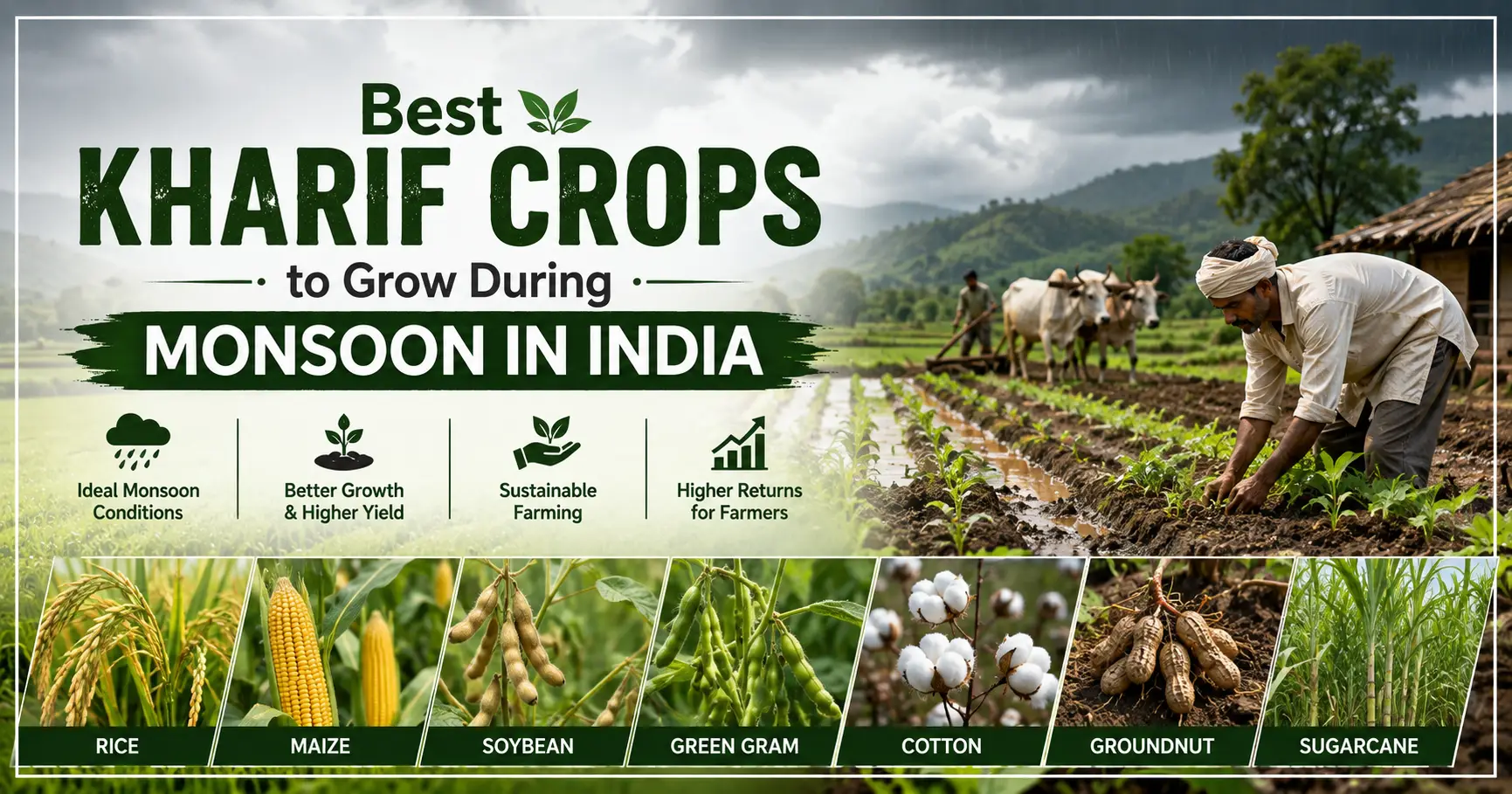
Best Kharif Crops to Grow During Monsoon in India
Posted on August 14, 2026
For millions of Indian farmers, the arrival of the monsoon is more than a change in weather. It marks the beginning of one of the most important farming seasons of the year, the Kharif season.
Kharif crops are generally sown with the arrival of the southwest monsoon, typically around June and July in many parts of India, and harvested from September onwards depending on the crop, variety, region, and sowing time.
Rice, maize, cotton, soybean, groundnut, bajra, and several pulses are among the major crops grown during this period.
However, choosing a Kharif crop should not be based only on what neighbouring farmers are growing. Rainfall, soil type, irrigation availability, local climate, crop duration, input costs, and market demand can all affect the final result.
A farmer in Rajasthan receiving limited rainfall will have very different options from a farmer working in a high-rainfall region of Assam or West Bengal.
So, which crops are suitable for the Indian monsoon?
Here are some of the best Kharif crops Indian farmers can consider, along with their general growing requirements and important factors to keep in mind.
What Are Kharif Crops?
Kharif crops are crops primarily associated with India’s monsoon season.
Farmers usually begin preparing their fields before the monsoon. Sowing then takes place according to local rainfall and recommended agricultural schedules.
The exact timing varies across India.
For example, monsoon conditions may arrive in Kerala before they reach Gujarat, Rajasthan, Punjab, or northern India. Farmers should therefore follow local weather conditions and agricultural advisories rather than using one fixed sowing date for the entire country.
Many Kharif crops prefer warm conditions and benefit from seasonal rainfall.
Common examples include:
- – Rice (dhan/chawal)
- – Maize (makka)
- – Cotton (kapas)
- – Soybean
- – Groundnut (moongfali)
- – Pearl millet (bajra)
- – Sorghum (jowar)
- – Pigeon pea (tur/arhar)
- – Green gram (moong)
- – Black gram (urad)
Let’s look at these crops in more detail.
1. Rice (Dhan)
Rice, commonly called dhan while referring to the crop and chawal after processing, is one of India’s most important Kharif crops.
It is widely cultivated in states such as West Bengal, Uttar Pradesh, Punjab, Telangana, Andhra Pradesh, Chhattisgarh, Odisha, Bihar, Assam, Tamil Nadu, and several other regions.
Rice is strongly associated with the monsoon because many traditional paddy-growing systems require substantial water.
However, not every rice variety or cultivation method has the same water requirement. Farmers now have access to different varieties and production methods suited to irrigated, rain-fed, upland, and other conditions.
Rice is generally better suited to areas where sufficient water is available throughout critical stages of crop development.
Common Indian name: Dhan / Chawal
Suitable conditions: Warm weather with adequate water availability.
Commonly grown in: West Bengal, Uttar Pradesh, Punjab, Telangana, Andhra Pradesh, Odisha, Chhattisgarh, Bihar, Assam, and other states.
Why farmers grow it: Strong domestic demand and its importance as a staple food.
Keep in mind: Water availability, drainage, variety duration, pests, diseases, and local cultivation methods.
2. Maize (Makka)
Maize, or makka, is another important crop grown during the Kharif season.
It is cultivated for human consumption, poultry and livestock feed, starch, processing, and other industrial uses.
Maize is grown across states including Karnataka, Madhya Pradesh, Maharashtra, Bihar, Rajasthan, Uttar Pradesh, and Telangana.
Unlike paddy, maize does not perform well when fields remain waterlogged for long periods. Good drainage is therefore particularly important during heavy monsoon rainfall.
Farmers should also pay attention to plant population, nutrient management, and pest monitoring.
The crop’s multiple end uses can make maize attractive, but local market access should be checked before choosing a hybrid and planting area.
Common Indian name: Makka / Makai
Suitable conditions: Warm climate with moderate rainfall and good drainage.
Why farmers grow it: Demand from the food, feed, poultry, starch, and processing industries.
Keep in mind: Avoid prolonged waterlogging and choose hybrids suited to local conditions.
3. Cotton (Kapas)
Cotton, or kapas, is one of India’s most important commercial Kharif crops.
It is widely cultivated in Gujarat, Maharashtra, Telangana, Rajasthan, Madhya Pradesh, Punjab, Haryana, Karnataka, and other cotton-producing areas.
Cotton generally requires a relatively long growing period. It benefits from moisture during establishment and vegetative growth but does not perform well under prolonged waterlogging.
Black cotton soil, commonly called kali mitti, is well known for cotton cultivation because of its moisture-holding properties. However, cotton is also grown in other suitable soils under appropriate management.
Pest management is a major consideration. Farmers need to monitor the crop throughout the season rather than waiting until pest damage becomes severe.
Common Indian name: Kapas
Suitable conditions: Warm climate, suitable soil, and well-distributed moisture with good drainage.
Why farmers grow it: Strong demand from India’s textile and related industries.
Keep in mind: Pest pressure, crop duration, input costs, drainage, and market prices.
4. Soybean
Soybean has become an important Kharif crop, particularly in central India.
Madhya Pradesh, Maharashtra, and Rajasthan are among the major soybean-producing states.
The crop is valued for its oil and protein content and is used by the edible oil, animal feed, and food-processing industries.
Soybeans can fit well into rain-fed farming systems, but excessive standing water can damage the crop. Field drainage becomes especially important when heavy rain falls over a short period.
Timely sowing can also affect plant establishment and yield potential.
Farmers should select recommended varieties based on local conditions and consider crop duration when planning the next Rabi crop.
Common Indian name: Soybean
Suitable conditions: Warm monsoon conditions with well-drained soil.
Why farmers grow it: Demand from the edible oil, feed, and processing sectors.
Keep in mind: Drainage, timely sowing, seed quality, diseases, and market prices.
5. Groundnut (Moongfali)
Groundnut, commonly known as moongfali, is an important oilseed crop in India.
Gujarat is particularly well known for groundnut production, while the crop is also grown in Rajasthan, Tamil Nadu, Andhra Pradesh, Karnataka, Maharashtra, and other states.
Groundnut generally performs well in loose, well-drained soils because its pods develop below the ground.
Heavy waterlogging can create serious problems. This makes field drainage especially important during the monsoon.
The crop is used for edible oil, direct consumption, snacks, animal feed, and food processing.
Farmers should consider variety, soil type, rainfall pattern, and expected market demand when planning the crop.
Common Indian name: Moongfali / Singdana
Suitable conditions: Warm weather and well-drained, relatively loose soil.
Why farmers grow it: Demand for edible oil, food, and snacks.
Keep in mind: Avoid waterlogged fields and manage soil conditions carefully.
6. Pearl Millet (Bajra)
Pearl millet, or bajra, is particularly important for farmers in lower-rainfall and drier areas.
It is widely cultivated in Rajasthan, Uttar Pradesh, Haryana, Gujarat, Maharashtra, and other regions.
One of bajra’s biggest strengths is its ability to grow under relatively dry conditions compared with crops that require substantially more water.
This makes it an important Kharif option in rain-fed and semi-arid regions.
Bajra is consumed as food and is also used as livestock feed and fodder.
Interest in millets has increased in recent years as consumers rediscover traditional grains for their nutritional value.
Common Indian name: Bajra
Suitable conditions: Warm and relatively dry; suitable for lower-rainfall areas.
Why farmers grow it: Drought tolerance, food and fodder value, and suitability for rain-fed farming.
Keep in mind: Select locally recommended varieties and match sowing with rainfall.
7. Sorghum (Jowar)
Sorghum, commonly called jowar, is another traditional Indian millet crop.
It is grown for grain, animal feed, and fodder.
Maharashtra, Karnataka, Madhya Pradesh, Telangana, and other states have long traditions of jowar cultivation.
Jowar can tolerate relatively dry conditions and is suitable for several rain-fed farming systems.
Jowar can grow in areas with limited or irregular rainfall. It is also widely used in Indian foods such as jowar roti and bhakri.
Common Indian name: Jowar
Suitable conditions: Warm climate and moderate to low rainfall, depending on the variety.
Why farmers grow it: Food, fodder, livestock feed, and adaptability to drier environments.
Keep in mind: Choose a variety according to whether grain, fodder, or both are the main objective.
8. Pigeon Pea (Tur/Arhar)
Pigeon pea is widely known as tur or arhar in India.
It is the crop behind one of India’s most commonly consumed dals – tur dal or arhar dal.
Maharashtra, Karnataka, Madhya Pradesh, Gujarat, Telangana, and Uttar Pradesh are among the states where pigeon pea is cultivated.
As a pulse crop, pigeon pea belongs to the legume family. Legumes can contribute to farming systems through their association with nitrogen-fixing bacteria.
Pigeon pea can also handle relatively dry conditions once established, although crop performance still depends on variety, rainfall, soil, and management.
The crop duration can be longer than some other Kharif pulses, so farmers should consider how it fits into their annual cropping schedule.
Common Indian name: Tur / Arhar
Suitable conditions: Warm climate with moderate rainfall and good drainage.
Why farmers grow it: Strong household demand for dal and suitability for several rain-fed regions.
Keep in mind: Crop duration, drainage, pod-related pests, and local variety selection.
9. Green Gram (Moong)
Green gram, commonly called moong, is a short-duration pulse crop that can be grown in different seasons depending on the region.
During Kharif, it can be a useful option for farmers looking for a relatively short-duration crop.
Moong is consumed widely across India as dal, sprouts, snacks, and other foods.
Short-duration crops can give farmers more flexibility to plan and sow the next crop on time. However, excessive rainfall and waterlogging can create problems.
Common Indian name: Moong
Suitable conditions: Warm weather, moderate rainfall, and good drainage.
Why farmers grow it: Short duration, strong demand, and usefulness in crop rotation.
Keep in mind: Waterlogging, disease pressure, and timely harvesting.
10. Black Gram (Urad)
Black gram, or urad, is another important pulse crop grown during the Kharif season.
Urad dal is widely consumed in Indian households and is also essential for foods such as idli, dosa, vada, papad, and dal preparations.
The crop is grown in several states, including Madhya Pradesh, Uttar Pradesh, Rajasthan, Maharashtra, Andhra Pradesh, Tamil Nadu, and others.
Like moong, urad is a legume and can fit into different crop rotations.
It generally needs well-drained soil. Excessive moisture and prolonged waterlogging can affect crop health, especially during heavy monsoon periods.
Common Indian name: Urad / Urad dal
Suitable conditions: Warm weather, moderate rainfall, and well-drained soil.
Why farmers grow it: Strong demand in Indian food markets and relatively flexible cropping opportunities.
Keep in mind: Drainage, disease management, variety selection, and harvest timing.
How to Choose the Right Kharif Crop for Your Farm
Looking at a list of popular crops is only the first step. The best Kharif crop depends on the farmer’s actual field conditions.
Check Your Local Rainfall
Start with expected rainfall.
If your region receives high and reliable monsoon rainfall and has suitable field conditions, crops such as paddy may be an option.
For lower-rainfall areas, bajra, jowar, pulses, or other crops adapted to dry conditions may be more practical.
However, rainfall totals alone do not tell the full story.
Receiving 500 mm of rain evenly over several weeks is very different from receiving much of it in a few heavy storms.
Understand Your Soil
Indian farmers commonly refer to soil types as kali mitti (black soil), lal mitti (red soil), jalodh mitti (alluvial soil), and sandy or light soils.
Different crops respond differently to these conditions.
Cotton is famously associated with black soil, while groundnut benefits from well-drained soil.
A soil test can provide more reliable information about pH, nutrients, organic carbon, and other characteristics before fertilizer planning.
Consider Irrigation Availability
Kharif farming should not automatically be treated as rain-only farming.
Monsoon rainfall can stop unexpectedly for several days or weeks. If irrigation is available, farmers may be able to protect the crop during these dry periods.
Check Drainage
During the monsoon, too much water can sometimes be as damaging as too little.
Soybean, maize, cotton, groundnut, and many pulse crops can suffer when water remains in the field for long periods.
Preparing drainage channels before heavy rainfall can therefore be an important part of Kharif field preparation.
Kharif Crop Selection by Rainfall Conditions
Farmers should choose crops based on local rainfall and available water.
Higher water availability: Paddy and other crops suited to wetter conditions may be considered.
Moderate rainfall: Maize, soybeans, cotton, groundnuts, tur, moong, and urad may be options depending on soil and local climate.
Lower or uncertain rainfall: Bajra, jowar, and selected pulse varieties may provide greater flexibility.
These are broad categories rather than fixed recommendations. Farmers should follow crop-specific guidance from local agricultural experts.
Don’t Ignore the Market Before Sowing
Before choosing a crop, farmers should check local demand, mandi access, nearby processors, and expected prices. A good crop may still give poor returns if there is no strong market.
Crop planning should consider both growing conditions and selling opportunities.
Kharif Farming Tips for Indian Farmers
- – Choose certified seeds suitable for your local climate and soil.
- – Prepare proper drainage before heavy monsoon rains.
- – Use seed treatment where recommended.
- – Apply fertilizers based on soil-test results.
- – Regularly check crops for weeds, pests, and diseases.
- – Follow Integrated Pest Management (IPM) practices.
- – Check local weather forecasts before important farm activities.
- – Follow local agricultural advice instead of relying on social media.
Where Can Farmers Get Local Kharif Crop Advice?
India has a large agricultural extension and research network.
Farmers can seek guidance from their nearest Krishi Vigyan Kendra (KVK), state agriculture department, agriculture university, or qualified agricultural adviser.
These organisations can provide more location-specific recommendations on crop varieties, sowing windows, seed rates, fertilizers, pests, diseases, and other farming practices.
Weather and agricultural advisories can also help farmers make better decisions during a changing monsoon.
This local guidance is particularly valuable because Kharif conditions can differ even between neighbouring districts.
How Climate Variability Is Changing Kharif Farming
Indian farmers have always depended heavily on the monsoon, but changing rainfall patterns are making planning more challenging.
A season may include delayed monsoon arrival, long dry periods, sudden heavy rainfall, or unusually high temperatures.
This makes flexibility increasingly important.
Farmers may need to consider shorter-duration varieties, better field drainage, water harvesting, efficient irrigation, crop diversification, and varieties suited to local climate risks.
The goal should not always be to chase the crop with the highest theoretical yield.
A crop that delivers a slightly lower but more reliable return under local conditions may be a better business decision.
Kharif vs Rabi Crops: What Is the Difference?
India’s two major agricultural seasons are Kharif and Rabi.
Kharif crops are mainly associated with the monsoon. Sowing usually begins with the arrival of monsoon rains, while harvest time varies by crop.
Examples include rice, maize, soybean, cotton, bajra, and several pulses.
Rabi crops are mainly grown during the cooler winter season. They are generally sown after the monsoon and harvested during spring or early summer.
Wheat (gehun), mustard (sarson), gram (chana), and barley (jau) are familiar Rabi crops.
Some crops can be cultivated in more than one season depending on the region, variety, irrigation, and production system.
Final Thoughts
The Indian monsoon creates an important growing window for rice (dhan), maize (makka), cotton (kapas), soybean, groundnut (moongfali), pearl millet (bajra), sorghum (jowar), pigeon pea (tur/arhar), green gram (moong), and black gram (urad).
But the most popular Kharif crop is not automatically the best crop for every farmer.
A farmer in Rajasthan may benefit from choosing a crop that can handle limited rainfall, while a farmer in West Bengal may work with completely different water conditions. Farmers in Gujarat, Maharashtra, Madhya Pradesh, Karnataka, Telangana, Punjab, and other states also need to consider their local soil, rainfall patterns, irrigation, and markets.
Before sowing, evaluate rainfall, soil, drainage, irrigation, crop duration, and expected market demand.
Whenever possible, combine personal farming experience with recommendations from the local Krishi Vigyan Kendra (KVK), agricultural university, or state agriculture department.
The monsoon will always contain some uncertainty. Choosing a crop that matches local conditions, rather than simply following what is popular, gives Indian farmers a stronger foundation for a productive Kharif season.