
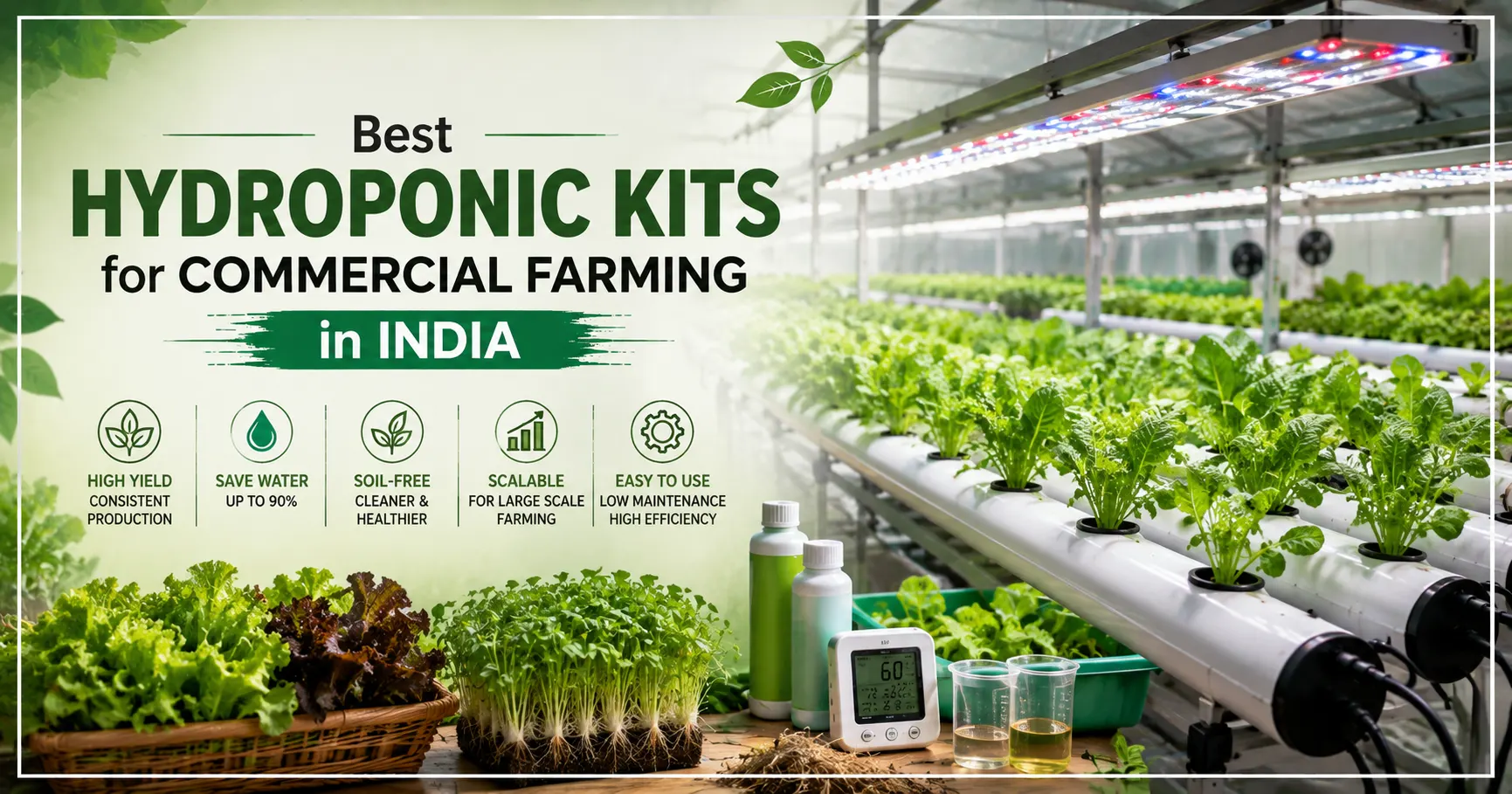
Best Hydroponic Kits for Commercial Farming
Posted on August 14, 2026
Farming without soil may once have sounded unusual, but hydroponics is gradually becoming a serious option for commercial growers in India. From leafy greens grown near Bengaluru and Pune to premium vegetables supplied to restaurants and supermarkets in Delhi, Mumbai, Hyderabad, and other cities, hydroponic farming is finding a place in modern Indian agriculture.
Hydroponics, often described simply as soil-less farming (bina mitti ki kheti), grows plants using water containing carefully managed nutrients instead of conventional soil.
For commercial farmers, however, hydroponics involves much more than putting plants into nutrient-rich water. A successful farm may require growing channels or containers, pumps, water tanks, filtration, nutrient dosing, monitoring equipment, suitable structures, and proper crop management.
This is why choosing the right hydroponic kit or system is important.
A small home hydroponic kit designed for 20 lettuce plants will not work for a farmer planning to supply 500 kg of produce every month. Commercial growers need scalable systems designed around the crop, available space, water quality, climate, labour, and target market.
Here are some of the best types of hydroponic kits and systems to consider for commercial farming in India.
1. NFT Hydroponic System
NFT, or Nutrient Film Technique, is one of the most widely recognised hydroponic systems.
The system is particularly popular for leafy vegetables because many plants can be arranged efficiently in rows.
For Indian commercial farms supplying fresh produce to supermarkets, restaurants, cloud kitchens, hotels, and direct customers, NFT can be a practical choice for crops that have relatively small root systems.
Since the nutrient solution is recirculated, the system can use water efficiently. However, farmers need reliable pumps and regular monitoring. If circulation stops for too long, especially during India’s hot summer months, plant roots can be affected quickly.
Best for: Lettuce, spinach (palak), basil (tulsi-type culinary basil varieties), pak choi, kale, and herbs.
Suitable commercial scale: Small to large farms.
Main advantage: Efficient use of growing space and water.
Keep in mind: Pump failure and high temperatures can quickly affect crops.
2. DWC or Deep Water Culture System
Deep Water Culture, commonly called DWC, grows plants with their roots suspended in an oxygenated nutrient solution.
A commercial variation is often called a raft or floating-raft system because plants are placed on floating boards above a large nutrient tank or growing bed.
DWC can be particularly useful for leafy vegetables.
Because the roots remain in the nutrient solution, maintaining sufficient dissolved oxygen is essential. Air pumps or other aeration systems are commonly used to provide oxygen.
DWC uses more water, which helps keep conditions around the plant roots more stable. However, managing water temperature becomes important in India’s warmer regions.
An excessively warm nutrient solution can reduce dissolved oxygen and create conditions that may increase the risk of root problems.
Best for: Lettuce, leafy greens, spinach (palak), kale, and selected herbs.
Suitable commercial scale: Medium to large operations.
Main advantage: Relatively stable nutrient availability and good suitability for leafy greens.
Keep in mind: Aeration and water-temperature management are critical.
3. Dutch Bucket Hydroponic System
The Dutch bucket, or Bato bucket, system is an excellent option for commercial growers interested in larger fruiting plants.
Plants are grown individually or in small groups in separate buckets filled with a growing medium.
A drip irrigation system supplies nutrient solution to each bucket. Excess solution can then drain away or return to the main reservoir depending on the system design.
For Indian farmers interested in premium greenhouse vegetables, Dutch buckets can provide greater control over irrigation and nutrition compared with conventional soil cultivation.
The system also makes individual plant management easier because each plant has its own growing container.
Best for: Tomato (tamatar), cucumber (kheera), capsicum (shimla mirch), and other fruiting crops.
Suitable commercial scale: Small to large commercial greenhouses.
Main advantage: Well suited to larger plants and high-value vegetables.
Keep in mind: Requires proper drip irrigation, drainage, support structures, and nutrient management.
4. Hydroponic Grow Bag System
Grow bags are already familiar to many Indian protected-cultivation farmers.
In a hydroponic or soilless grow-bag system, plants are grown in bags containing media such as cocopeat rather than agricultural soil. Nutrient solution is delivered through drip irrigation.
Cocopeat is particularly relevant to India because coconut-producing regions provide access to this widely used growing medium.
Commercial growers commonly use cocopeat grow bags for crops such as tomatoes, cucumbers, capsicum, and strawberries.
One advantage is that growers can control the root environment more precisely than in ordinary field soil.
Grow bags can also help avoid certain soil-related problems, although they do not eliminate the need for good hygiene, water management, and crop protection.
Best for: Tomatoes, cucumber, capsicum, strawberry, and other high-value crops.
Suitable commercial scale: Medium and large polyhouse or greenhouse farms.
Main advantage: Practical for commercial fruiting vegetables and compatible with drip fertigation.
Keep in mind: Drainage, cocopeat quality, irrigation scheduling, and nutrient management must be carefully controlled.
5. Vertical NFT Hydroponic System
Land prices can be a major challenge near Indian cities.
Vertical hydroponic systems attempt to solve this problem by using height as well as floor area.
Instead of arranging all growing channels at the same level, plants are grown across multiple layers or vertical structures.
For commercial farms near Bengaluru, Mumbai, Delhi NCR, Pune, Hyderabad, Chennai, Ahmedabad, and other urban markets, using space more efficiently can be attractive.
Best for: Lettuce, leafy greens, herbs, and compact crops.
Suitable commercial scale: Urban and peri-urban commercial farms.
Main advantage: Produces more plants from limited floor space.
Keep in mind: Light distribution, airflow, temperature, and electricity costs.
6. Hydroponic Fodder System
Hydroponics is not limited to vegetables.
Hydroponic fodder systems are designed to produce fresh green fodder (hara chara) from grains or seeds under controlled conditions, usually over a relatively short growing cycle.
In areas facing land or water constraints, producing fodder in a compact, controlled setup may appear attractive.
However, farmers should evaluate the economics carefully.
Fresh hydroponic fodder contains a high percentage of water, so comparing only the fresh weight with dry fodder can create a misleading picture. Feed quality, dry matter, seed cost, labour, electricity, animal nutrition requirements, and total cost per kilogram of useful nutrition should all be considered.
Best for: Dairy farms, cattle farms, livestock operations, and gaushalas.
Common Indian description: Hydroponic hara chara system.
Main advantage: Compact production of fresh green fodder.
Keep in mind: Evaluate nutritional value and economics rather than fresh weight alone.
7. Drip Hydroponic System
A drip hydroponic system delivers nutrient solution directly to each plant through small drip emitters.
The plants may grow in cocopeat, perlite, rockwool, or another suitable soilless medium.
This approach is highly adaptable and can be used for many commercial crops.
It is particularly useful for fruiting vegetables where individual plants need controlled amounts of water and nutrients throughout the day.
Drip systems can be designed as recirculating or drain-to-waste setups. Water quality should also be tested before designing the nutrient programme.
Best for: Tomato, cucumber, capsicum, strawberry, flowers, and other commercial crops.
Suitable commercial scale: Small to very large farms.
Main advantage: Precise delivery of nutrients and irrigation to individual plants.
Keep in mind: Emitters, filters, pumps, and irrigation lines require regular inspection.
8. Aeroponic Growing System
Aeroponics takes soil-less farming a step further.
Plant roots remain suspended in the air while a fine mist of nutrient solution is sprayed directly onto them. This gives roots access to both nutrients and oxygen.
Aeroponics can provide excellent control when designed and operated correctly. However, it is also technically demanding.
If the misting system fails, roots can dry quickly. Nozzle blockage, pump problems, water quality, and power interruptions can therefore become serious concerns.
In India, aeroponics may be more suitable for technically advanced commercial farms, research operations, specialised propagation, and certain high-value applications rather than first-time growers seeking a simple hydroponic setup.
Best for: Specialised crops, propagation, research, and high-tech commercial farming.
Suitable commercial scale: Specialised operations.
Main advantage: High level of root-zone control.
Keep in mind: Greater technical complexity and dependence on reliable equipment.
9. Climate-Controlled Greenhouse Hydroponic System
For serious year-round commercial production, the growing structure can be just as important as the hydroponic system inside it.
A climate-controlled greenhouse combines hydroponics with technologies designed to manage temperature, humidity, ventilation, irrigation, and other environmental conditions.
Depending on the location and crop, the structure may use fans, cooling pads, shade systems, foggers, sensors, automated irrigation, and environmental controllers.
Even a well-functioning NFT system may struggle in extreme heat if the growing structure is not suitable for local conditions.
Best for: Premium vegetables, leafy greens, herbs, and year-round commercial supply.
Suitable commercial scale: Medium to large professional farms.
Main advantage: Better environmental control and production consistency.
Keep in mind: Higher investment and electricity requirements.
10. Automated Commercial Hydroponic System
As a hydroponic farm becomes larger, manually checking every parameter becomes difficult.
Automated commercial systems can use sensors, controllers, dosing pumps, and software to monitor and adjust important growing conditions.
For example, the system may monitor pH and electrical conductivity (EC) and automatically add nutrient solution or make other controlled adjustments.
Some systems also monitor water temperature, air temperature, humidity, tank level, irrigation schedules, and other parameters.
Automation can reduce repetitive labour and improve consistency, but farmers should not treat it as a replacement for crop knowledge.
Sensors can fail. Dosing pumps can malfunction. Calibration can drift.
Best for: Medium and large commercial hydroponic farms.
Suitable commercial scale: Professional operations requiring consistent production.
Main advantage: Greater control and reduced manual monitoring.
Keep in mind: Requires investment, calibration, maintenance, and trained staff.
What Should a Commercial Hydroponic Kit Include?
A commercial hydroponic setup is much more than a few pipes and a water pump.
Depending on the system, a complete setup may include:
- – Growing channels, buckets, beds, or grow bags
- – Water or nutrient reservoir
- – Water pumps
- – Air pumps and aeration equipment
- – Filters
- – Irrigation pipes and fittings
- – Drippers or spray nozzles
- – Net pots
- – Cocopeat or another growing medium
- – Nutrient tanks
- – pH and EC meters
- – Nutrient dosing equipment
- – Timers and controllers
- – Sensors
- – Drainage and recirculation systems
- – Seedling trays
- – Support or trellising systems
- – Greenhouse or polyhouse structure
- – Cooling and ventilation equipment where required
- – Backup power arrangements
The exact components depend on the crop and farming method.
Commercial growers should therefore be cautious about buying a generic “hydroponic kit” before deciding what they plan to grow.
Which Hydroponic System Is Best for Commercial Farming?
The crop should usually determine the system, not the other way around.
If the target is lettuce and leafy vegetables, NFT or DWC may be suitable.
For tomato, cucumber, and capsicum, Dutch buckets, grow bags, or drip-based soilless cultivation are generally more appropriate.
A dairy business interested in producing green fodder (hara chara) requires a completely different hydroponic fodder system.
Urban farms with expensive floor space may consider vertical systems, while large commercial farms aiming for consistent year-round production may require climate-controlled greenhouses and automation.
Before choosing a system, decide what you will grow, who will buy it, how much they will pay, and how much you need to produce.
How Much Does Commercial Hydroponic Farming Cost in India?
There is no single cost for starting a commercial hydroponic farm.
The cost of a hydroponic farm depends on its size, crop, system type, automation, cooling needs, water treatment, and location.
A simple ventilated polyhouse with grow bags will have very different economics from a fully climate-controlled vertical farm using artificial lighting.
Land cost can also change the calculation.
Farmers who already own agricultural land may have a major advantage compared with urban entrepreneurs renting expensive commercial space.
Instead of asking only, “How much does a hydroponic farm cost per acre?”, prepare a detailed project estimate covering:
Initial investment: Structure, hydroponic system, pumps, tanks, electrical work, water treatment, nursery, sensors, and installation.
Operating expenses: Seeds, nutrients, electricity, labour, packaging, transport, maintenance, replacement parts, water, and marketing.
Revenue assumptions: Expected production, selling price, rejected produce, crop cycles, and realistic market demand.
This gives a much clearer picture than relying on an advertised project cost.
Choosing Crops for a Hydroponic Farm in India
High-priced crops are not always the most profitable. Farmers should first check local demand and identify reliable buyers.
Hydroponic farms near major cities can sell to supermarkets, hotels, restaurants, cafés, cloud kitchens, caterers, and direct customers.
Popular commercial hydroponic crops in India can include:
- – Lettuce
- – Basil
- – Spinach (palak)
- – Pak choi
- – Kale
- – Coriander (dhaniya)
- – Mint (pudina)
- – Tomato (tamatar)
- – Cherry tomato
- – Cucumber (kheera)
- – Capsicum (shimla mirch)
- – Strawberry
Before investing, check which crops local buyers need and how much they regularly purchase.
Important Factors Before Buying a Commercial Hydroponic Kit
Water Quality
Hydroponics depends heavily on water.
A laboratory water test should ideally be conducted before designing a commercial farm. Poor water quality or high salt levels can affect plant nutrition and may require water treatment.
Electricity and Backup
Pumps are essential in many hydroponic systems.
A long power cut can interrupt nutrient circulation, aeration, cooling, or irrigation. Commercial farms should therefore consider suitable backup arrangements based on the system’s risk.
Indian Summer Temperatures
Heat is one of the biggest challenges for hydroponics in many parts of India.
A system that performs well during December may behave very differently in May.
Greenhouse design, ventilation, shading, water temperature, crop selection, and cooling requirements should be planned according to the local climate.
pH and EC Monitoring
Commercial hydroponic farmers should understand pH and EC rather than relying entirely on automated equipment.
pH affects nutrient availability, while electrical conductivity provides useful information about the concentration of dissolved salts in the nutrient solution.
Target values vary according to the crop and growing stage.
After-Sales Support
Commercial hydroponics contains many components that can eventually require attention.
Pumps fail, sensors need calibration, pipes can leak, filters need cleaning, and dosing equipment requires maintenance.
When comparing suppliers, farmers should ask who will provide technical support after installation.
Hydroponics vs Traditional Soil Farming
Hydroponics can save water, improve nutrient control, and support intensive farming. However, it requires reliable equipment, technical knowledge, and regular monitoring. Unlike traditional farming, hydroponic crops can be affected quickly if pumps or other essential equipment fail.
Both traditional and hydroponic farming have their advantages. The right choice depends on the crop, location, available investment, market demand, and the farmer’s experience.
Common Mistakes New Hydroponic Farmers Should Avoid
Avoid starting a hydroponic farm before checking local demand and finding reliable buyers. A system that works in Bengaluru may not perform the same way in Ahmedabad or Jaipur because climate conditions differ.
Start with a small pilot project to learn crop management, nutrients, harvesting, packaging, and sales. Also, create your own business plan (instead of depending only on the system supplier).
Final Thoughts
The best hydroponic kit for commercial farming in India depends on the crop, location, production target, available capital, and customer base.
NFT and DWC systems are strong options for lettuce and leafy vegetables. Dutch buckets, cocopeat grow bags, and drip hydroponics are better suited to crops such as tomato (tamatar), cucumber (kheera), and capsicum (shimla mirch). Vertical systems can help when space is expensive, while climate-controlled and automated systems provide greater control for professional commercial farms.
For livestock businesses, hydroponic fodder (hara chara) systems serve an entirely different purpose.
Before investing, Indian farmers and agri-entrepreneurs should first answer three questions:
What will I grow? Who will buy it? Can I produce it profitably throughout the year?
Once those answers are clear, choosing the right hydroponic technology becomes much easier.
Hydroponics (bina mitti ki kheti) can create interesting opportunities in Indian agriculture, particularly for high-value crops and farms close to urban markets. But successful commercial hydroponics requires more than a ready-made kit. It requires the right crop, reliable equipment, good water, climate management, technical knowledge, and a dependable market for the produce.