
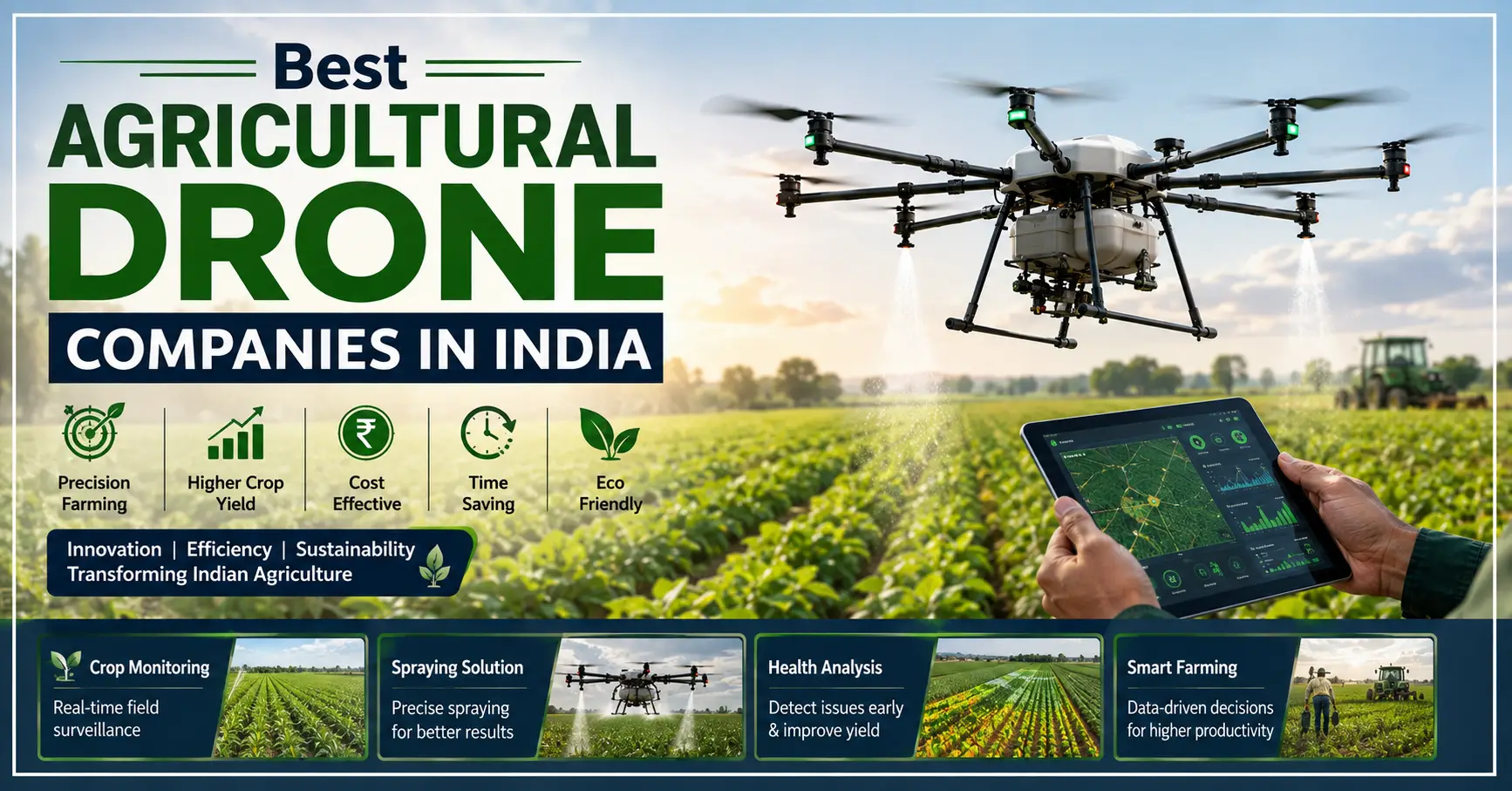
Best Agricultural Drone Companies in India
Posted on August 9, 2026
Agriculture in India is changing rapidly as farmers, agricultural businesses, and service providers adopt new technologies to improve efficiency. Among these technologies, agricultural drones have become increasingly important for crop spraying, monitoring, mapping, fertilizer application, and other precision farming activities.
Traditional agricultural spraying can require significant time, labour, and water. It may also expose workers directly to pesticides and other chemicals. Agricultural drones help farmers and service providers spray crops quickly and apply inputs more precisely across fields.
India now has a growing ecosystem of companies developing drones specifically for agricultural applications. Some focus primarily on drone manufacturing, while others combine drones with software, crop analytics, training, spraying services, and precision agriculture solutions.
Here are 10 agricultural drone companies in India that are contributing to the growth of technology-driven farming.
1. Marut Drones
Marut Drones is an Indian drone technology company developing solutions for agriculture and several other applications. Agriculture is an important part of its business, with its Kisan Drone range designed to help automate common farm operations.
One of its key agricultural platforms is the AG 365 series. Depending on the model, these drones can be used for pesticide spraying, fertilizer spreading, seeding, fumigation, crop monitoring, and other agricultural activities.
For example, the AG 365 has an 11-litre maximum payload and supports manual, semi-autonomous, and fully autonomous operation. Marut also offers models such as the AG 365XP, AG 365H, and AG 365S to meet different operational requirements.
Another useful part of Marut’s offering is its agriculture-focused mobile application. It allows operators to manage drone operations, monitor drone health, review usage information, and control spraying activities.
The company’s focus on multi-purpose agricultural drones makes it relevant not only for individual farming operations but also for agricultural entrepreneurs and drone service providers.
Key agricultural solutions: Crop spraying, fertilizer spreading, seeding, fumigation, crop monitoring, and agricultural drone services.
2. Fuselage Innovations
Fuselage Innovations is a Kerala-based agri-tech company working with unmanned aerial vehicles (UAVs), artificial intelligence, IoT, and precision farming technologies.
Rather than concentrating on spraying, Fuselage has developed solutions for various stages of farm management.
Its FIA QD10 is a DGCA type-certified agricultural drone designed for precision agriculture. The company also offers Nireeksh, a multispectral crop surveillance drone that can help collect information about crop conditions.
Multispectral monitoring can be particularly useful in precision farming because aerial data helps agricultural professionals identify variations across a field that may not always be easy to detect from ground level.
Fuselage therefore combines drone hardware with technologies that support smarter crop observation and management.
Key agricultural solutions: Precision spraying, crop surveillance, multispectral imaging, GIS tracking, UAV technology, and customized drones.
3. IoTechWorld Avigation
IoTechWorld Avigation is a Gurugram-based drone manufacturer with a strong focus on agricultural applications.
Its Agribot range has been developed specifically for farming operations. The company positions its agricultural drones as tools that can help make drone technology accessible to farmers while improving the efficiency of farm activities.
Beyond drone hardware, IoTechWorld has developed AGRINET, a smartphone application created for the agricultural drone ecosystem. The platform is intended to connect farmers, drone service providers, dealers, component buyers, and other agri-tech participants.
This ecosystem approach is important because wider adoption of agricultural drones requires more than simply manufacturing equipment. Farmers and operators also need access to service networks, training, maintenance, technology support, and other resources.
For agricultural businesses looking at both drone equipment and a broader support ecosystem, IoTechWorld is a notable name in India’s growing agri-drone sector.
Key agricultural solutions: Agricultural spraying drones, precision farming, digital agriculture platforms, drone services, and ecosystem support.
4. Aries Agro Limited
Aries Agro Limited brings a slightly different background to the agricultural drone industry. The company has been working in agricultural inputs and plant nutrition for decades and has expanded its technology offering to include agricultural equipment and drones.
Its Aries Agribot is a hexacopter agricultural drone with a 10-litre tank. According to the company, the drone can spray up to eight acres per hour under suitable operating conditions and supports fully autonomous, semi-autonomous, and loiter flight modes.
The system also includes features such as radar-based collision avoidance and terrain following. These technologies help the drone respond to obstacles and changes in ground height while operating over agricultural land.
Aries Agro also offers additional agricultural equipment and drone models as part of its expanding portfolio. Its experience in crop nutrition allows the company to combine agricultural products with modern farming technology.
Key agricultural solutions: Drone spraying, crop nutrition, precision agriculture equipment, soil testing, and farm technology.
5. Garuda Aerospace
Garuda Aerospace is one of India’s well-known drone technology companies, with solutions covering agriculture, infrastructure, surveillance, and other sectors.
Agriculture is a major application area for the company. Its Kisan Drone platform is designed to make activities such as pesticide and fertilizer spraying faster and more efficient.
Garuda offers agricultural drone models with different payload capacities. Its agricultural systems are designed to reduce the need for farmers and workers to come into direct contact with chemicals during spraying operations.
The company says its Kisan Drone solutions have been tested across more than 15 crops. Its agricultural spraying case studies also highlight the use of 10-litre and 8-litre DGCA type-certified models.
Garuda’s broader Drone-as-a-Service approach is particularly relevant in India. With service-based models, farmers can use drones for spraying and other tasks without having to buy a drone.
Key agricultural solutions: Precision crop spraying, crop monitoring, Drone-as-a-Service, agricultural drone operations, and farmer-focused drone solutions.
6. Dhaksha Unmanned Systems
Dhaksha Unmanned Systems develops drones for agriculture, defence, logistics, surveillance, and enterprise applications.
The company offers multiple agricultural drone platforms designed for spraying crop protection products and nutrients.
One notable product is the DH-AG-H1, a medium-category agricultural drone with a 12-litre spraying tank. It uses a hybrid propulsion system (combining an engine and battery). Dhaksha also offers the DH-AGRIGATOR-E10, a smaller agricultural drone equipped with a precision spraying system.
Having multiple drone configurations gives agricultural businesses the flexibility to evaluate a platform based on field size, spraying requirements, operating time, and other practical considerations.
Dhaksha’s involvement across different drone categories also gives the company experience in developing UAV technologies for demanding environments.
Key agricultural solutions: Agricultural spraying, nutrient application, crop protection, hybrid-powered drones, and precision farming equipment.
7. General Aeronautics
General Aeronautics is a Bengaluru-based company developing aerial technologies for agriculture and other applications.
Its agricultural offering goes beyond basic drone spraying. The company describes its solution as an Advanced Crop Protection Platform combining drone technology, artificial intelligence, crop science, mission planning, and data management.
Its Krishak agricultural drone platform is designed for precision spraying across different crop types and agricultural conditions. The system includes features such as variable-rate spraying, droplet control, obstacle detection, system health monitoring, and mission planning.
General Aeronautics also combines its drones with an Agri App and management platform. Operators can use these tools for route planning, setting drone parameters, monitoring missions, and reviewing drone health.
This integrated approach makes General Aeronautics particularly interesting for precision agriculture, where the quality of the data and control system can be just as important as the drone itself.
Key agricultural solutions: Precision spraying, crop protection, agricultural mapping, multispectral monitoring, AI-supported agriculture, and mission management.
8. Thanos Technologies
Thanos Technologies is a Hyderabad-based technology company specializing in agricultural drones and related UAV services.
Its flagship agricultural platform is the SYENA series. The SYENA-H10 and H10i are designed primarily for agricultural spraying.
The SYENA-H10 has a 10-litre payload capacity and supports manual, semi-autonomous, and autonomous flight modes. It uses GPS and radar to improve spraying accuracy and consistency. The H10i also includes obstacle avoidance, live video monitoring, and an upgraded controller.
Thanos says its agricultural drones have been tested through spraying pilots and demonstrations covering thousands of acres. The company also provides services such as drone spraying, custom drone development, repair, and maintenance support.
Its strong specialization in agricultural spraying makes Thanos relevant for farmers, agricultural businesses, and entrepreneurs planning to offer drone spraying as a commercial service.
Key agricultural solutions: Agricultural spraying drones, autonomous spraying, drone spraying services, maintenance, training, and custom UAV development.
9. Paras Aerospace
Paras Defence and Space Technologies operates in the drone industry through Paras Aerospace, which develops drone technologies and services for multiple sectors.
Agriculture is one of the company’s application areas. Paras Aerospace’s portfolio includes agriculture drones as well as agricultural drone services.
One of its dedicated solutions is the Paras Agri Copter, which the company identifies as a certified agricultural drone.
The company’s broader capabilities include drone manufacturing, drone payloads, maintenance and repair, autonomous systems, GIS services, industrial applications, and training.
This combination can be useful for organizations looking for more than a single agricultural drone product. Agricultural businesses, institutions, and service providers may require training, technical support, data services, and long-term maintenance alongside the hardware.
Key agricultural solutions: Agriculture drones, drone spraying services, GIS services, drone maintenance, training, and UAV technology.
10. Drone Destination
Drone Destination is another notable participant in India’s growing drone ecosystem. The company operates across drone training, services, technology, and agricultural applications.
Its agricultural activities include drone-based spraying services, allowing farmers and agricultural organizations to use drone technology without necessarily investing in their own equipment.
This service-based approach can be valuable in India, particularly for smaller farms where purchasing and maintaining a dedicated agricultural drone may not always be economically practical.
For farmers, FPOs, agricultural businesses, and rural entrepreneurs, companies offering both services and training can help make drone technology more accessible.
Key agricultural solutions: Agricultural drone spraying, Drone-as-a-Service, drone pilot training, drone operations, and rural drone services.
How Agricultural Drones Are Changing Farming in India
Agricultural drones are becoming useful because they can address several practical challenges faced by Indian farmers.
One of the biggest advantages is faster spraying. A drone can cover agricultural land considerably faster than manual spraying under suitable field conditions. This can be especially useful when pesticides, nutrients, or other inputs need to be applied within a limited period.
Another important benefit is reduced direct chemical exposure. With manual spraying, workers may operate close to pesticides and other agricultural chemicals. Drone-based spraying allows the operator to remain away from the immediate application area.
Drones can also support precision agriculture. When equipped with cameras, multispectral sensors, GPS, mapping software, and analytics platforms, drones can collect information about fields and crops. Farmers and agronomists can use this information to make better-informed crop management decisions.
However, agricultural drones are not simply a replacement for every traditional farming method. Their effectiveness depends on the crop, field conditions, weather, application method, operator skill, equipment quality, and the agricultural inputs being used.
What to Consider When Choosing an Agricultural Drone Company
Choosing a drone should involve more than comparing tank capacity or flight time.
Farmers, FPOs, agri-businesses, and drone entrepreneurs should first determine what they want the drone to do. A drone designed mainly for pesticide spraying may have different requirements from one used for multispectral crop monitoring or mapping.
Payload capacity, spraying accuracy, battery performance, ease of transportation, obstacle detection, terrain-following capability, software, spare-part availability, training, warranty, and after-sales service should all be considered.
Buyers should also check the current DGCA certification and regulatory status of the specific drone model rather than assuming that every product sold by a drone company has the same approval status.
For commercial operations, access to reliable technical support can be especially important. Agricultural drones operate in demanding environments involving dust, heat, moisture, chemicals, repeated battery cycles, and frequent transportation. Easy access to maintenance and replacement parts can therefore have a major impact on long-term operating costs.
The Future of Agricultural Drones in India
The future of agricultural drones in India is likely to extend well beyond pesticide spraying.
Companies are already developing platforms that combine drones with artificial intelligence, multispectral imaging, GIS mapping, autonomous navigation, mobile applications, and farm analytics.
Over time, farmers may increasingly use aerial data to identify crop stress, monitor plant health, plan fertilizer applications, map fields, assess damage, and make more informed decisions about farm resources.
Drone-as-a-Service models could also play a major role. Instead of purchasing expensive equipment, farmers may be able to book a trained operator to complete a specific spraying, monitoring, or mapping job. This could make advanced technology more practical for small and medium-sized farms.
At the same time, agricultural drone businesses can create opportunities for rural entrepreneurs. Trained drone pilots and service providers can work with multiple farms and Farmer Producer Organizations (FPOs), creating technology-based employment while helping farmers access modern equipment.
Agricultural drones are becoming an important part of smarter and more precise farming in India. Indian drone companies offer solutions for spraying, crop monitoring, mapping, training, software, and Drone-as-a-Service.
The right drone depends on crop type, farm size, budget, application, and local support. As the technology becomes more accessible, drones can help farmers reduce manual work, improve accuracy, and use resources more efficiently.
Before investing, farmers should compare certified models, request demonstrations, check operating costs, and review after-sales support.