
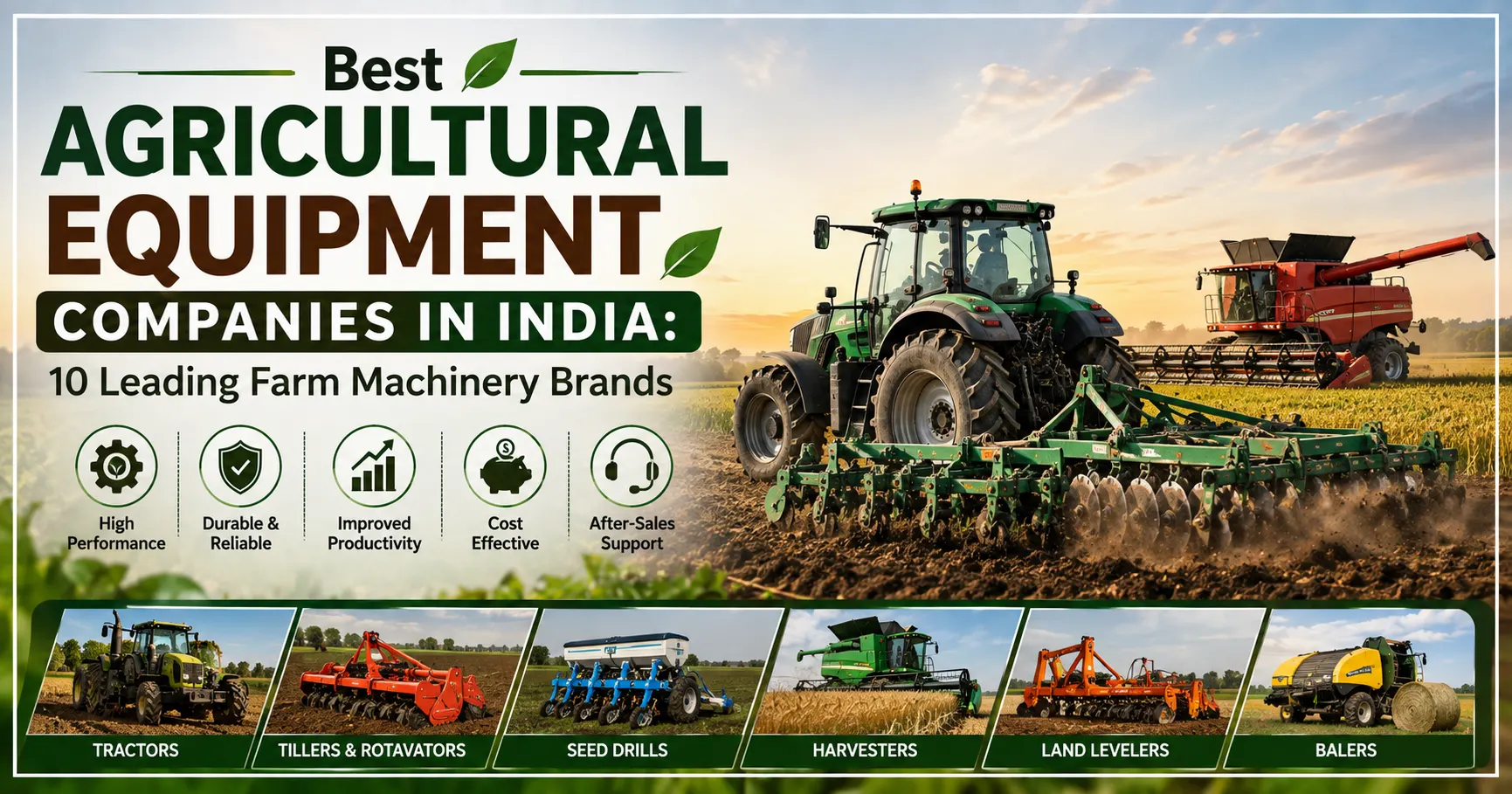
Best Agricultural Equipment Companies in India: 10 Leading Farm Machinery Brands
Posted on August 10, 2026
Indian farming has changed significantly over the past few decades. While traditional tools such as the plough (hal), sickle (daranti/hasiya), and bullock-drawn implements are still used in some areas, machines now handle a growing share of work on Indian farms.
Tractors, rotavators, cultivators, power tillers, seed drills, threshers, combine harvesters, balers, and rice transplanters are helping farmers complete work and reduce dependence on manual labour.
This shift towards farm mechanisation is particularly important in India because agricultural needs vary widely. A wheat farmer in Punjab may require powerful tractors, seed drills, and combine harvesters, while a farmer cultivating vegetables in Gujarat or Maharashtra may prefer a compact tractor and smaller implements. Paddy farmers in southern and eastern India may have completely different requirements.
Choosing agricultural machinery, therefore, is not simply about buying the biggest or most expensive machine. Farmers need equipment that matches their landholding, crop, soil, budget, and local conditions.
Here are 10 leading agricultural equipment companies in India that farmers, agricultural businesses, and rural entrepreneurs should know.
1. Mahindra Farm Equipment
Mahindra is one of the most recognised names in Indian agriculture. For many farming families, particularly in rural India, the Mahindra name is closely associated with tractors.
The company’s farm equipment business covers Mahindra Tractors and Swaraj Tractors, along with an expanding range of farm machinery.
Mahindra offers tractors across different power categories, making its products suitable for everything from smaller farms and orchards to demanding field operations. Depending on the model and available equipment, farmers can use tractors with implements for ploughing (jutaai), tilling, sowing (buwai), crop care, harvesting, and post-harvest work.
The company’s farm machinery portfolio also includes equipment designed for different stages of cultivation.
One of Mahindra’s biggest advantages is its long presence in the Indian agricultural market. For farmers purchasing expensive machinery, access to dealerships, spare parts, servicing, and local support is an important part of the buying decision.
Major equipment: Tractors, rotavators, cultivators, harvesters, planters, and other tractor-mounted farm implements.
Best suited for: Small, medium, and large farms looking for tractors and general-purpose agricultural machinery.
2. TAFE – Tractors and Farm Equipment Limited
TAFE, or Tractors and Farm Equipment Limited, is another major name in India’s agricultural machinery industry.
Established in Chennai in 1960, TAFE has built a large tractor business in India and international markets. Its tractor brands include Massey Ferguson, TAFE, Eicher, and IMT.
Indian farmers may be particularly familiar with Massey Ferguson and Eicher tractors, which have been used across different agricultural regions for many years.
TAFE’s operations are not limited to tractors. The company is also involved in farm machinery, diesel engines, engineering products, and other areas connected with agriculture and mobility.
Through its farm equipment portfolio, farmers can find machinery for land preparation and other agricultural operations.
For Indian conditions, one advantage of having multiple tractor brands is the variety of options available. A farmer who needs a straightforward machine for routine cultivation may have different priorities from someone who regularly operates heavier implements.
Major equipment: Tractors, rotary tillers (rotavators), cultivators, farm implements, and related agricultural machinery.
Best suited for: Farmers looking for established tractor brands with options across different farming requirements.
3. Sonalika Tractors
Sonalika is a well-known Indian tractor brand manufactured by International Tractors Limited.
The company has built a significant presence in rural India by offering tractors across a broad range of power categories. Its machines are used for regular agricultural activities such as ploughing (jutaai), cultivation, sowing (buwai), haulage, and tractor-mounted implements.
For many Indian farmers, a tractor is not only for inside the field. It may also pull a trolley for transporting crops, fertilizer, animal feed, and other materials. This makes versatility an important consideration.
Sonalika offers tractors and implements designed for different crops and agricultural applications.
The company also offers Solis tractors, including compact and specialised models for certain farming requirements.
For farmers considering Sonalika, choosing the correct horsepower (HP) is important. Buying more power than necessary can increase the purchase and operating cost, while an underpowered tractor may struggle with heavier implements.
Major equipment: Tractors, rotavators, cultivators, ploughs (hal), harrows, seeders, and other farm implements.
Best suited for: Farmers looking for tractors across different HP categories for both agricultural and transportation work.
4. Escorts Kubota
Escorts Kubota brings together Escorts’ experience in the Indian market and Kubota’s expertise in agricultural machinery.
The company operates tractor brands familiar to Indian farmers, including Farmtrac and Powertrac, while Kubota brings additional expertise in tractors and specialised agricultural machinery.
Its product range serves different farming requirements, from routine tractor operations to more specialised mechanisation.
This is particularly relevant as Indian farms gradually move beyond basic tractor ownership. Farmers are increasingly looking at equipment that can mechanise specific tasks such as planting, tilling, and harvesting.
Kubota’s experience with machinery such as rice transplanters (dhan ropai machine) and combine harvesters is particularly useful for paddy-growing regions.
Mechanising rice transplantation can reduce dependence on large groups of workers during a narrow planting window. Similarly, harvesting equipment can help farmers complete operations quickly when the crop is ready.
Major equipment: Tractors, power tillers, rotary tillers, rice transplanters, combine harvesters, and farm implements.
Best suited for: Farmers interested in tractors and specialised equipment for crops such as paddy.
5. John Deere India
John Deere is a global agricultural machinery company with a significant presence in India.
The company’s green tractors are easily recognised in many farming regions. In India, John Deere offers tractors and agricultural equipment for different field operations.
Its tractors cover different power requirements and can work with implements used for land preparation, sowing, crop management, and harvesting.
John Deere is also known for bringing technology into agricultural machinery. Modern farming equipment can include features such as machine monitoring, precision agriculture, and better control of field operations.
Such technology can be particularly valuable for large farms, commercial agricultural operations, and custom hiring businesses where machinery is used across many acres.
However, farmers should choose features based on practical value rather than technology alone. A machine should ultimately help reduce operating costs, save time, improve field performance, or make work easier.
Major equipment: Tractors, combine harvesters, balers, planters, and precision agriculture solutions.
Best suited for: Medium and large farms, commercial farming operations, and farmers interested in technology-enabled machinery.
6. VST Tillers Tractors
VST Tillers Tractors is known in India for its compact tractors, power tillers, and other small farm machinery.
While large tractors are useful for extensive farms, they are not practical everywhere. India has millions of small and marginal farmers, and many fields are divided into relatively small plots.
This is where power tillers (often called mini tractors by farmers) and compact tractors can be particularly useful.
VST offers power tillers, tractors, and other agricultural equipment suitable for operations where manoeuvrability matters. Smaller machines can work well in vegetable farms, orchards (bagicha), vineyards, wetland cultivation, and fields where a large tractor may be difficult to operate.
Power tillers can perform multiple tasks when fitted with suitable attachments. They may be used for soil preparation, inter-cultivation, puddling, and other operations.
For small farmers, the smaller size and operating requirements of this type of equipment can make mechanisation more accessible.
Major equipment: Power tillers (mini tractors), compact tractors, weeders, reapers, and agricultural implements.
Best suited for: Small farms, horticulture, orchards, vegetable cultivation, and areas where compact machinery is more practical.
7. Shaktiman – Tirth Agro Technology
Shaktiman is an Indian agricultural machinery brand from Tirth Agro Technology. It is particularly well known for tractor-mounted farm implements.
This makes it slightly different from companies that are primarily known for tractors.
A tractor becomes much more useful when it is paired with the right implement. For example, a rotavator can prepare soil, a seed drill can support sowing, and a mulcher can help manage crop residue.
Shaktiman offers machinery for several stages of agricultural production.
Its portfolio includes rotary tillers (rotavators), power harrows, mulchers, shredders, balers, crop residue management equipment, and other farm machinery.
Crop residue management has become particularly important in states where farmers need to prepare fields quickly between two crops. Instead of relying only on burning crop residue (parali), specialised machinery can help chop, spread, collect, or incorporate residue into the field.
Major equipment: Rotavators, mulchers, shredders, balers, power harrows, and crop residue management machinery.
Best suited for: Farmers and custom hiring businesses looking for tractor-mounted implements and specialised machinery.
8. Fieldking – Beri Udyog
Fieldking is another major Indian agricultural implement brand.
The company manufactures a wide variety of machinery used with tractors for soil preparation, sowing, crop management, harvesting, and post-harvest activities.
Fieldking provides options across these categories.
Its products include rotavators, cultivators, disc harrows, ploughs (hal), seed drills, planters, mulchers, mowers, and other equipment.
The correct implement can make a major difference to tractor performance. Farmers should always check whether the implement’s size and power requirement match the tractor’s horsepower and PTO specifications.
Major equipment: Rotavators, cultivators, ploughs, harrows, seed drills, planters, mulchers, and mowers.
Best suited for: Farmers who already own tractors and want to mechanise additional farm operations with compatible implements.
9. PREET Agro Industries
PREET is an Indian agricultural machinery company with a strong presence in tractors and harvesting equipment.
The company is particularly notable for its combine harvesters.
A combine harvester (fasal katne ki machine) performs multiple harvesting operations in a single process. Depending on the crop and machine, it can cut, thresh, and separate grain, significantly reducing the amount of manual work required during harvest.
This type of equipment is commonly associated with major grain-producing areas where wheat, paddy, and similar crops are grown on a large scale.
PREET also manufactures tractors, rotavators, balers, and other agricultural machinery.
For smaller farmers, purchasing a combine harvester individually may not make financial sense. However, custom hiring is common in many agricultural areas, allowing farmers to pay for harvesting on an acreage or hourly basis instead of owning the machine.
Major equipment: Tractors, combine harvesters, rotavators, balers, and agricultural implements.
Best suited for: Grain-growing regions, large farms, contractors, and custom hiring businesses.
10. New Holland Agriculture India
New Holland Agriculture is another established agricultural machinery brand operating in India.
It’s a part of CNH and offers tractors and farm machinery for different farming needs, including harvesting and baling equipment.
Its machinery is relevant to farmers who want to mechanise several stages of crop production rather than using a tractor only for land preparation.
Balers, for example, can collect crop residue such as straw (bhusa/parali) into manageable bales. Depending on local demand, this material may then be transported, stored, used as livestock feed, or supplied for other purposes.
For farmers and agricultural contractors handling larger areas, equipment that reduces the number of separate field operations can provide significant time savings during busy seasons.
Major equipment: Tractors, combine harvesters, balers, and other agricultural machinery.
Best suited for: Medium and large farms, agricultural contractors, and farmers looking for advanced farm mechanisation.
Common Types of Agricultural Equipment Used in India
Agricultural machinery can sometimes be confusing because the same machine may be known by an English name, a Hindi name, or simply a local name in different parts of India.
Here are some commonly used machines and their purposes:
- – Tractor: Helps operate or pull different types of farm equipment.
- – Plough (hal): Turns and loosens the soil before cultivation.
- – Cultivator (kultivator): Breaks and prepares soil and can also help control weeds.
- – Rotavator/Rotary tiller: Uses rotating blades to prepare the seedbed.
- – Seed drill (beej bone ki machine): Places seeds in the soil at controlled spacing and depth.
- – Power tiller (mini tractor): A smaller machine used for tilling and other operations, particularly on small farms.
- – Rice transplanter (dhan ropai machine): Helps farmers plant paddy seedlings more quickly and evenly.
- – Reaper (fasal katne ki machine): Cuts mature crops.
- – Thresher (thresher machine): Separates grain from harvested crop material.
- – Combine harvester: Combines harvesting, threshing, and grain separation.
- – Baler: Compresses straw and crop residue into bales.
- – Sprayer (dawai chhidkav machine): Applies pesticides, herbicides, or other agricultural inputs.
Regional names can differ across India, so farmers should always confirm the exact function and specifications of a machine before purchasing it.
How to Choose the Right Agricultural Equipment
The biggest machine is not always the best machine.
For a farmer with a few acres of vegetables or an orchard, a compact tractor or power tiller may be more practical than a high-horsepower tractor. On the other hand, a farmer managing large wheat or paddy fields may need considerably more power and larger implements.
Start with the farm size and crop. Paddy, wheat, cotton, sugarcane, vegetables, and fruit orchards all have different machinery requirements.
Next, consider the soil and field conditions. Heavy soil may require more tractor power for certain operations, while narrow orchard rows need compact equipment with a smaller turning radius.
Fuel consumption and maintenance also matter. The purchase price is only the beginning. Diesel, servicing, tyres, replacement parts, lubricants, and repairs contribute to the total cost of ownership.
Farmers should also check the local dealer and service network. A slightly cheaper machine may become expensive if spare parts are difficult to find or the nearest authorised service centre is far away.
Finally, calculate how frequently the equipment will actually be used.
Should You Buy or Rent Farm Machinery?
Not every Indian farmer needs to own every machine.
Farmers can use a tractor for different farming tasks throughout the year. A combine harvester, however, may only be needed for a short period during harvesting.
In such cases, renting machinery or using a Custom Hiring Centre (CHC) can be more economical.
Custom hiring allows farmers to access equipment such as tractors, rotavators, seed drills, transplanters, harvesters, and other machines without making a large upfront investment.
This approach can be particularly helpful for small and marginal farmers.
Farmers can compare the cost of renting machinery with the total cost of owning and maintaining it. If a machine will remain unused for most of the year, hiring may be the smarter choice.
Farm Mechanisation and the Future of Indian Agriculture
The future of Indian farming will depend on practical and affordable technology. Mechanisation can reduce labour needs, save time, and improve efficiency, while tools such as GPS, drones, sensors, and smart machinery will continue to grow. However, equipment must remain affordable for both small farmers and large commercial farms.
Final Thoughts
Mahindra, TAFE, Sonalika, Escorts Kubota, John Deere, VST Tillers Tractors, Shaktiman, Fieldking, PREET, and New Holland are among the notable companies contributing to farm mechanisation in India.
However, there is no single agricultural equipment company that is best for every Indian farmer.
A paddy farmer may prioritise a rice transplanter and harvester. A wheat farmer may need a tractor, seed drill, and combine harvester. An orchard owner may prefer a compact tractor and sprayer, while a small vegetable farmer may find a power tiller more economical.
Instead of asking only, “Which is the best agricultural equipment company in India?”, farmers should ask, “Which machine is right for my farm, crop, budget, and local conditions?”
Before making a major purchase, compare at least two or three machines, check local dealer and spare-parts availability, request a field demonstration where possible, and calculate the total operating cost.
For expensive equipment that is required only a few times each season, farmers should also explore rental services and Custom Hiring Centres before investing.
The right machinery does not simply save labour. When chosen carefully, it can help an Indian farmer complete operations on time, use available resources more efficiently, reduce unnecessary costs, and run the farm as a more productive business.