
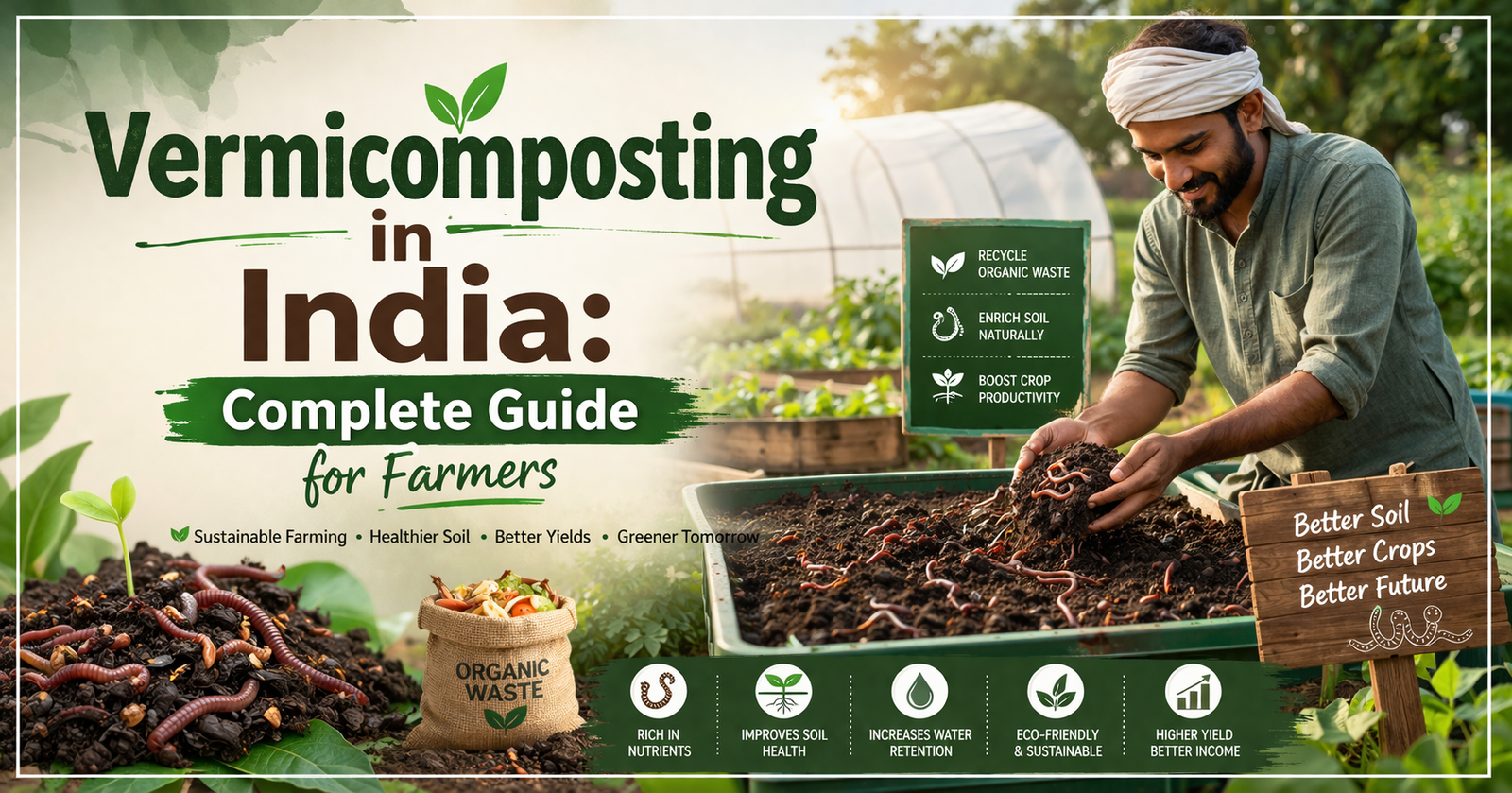
Vermicomposting in India: A Complete Guide for Farmers
Posted on April 12, 2026
India’s agricultural landscape is undergoing a silent transformation. Rising input costs, declining soil fertility, and increasing awareness of sustainable farming are pushing farmers to explore alternatives to chemical fertilizers. Among these, vermicomposting has emerged as a practical, low-cost, and highly effective solution.
Vermicomposting is not just a farming technique; it is a system that converts waste into wealth while restoring soil health. For Indian farmers, especially small and marginal ones, it offers both ecological and economic benefits.
What is Vermicomposting?
Vermicomposting is a biological process in which earthworms convert organic waste into nutrient-rich compost known as vermicast. Unlike traditional composting, this method uses specific species of earthworms to accelerate decomposition and improve nutrient quality.
The process produces a stable, finely textured compost rich in essential nutrients and beneficial microorganisms. It typically works best within a temperature range of 10°C to 32°C, making it suitable for most Indian climatic conditions.
Why Vermicomposting is Important for Indian Farmers
Indian agriculture has heavily depended on chemical fertilizers for decades. While they have increased short-term productivity, they have also contributed to soil degradation, reduced microbial activity, and declining long-term yields.
Vermicomposting addresses these challenges in several ways:
- Improves Soil Health
Vermicompost enhances soil structure, aeration, and water retention. It also increases organic matter content and supports beneficial microbial populations.
- Provides Essential Nutrients
It contains key nutrients like nitrogen (N), phosphorus (P), potassium (K), calcium, and magnesium, which are essential for plant growth.
- Reduces Input Costs
By replacing or reducing chemical fertilizers, farmers can significantly cut production costs.
- Increases Crop Yield
Studies and field experiences show improved germination, stronger root systems, and higher yields in crops like vegetables, fruits, and cereals.
- Sustainable Waste Management
It converts agricultural residues, animal waste, and kitchen waste into valuable manure, reducing environmental pollution.
Types of Earthworms Used in India
Selecting the right species of earthworms is critical for successful vermicomposting. Commonly used species in India include:
- – Eisenia fetida (Red wigglers) – Ideal for moderate climates
- – Perionyx excavatus (Indian blue worm) – Suitable for tropical regions
- – Lampito mauritii – Indigenous species found in Indian soils
These worms are surface dwellers and are highly efficient in breaking down organic matter.
Materials Required for Vermicomposting
Farmers can start vermicomposting with minimal investment using locally available materials:
- – Organic waste (crop residues, vegetable waste, cow dung)
- – Dry materials (leaves, straw, paper)
- – Earthworms
- – Water source
- – Shaded area or shed
- – Containers, pits, or beds
Cow dung is often used as a base material because it contains beneficial microbes and provides a suitable environment for worms.
Step-by-Step Process of Vermicomposting
Step 1: Site Selection
Choose a cool, shaded area protected from direct sunlight and heavy rain. Proper ventilation is essential.
Step 2: Bed Preparation
Prepare a bed using bricks, wooden boxes, or pits. A typical size can be 10 ft x 3 ft x 1 ft, depending on scale.
Step 3: Bedding Layer
Add a 5–6-inch layer of bedding material, such as dry leaves, straw, or shredded paper. Maintain moisture at around 40–50%.
Step 4: Adding Organic Waste
Layer organic waste mixed with partially decomposed cow dung. Maintain a balance between green (nitrogen-rich) and brown (carbon-rich) materials.
Step 5: Introducing Earthworms
Release earthworms evenly across the bed. 1 kg of worms is sufficient for 1 ton of organic waste.
Step 6: Maintenance
- – Maintain moisture (not too wet or dry)
- – Protect from extreme temperatures
- – Avoid adding oily, spicy, or non-biodegradable materials
- – Cover with gunny bags or straw
Step 7: Harvesting
Vermicompost is ready in 45–60 days under optimal conditions. It appears dark, granular, and earthy in smell.
Methods of Vermicomposting in India
- Bed Method
Organic waste is placed in raised beds. This is widely used due to better aeration and ease of management.
- Pit Method
Waste is decomposed in pits dug into the ground. While cost-effective, it may face drainage issues during the monsoon.
- Tank Method
Concrete tanks are used for large-scale production. Suitable for commercial units.
- Container Method
Used for small-scale or urban farming, including terrace gardening.
Key Factors for Successful Vermicomposting
Moisture
Maintain 40–60% moisture. Excess water can suffocate worms, while dryness reduces activity.
Temperature
The optimal temperature is between 20°C and 30°C for maximum efficiency.
pH Level
Neutral pH (6.5–7.5) is ideal. Highly acidic or alkaline conditions harm worms.
Aeration
Proper airflow is necessary to prevent foul smells and ensure healthy decomposition.
Common Challenges and Solutions
- Foul Odor
Cause: Excess moisture or overfeeding
Solution: Add dry materials and reduce feeding
- Worm Mortality
Cause: High temperature or toxic materials
Solution: Maintain shade and avoid chemicals
- Pest Infestation
Cause: Improper covering
Solution: Cover beds properly and maintain hygiene
- Slow Composting
Cause: Imbalanced carbon-nitrogen ratio
Solution: Maintain a proper mix of green and brown materials
Economic Potential of Vermicomposting
Vermicomposting is not only beneficial for soil but also offers income opportunities. Farmers can sell:
- – Vermicompost (₹5–10 per kg depending on quality)
- – Earthworms for breeding
- – Vermiwash (liquid fertilizer)
With increasing demand for organic produce, vermicompost has become a valuable input in both agriculture and horticulture.
Small-scale units can be started with low investment, making it ideal for rural entrepreneurs and self-help groups.
Government Support and Schemes in India
The Indian government promotes organic farming through various schemes:
- – Paramparagat Krishi Vikas Yojana (PKVY)
- – National Mission on Sustainable Agriculture (NMSA)
- – Rashtriya Krishi Vikas Yojana (RKVY)
These schemes provide financial assistance, training, and subsidies for composting units and organic farming practices.
Environmental Impact
Vermicomposting plays a crucial role in sustainable agriculture:
- – Reduces landfill waste
- – Lowers greenhouse gas emissions
- – Enhances biodiversity in soil
- – Promotes circular economy in farming
It aligns with global agroecological principles by improving soil, conserving resources, and reducing dependence on synthetic inputs.
Future of Vermicomposting in India
As awareness around organic food and sustainable practices increases, vermicomposting is expected to grow rapidly in India. Urban demand for chemical-free produce and government support for natural farming are key drivers.
Additionally, integration with agri-startups, waste management systems, and farmer-producer organizations (FPOs) can further scale its adoption.
Conclusion:
Vermicomposting is more than just a technique; it is a shift toward sustainable and regenerative agriculture. For Indian farmers facing rising costs and declining soil fertility, it offers a practical, affordable, and eco-friendly solution.
By converting organic waste into nutrient-rich compost, farmers not only improve their soil health but also create additional income streams. With the right knowledge and minimal resources, vermicomposting can become a cornerstone of resilient farming systems in India.
In a country where agriculture sustains millions, such solutions are not just beneficial; they are essential for the future.