
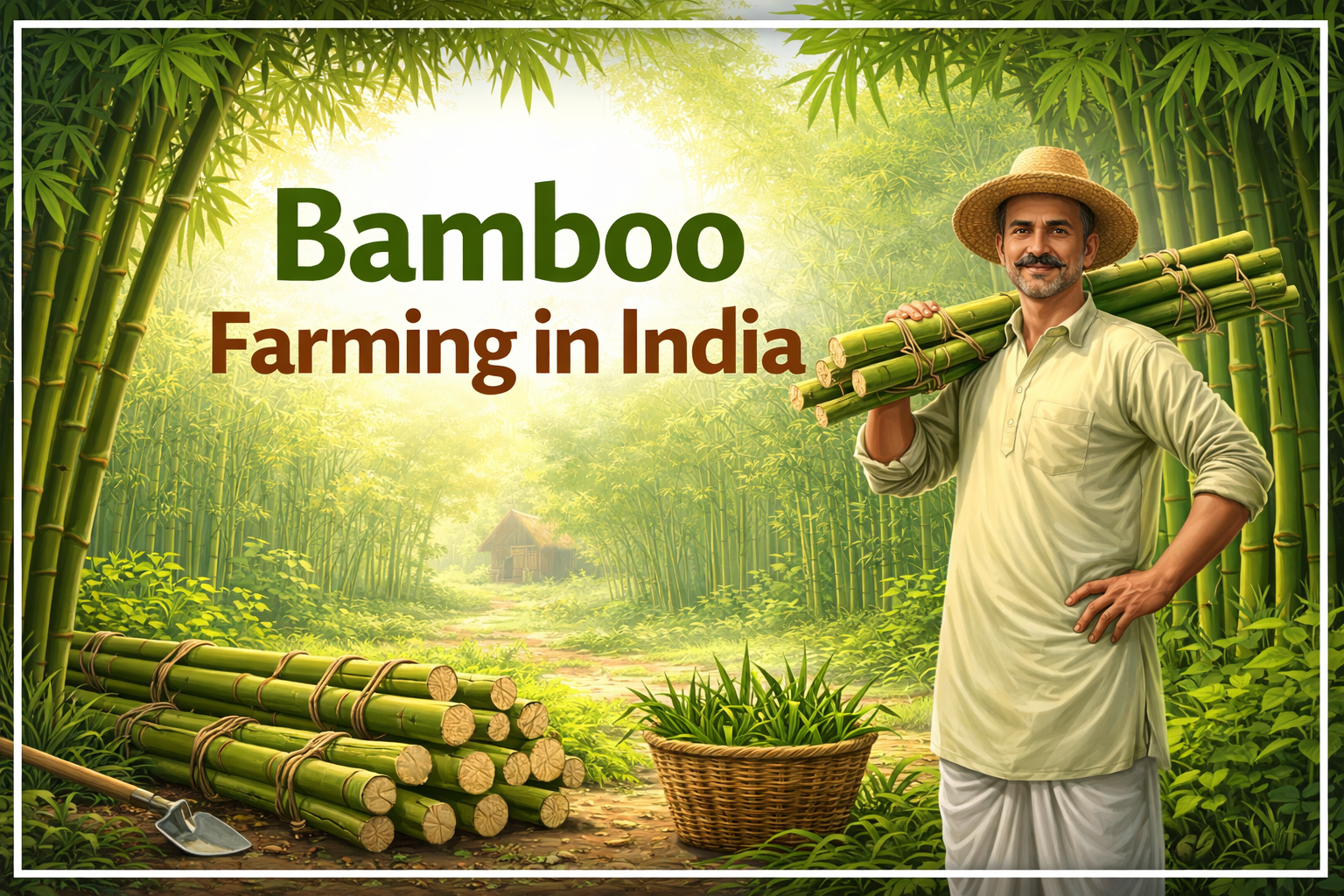
Bamboo farming in India
Posted on March 23, 2026
The bamboo industry is transforming in India and generating high income, which is helping to promote the economy of the country. Bamboo was once known to be poor man’s lumber, but with time, it is one of the most lucrative and environmentally friendly businesses in modern agriculture, which requires little maintenance and marginal soil.
Madhya Pradesh is the largest area, but northeastern states also use bamboo in their daily lives and are the largest producers of bamboo. It is one of the fastest-growing woody plants with the ability to withstand floods and droughts. The National Bamboo Mission (NBM) is taking different initiatives to promote bamboo plantation.
Uses of Bamboo in India
Bamboo is a versatile, multipurpose plant and is known for being sustainable and renewable, and its multipurpose uses are in demand. Here are some main uses of bamboo.
Food: Bamboo is a regular food item in Northeast cuisine, and bamboo murabba is another popular food.
Textile: Bamboo is often used for clothing and fabric making.
Furniture: Bamboo is used for making different furniture, which is used by different numbers of people.
Handicrafts: Bamboo is one of the ideal materials for different ranges of handicrafts, which are used in both domestic and international markets.
Ethanol: Ethanol is a biofuel that is used by governments across the globe. The Government of India is speeding up the process of ethanol production, which can be used for multiple purposes. Sugarcane is the main source of ethanol in India, but bamboo is considered another sustainable resource.
Cultivation Method for Growing Bamboo
Choosing the Right Bamboo: There are different varieties of bamboo that can be used for different purposes, such as construction, biomass, furniture making, and handicrafts. Some of the wide varieties are Thyrsostachys oliveri, bambos, Bambusa balcooa, and B. nutans.
Propagation: Bamboo is propagated through air layering, tissue culture, offsets, and cuttings. Bamboo is propagated by cutting and then used for bulk by different industries.
Planting: After clearing the land, pits are dug, and their size usually ranges from 1 ft to 3 ft. After the process of initial planting, bamboos multiply each year and do not need to be replanted every year.
Spacing: The planting density is dependent upon different factors, such as the objective of the plantation and agroclimatic conditions. Too closely planted plants will suffer from competition for air, soil, and sunlight, whereas too open plantations will lead to canopy exposure, and plants will fall over each other.
Intercropping: Planting bamboo and making income from it is a longer process, as it takes time to grow, at least a period of 6 years. Intercropping can be done where banana, sweet potato, turmeric, ginger, and watermelon can be grown between the time periods.
Manuring and fertilization: Bamboo is considered to be a heavy feeder and requires different sources of nutrients. A yearly application of FYM around every bunch of plants is required for faster growth and color development.
Irrigation: Irrigation plays an important role in development; for health and faster growth, irrigation is mandatory. Drip or sprinklers can be installed for efficient use of water.
Mulching: Mulching is an important process to conserve soil moisture. Dry fallen bamboo leaves are gathered and can be used in many ways. The leaves prohibit soil from getting direct sunlight exposure and promote growth. It also protects bamboo shoots and reduces mortality and deformation.
Harvesting and yielding of bamboo
Bamboo harvesting starts from the 7th year and lasts for 100-120 years. Within 3 years of planting, culms start coming, and at the end of 6 years, culms are obtained per bamboo clump. In a high-density population, 20-30 tonnes in the 7th year and 40-50 tonnes from the 9th year can be obtained in the case of Beema bamboo.
Importance of Bamboo Farming in India
Some of the major benefits of growing bamboo in India are as follows:
Bamboo plays an important role in contributing to the economy of the country, contributing about 9000 crore rupees to the country’s economy.
Bamboo helps boost oxygen production by 35% and helps to remove excess carbon dioxide in the air.
Bamboo is a great plant for controlling soil erosion.
The Indian government is promoting bamboo plantations by giving big subsidies through NBM.
What is the National Bamboo Mission?
The National Bamboo Mission is an initiative taken by the government to foster the growth of the bamboo industry, which provides a holistic approach that helps in providing planting materials, setting up plantations, and creating facilities for bamboo processing and collection. It is helping micro, small, and mid-sized enterprises to enhance workforce skills.
Conclusion:
Bamboo farming is one of the most promising activities to promote the economic growth of the country. With the development and growth of bamboo plantations it presents great opportunities for environmental conservation, job creation, and rural development.
Different organizations like the National Bamboo Mission (NBM) are taking various efforts to enhance the prospects of bamboo farming and focusing on the entire value chain from cultivation to marketing, as there is huge potential to transform livelihoods and contribute to a greener and more prosperous future for the country and rural communities.