
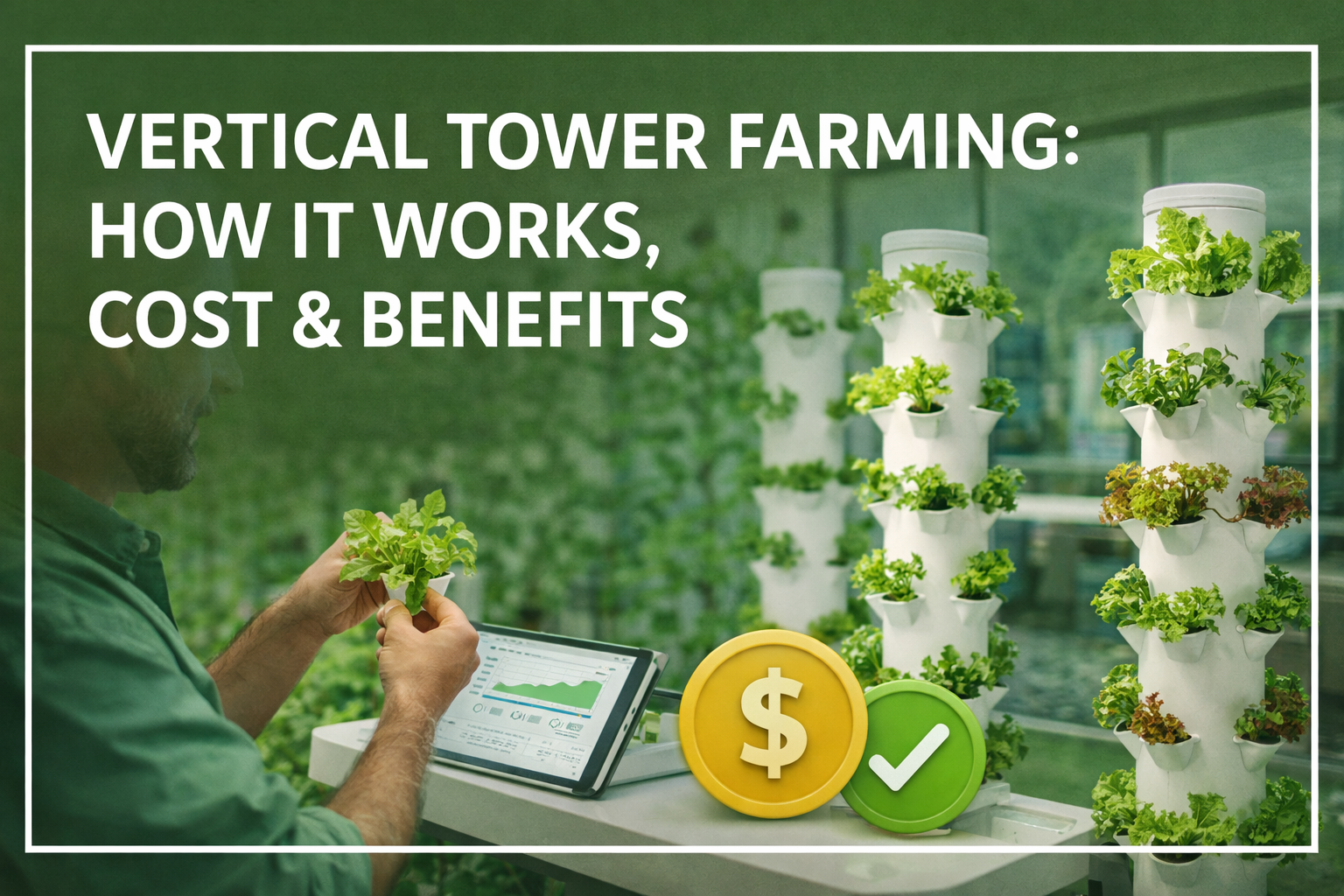
Vertical Tower Farming: How It Works, Cost & Benefits
Posted on January 16, 2026
Cities are growing upward, and so is agriculture, with vertical tower farming redefining how food is produced in limited spaces.
Vertical tower farming is a modern agricultural technique where crops are grown in stacked vertical structures rather than across large horizontal fields. This method is gaining global attention due to rapid urbanization, shrinking farmland, and rising demand for fresh, pesticide-free produce. By using vertical space efficiently, tower farming enables year-round cultivation with significantly lower water usage and minimal environmental impact.
What Is Vertical Tower Farming?
Vertical tower farming involves growing plants in tall, cylindrical, or stacked tower systems. These towers can be installed indoors, in greenhouses, on rooftops, or even in open spaces. The plants are arranged in tiers, allowing dozens or even hundreds of plants to grow in the footprint of a single square meter.
Most vertical towers use hydroponic or aeroponic systems where plant roots are nourished with nutrient-rich water instead of soil. This ensures faster growth, better control over nutrients, and cleaner produce.
How Vertical Tower Farming Works
1. Structural Design
Towers are typically made of food-grade PVC, plastic, or metal. Each tower has multiple planting slots arranged vertically. Water and nutrients flow from the top and cascade down to each plant level.
2. Growing Medium
Instead of soil, plants are supported using cocopeat, rockwool, clay pebbles, or a sponge. These hold moisture and provide root support.
3. Nutrient Delivery System
A water pump circulates nutrient solution from a reservoir to the top of the tower. Gravity helps distribute the solution evenly to all plant roots.
4. Lighting
Indoor vertical tower farms use LED grow lights to mimic sunlight. These lights are energy-efficient(for plant growth).
5. Climate Control
Temperature, humidity, and airflow are controlled using fans, heaters, or cooling systems to create ideal growing conditions.
Cost of Vertical Tower Farming
The cost varies depending on the scale, materials used, and level of technology.
Small-Scale Setup (Home or Balcony)
- – Tower system: ₹3,000 – ₹8,000 per tower
- – Pump & reservoir: ₹1,500 – ₹3,000
- – Grow lights (optional): ₹2,000 – ₹5,000
- – Total estimated cost: ₹7,000 – ₹15,000
Medium-Scale Setup (Rooftop or Small Commercial)
- – 10–20 towers: ₹50,000 – ₹1.2 lakh
- – Lighting & automation: ₹30,000 – ₹80,000
- – Total estimated cost: ₹1 – ₹2 lakh
Large-Scale Commercial Setup
- Fully automated systems can range from ₹5 lakh to ₹25 lakh or more, depending on size and technology.
While initial investment may seem high, operational costs are lower due to water savings, reduced labor, and minimal pesticide use.
Key Benefits of Vertical Tower Farming
1. Space Efficiency
One vertical tower can replace 10–15 square meters of traditional farmland.
2. Water Conservation
Uses up to 90% less water than soil-based farming.
3. Faster Growth Cycles
Plants grow 30–50% faster due to direct access to nutrients.
4. Year-Round Production
Independent of seasons and climate.
5. Pesticide-Free Crops
A controlled environment reduces pest attacks.
6. Urban Farming Friendly
Ideal for cities, rooftops, balconies, and warehouses.
Crops Suitable for Vertical Tower Farming
- – Leafy greens (lettuce, spinach, kale)
- – Herbs (basil, mint, coriander)
- – Strawberries
- – Cherry tomatoes
- – Microgreens
Challenges and Limitations
- – High initial investment
- – Technical knowledge required
- – Dependence on electricity
- – Not suitable for large root crops
Conclusion:
Vertical tower farming is more than a trend; it is a sustainable solution to future food security challenges. With increasing pressure on land and water resources, this method offers an efficient, clean, and scalable way to grow fresh produce anywhere. As awareness and technology improve, vertical tower farming will become an essential part of modern agriculture. Platforms like AgriWorldView continue to highlight and support such innovative farming practices, helping farmers and entrepreneurs adopt smarter, greener solutions.