
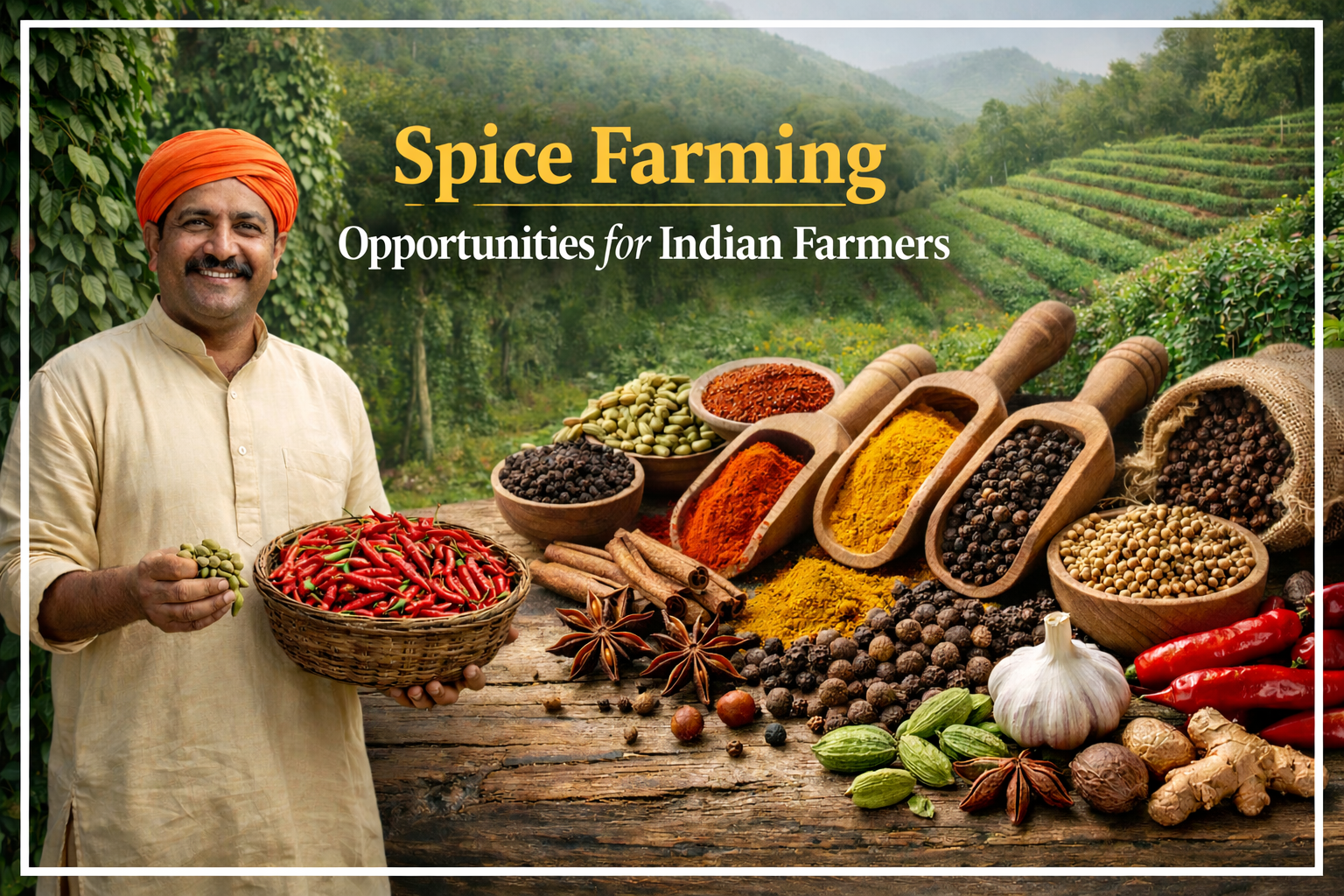
Spice Farming Opportunities for Indian Farmers
Posted on March 23, 2026
India is one of the leading countries for cultivating a wide range of spices, which are imported and exported worldwide. Every year in India, spices are cultivated on about 12.50 lakh hectares, producing 10.5 lakh tonnes. The government is also taking different initiatives and providing subsidies to the farmers in many states to grow spices. Spices are mainly cultivated in South India and are then exported abroad on a large scale.
Indian spices, with an export base of Rs 17,000 crores, account for 40% of the global spice trade. The domestic market for spices is around Rs 1 lakh crore. Still, the main challenge is to add value by educating the stakeholders to realize the potential and make it a sustainable program. The major challenges facing the sector are climate change, low productivity, pesticide residues, and depleting water resources.
To address these challenges and to find solutions, stakeholders have announced the National Sustainable Spice Program. Some other organizations, such as the World Spice Organization, the Spice Board of India, and the GIZ Global Project of Germany, have joined hands to launch a spice program for the farmers. Let us see how spice farming works.
Cultivation: The journey of spices begins on farms across India. Farmers often spice crops to ensure they are grown under optimal conditions. Different spices, such as coriander, cumin, and red chili, require specific climates and soil types, which Indian farmers manage. One of the major steps is to select the best seeds and plant them at the right time. Farmers combine traditional and modern marketing methods to maximize quality, thereby ensuring good yields in the future.
Harvesting and Processing: Once the spices reach maturity, they are harvested. For example, the vibrant hue of turmeric and the fiery red of chili peppers depend on the precise timing of harvest. After harvesting, there is processing where the expertise of masala manufacturers shines. Processing involves drying, cleaning, and grinding spices to preserve their integrity and quality. Different traditional and modern methods are combined to achieve a perfect balance.
Quality control and packaging: Quality and packaging are key. To maintain high standards of potency and purity, it is important to do rigorous testing. Manufacturers use laboratories to conduct various tests to ensure that the best products reach consumers. After these processes, packaging is important to protect spices from light, air, and moisture, which can degrade their quality.
Distribution and Marketing: Once packed, the spices are ready for extensive distribution across local supermarkets, local markets, and international destinations, ensuring spices are available to a wide audience. Marketing plays an important role in this, and on the packaging, it highlights the unique qualities of the products, such as purity, flavor, and authenticity, attracting customers.
Economic Contribution of the Spice and Plantation Crop Sector
Some of the major economic contributions are as follows:
Income Generation: Farmers and plantation owners can benefit economically from planting these plants. In some cases, revenue from spices exceeds that from traditional staple crops.
Rural Development: The growth in spice imports and exports leads to rural development and necessitates infrastructure such as processing facilities and roads, which improve the overall quality of life in rural areas.
Value Addition: Processing and value addition, such as spice grinding or tea blending, help create high-value products that increase income and employment, both of which are necessary for the livelihoods of millions of people.
Conclusion:
The journey of spices from farm to your table, bringing flavor to your food, is a meticulous process that includes cultivation, processing, quality assurance, and distribution. One of the major roles in the process is played by farmers and manufacturers, who ensure that spices reach your kitchen at the highest quality. By understanding the complete journey, you will be grateful for all the spices on your table. The dedication and rich tradition of cultivation and processing are what make Indian cuisine so powerful and unique. By harmonizing standards and implementing good agricultural practices, our country can boost incomes, achieve sustainability in spice farming operations, and introduce NSSP features to farmers, processors, exporters, academic institutions, and other organizations.