
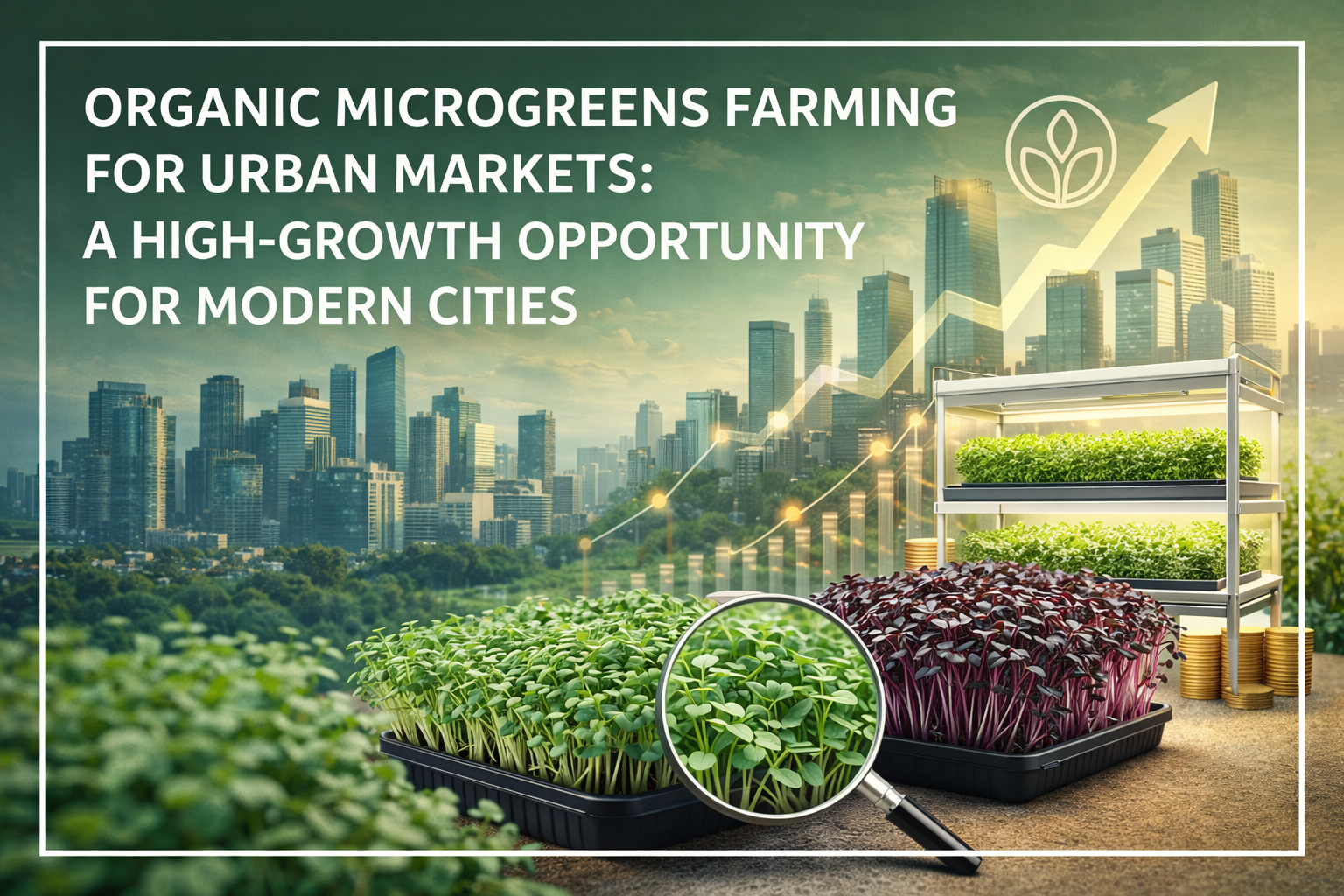
Organic Microgreens Farming for Urban Markets: A High-Growth Opportunity for Modern Cities
Posted on January 11, 2026
Urban organic microgreens farming is gaining popularity as an alternative approach for cities that want to implement fresh, healthy, and locally grown food production. Microgreens have been acknowledged as the ideal candidate for urban agriculture, mainly because of the limited space and the increasing number of people who are conscious of nutrition and eco-friendliness.
The young greens are packed with nutrients, and besides that, they have a very short cycle of growth, low input requirements, and high market value, which make them suitable for urban farming and small-scale farming projects.
What Is Organic Microgreens Farming for Urban Markets
Organic microgreens consist of vegetable greens that are young and harvested almost directly after germination, typically taking 7 to 21 days. The most common varieties that are grown are broccoli, radish, mustard, sunflower, pea shoots, and arugula. Urban organic microgreens farming makes it a point to focus on chemical-free production and the use of organic seeds and natural growing media. This practice aligns with the demands of health-conscious urban dwellers who want food that is safe, fresh, and sustainably grown.
Why Organic Microgreens Farming for Urban Markets Is Perfect for Cities
In the case of urban markets, one of the biggest advantages of organic microgreens farming is the possibility of being located in small and non-traditional places. With the help of indoor planting, microgreens can be grown on roofs, in yards, garages, or even in unused places of commercial buildings. The use of vertical farming systems allows growers to maximise their output in a small area, which is vital in highly populated cities where space is a premium.
Also, being near consumers is another major benefit. Urban agronomists can pick their microgreens just in time when they are at the peak of taste, and then bring them directly to the customers.
Low Startup Cost and Fast Returns in Organic Microgreens Farming for Urban Markets
Urban markets for organic microgreens farming entail a considerably lower initial investment compared to conventional farming. Trays, organic seeds, natural substrates, water supply, shelving, and proper lighting are the basic needs. Numerous growers commence operations on a small scale and subsequently enlarge their units in proportion to the rise in market demand.
A short growth cycle characterises microgreens, thus allowing their multiple harvests each month. The rapid turnover generates a constant cash flow and quick investment returns. Organic microgreens are regarded as premium produce and are therefore often sold at higher prices in urban markets, which allows them to have strong profit margins even with limited production space.
Health Trends Driving Organic Microgreens Farming for Urban Markets
Health awareness among the masses is on the rise, and that is mainly why urban markets are turning towards organic microgreens farming. Microgreens are the nutrient powerhouses as they are loaded with vitamins, minerals, antioxidants, etc.
Urban consumers who are health-conscious, story-telling, and practising clean eating habits are steadily adding microgreens to their daily diets.
Microgreens are considered by chefs and food professionals as plants that can do a lot because of their different uses, strong flavours, and appealing features. They are salad makers, smoothie drinkers, sandwich and gourmet dish users, all boost their demand in urban food markets.
Environmental Benefits of Organic Microgreens Farming for Urban Markets
Sustainability ranks as a major virtue of organic microgreens farming for city markets. The amount of water needed for such crops is considerably lower compared to traditional vegetables, and they are free from the use of synthetic fertilisers and pesticides. In addition, indoor environments that are controlled lead to the reduction of pest risks and the enhancement of resource efficiency.
Producing locally also results in lower carbon emissions since it cuts down on long-distance shipping. By using green methods of production, microgreens farming not only aids in the fight against global warming but also contributes to the establishment of sustainable urban areas and the strengthening of local food networks.
Challenges and Business Opportunities in Organic Microgreens Farming for Urban Markets
Organic microgreens farming for urban markets, although it offers numerous benefits, still presents its challenges. Proper control of temperature, humidity, airflow, and lighting is necessary for producing high-quality plants. Strict hygiene measures must be in place to avoid mould or contamination ruining the crops.
On the other hand, the business opportunities are huge. Farmers can sell their products to restaurants, cafes, health food stores, grocery shops, and directly to consumers. Subscription models and weekly delivery services are accepted in urban regions, and this helps farmers in forming loyal customer bases.
Conclusion:
Growing organic microgreens for city markets is a feasible, lucrative, and eco-friendly farming system for today’s urban areas. The low capital needed, rapid production cycles, and high consumer demand make it a great chance for urban farmers and business people, along with the contribution to healthier and more sustainable urban food systems.