
Organic Agricultural Products Market in India
Posted on January 1, 2026
In 2025, the organic agricultural products market in India will have transitioned from a niche premium segment to a mainstream pillar of the country’s agricultural economy. Driven by a fundamental shift in consumer health consciousness and backed by robust government Digital Public Infrastructure (DPI), the sector is experiencing an unprecedented surge.
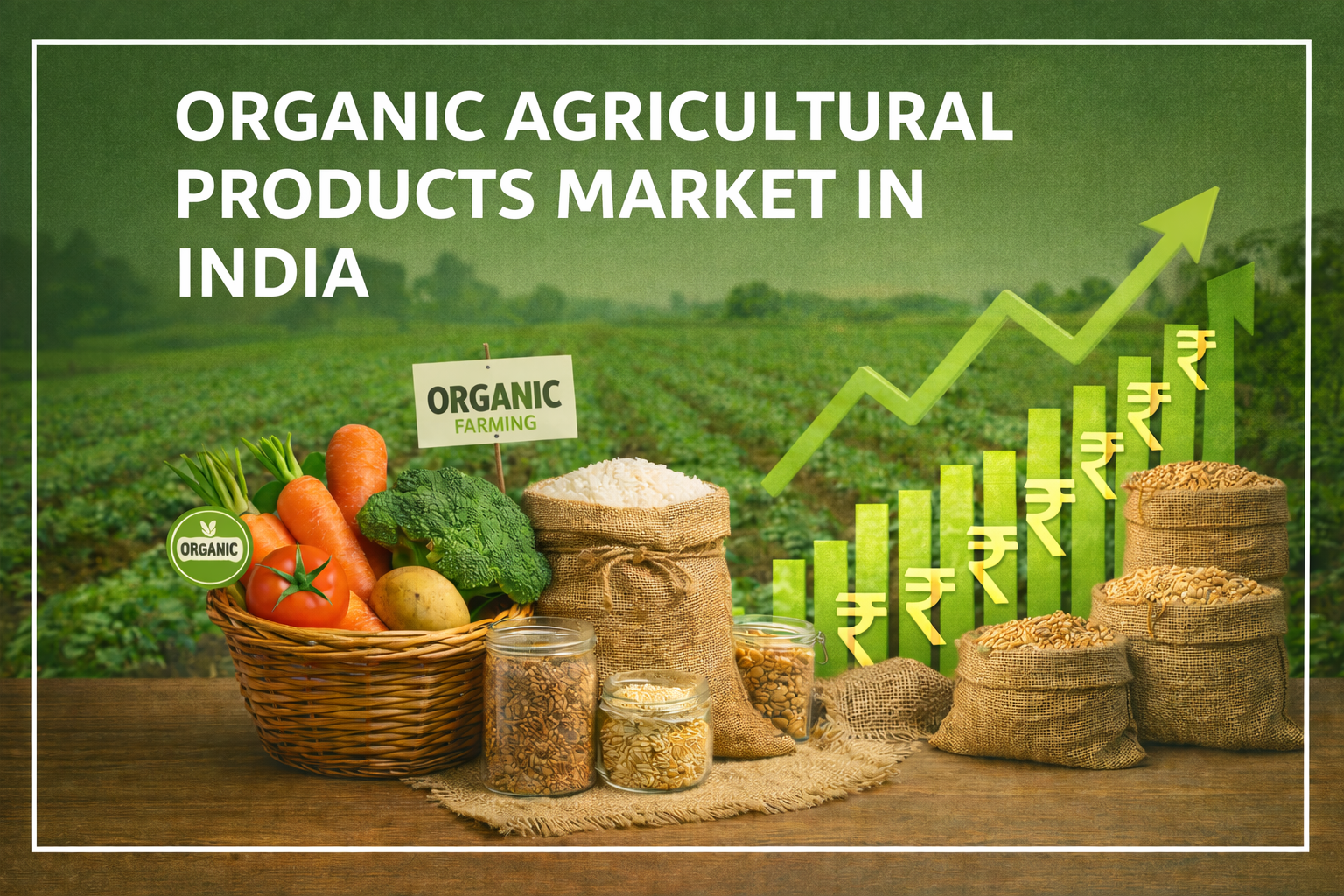
As of early 2025, the Indian organic food market is valued at approximately $2.53 billion (₹21,000 crore) and is projected to maintain a compound annual growth rate (CAGR) of over 20% through 2033. This growth signifies more than just a trend; it represents a “Green Recovery” for Indian soil and a new health standard for its citizens.
Market Dynamics and Consumer Behavior
The primary engine of growth is the evolving Indian consumer. Post-pandemic health awareness has solidified into a permanent preference for “clean labels.”
- Urban Demand: In metros like Bengaluru, Delhi, and Mumbai, nearly 48% of consumers now express concern over food production methods and chemical residues.
- Segment Leaders: While fresh fruits and vegetables remain the largest category, organic cereals and food grains (pulses, millets, and rice) are the leading revenue generators due to their role as household staples.
- The “Premium” Shift: Interestingly, research in 2025 shows that while price sensitivity remains, urban households are increasingly willing to pay a 15–25% premium for certified organic products, viewing it as “preventative healthcare” rather than an optional luxury.
Key Players and Competitive Landscape
The market is characterized by a mix of established legacy brands and agile D2C (Direct-to-Consumer) startups.
| Company | Core Focus | Key Innovation (2025) |
| Organic India | Ayurvedic & Herbal | Integrated farm-to-shelf traceability for teas and supplements. |
| 24 Mantra Organic | Household Staples | Mass-market affordability through extensive FPO networks. |
| Nature Bio-Foods | Exports & Grains | Focus on carbon-neutral farming and large-scale organic rice exports. |
| Earthy Tales / DeHaat | D2C & Tech-led | AI-driven supply chains connecting small farmers directly to urban kitchens. |
Government Initiatives: From Policy to Implementation
The government of India has played an enabling role in the scaling up of the organic sector through two flagship schemes:
Paramparagat Krishi Vikas Yojana (PKVY)
This is a scheme that promotes cluster-based organic farming. The area under this has now expanded to millions of hectares by 2025, with assistance offered at ₹31,500 per hectare to farmers for organic inputs and certification.
National Programme for Organic Production (NPOP)
The 8th edition of NPOP, launched in 2024-25 and managed by APEDA, has ensured that certification is facilitated and smooth. Unified India Organic logo: It replaces all the older, disparate labels that existed in the country, such as Jaivik Bharat, with a single logo that consumers can trust as assuring purity.
Digital Revolution in Organic Farming
The silent partner of this organic success story is technology. In 2025, digital tools will have solved the sector’s biggest historical challenge: Trust.
- Blockchain Traceability: Leading platforms now use blockchain to let consumers scan a QR code on a packet of turmeric and trace exactly which farm in Kerala it originated from, down to the harvest date and pesticide-test results.
- Satellite Monitoring: Lenders and certifiers use geospatial data to confirm that a farm has remained chemical-free during the required three-year “conversion period,” reducing the expense of physical inspections.
- E-commerce Dominance: Online grocery platforms such as BigBasket, Amazon Fresh, and specialist apps already take up approximately 35% of all organic sales, bypassing traditional middleman-heavy supply chains.
Major Bottlenecks and Challenges
Despite the optimism, there is a long and arduous route that faces some obstacles for “100% Organic India” to become a reality:
- The Yield Gap: In the first 2–3 years transitioning from conventional to organic farming, yield usually goes down by 20–30%. With little or no “transition subsidies,” most small-scale farmers go back to chemicals. Organic produce, by definition, is free of synthetic preservatives, has a shorter shelf life. The cold-chain infrastructure in India’s countryside remains a captive investment to avoid high post-harvest losses.
- Certification Costs: For a two-acre smallholder farmer, the costs of “Third-Party Certification” under NPOP are beyond his imagination. The Participatory Guarantee System is very helpful, but it lacks international recognition in the export market.
Export Potential
India is a Global Hub. India is currently one of the biggest exporters of organic products in the world. The focal shift from raw ingredients to value-added products has been reflected in 2025. Key Exports: Organic soybeans, flaxseed, tea, and medicinal plant extracts. New frontiers include surging demands in the EU and North America for Indian organic millets-a.k.a. the “superfood” of the decade-and processed organic snacks.
Perspectives for the Future: Towards 2030
The future of the Indian organic market rests with “Natural Farming” or Prakritik Kheti. The National Mission on Natural Farming, which was launched with an outlay of ₹2,481 crore, aims to bring 1 crore farmers into the chemical-free fold by 2026. As the “Feed India” domain inches toward a projected value of $1.3 trillion by 2035, organic agriculture will no longer be a distinct category; it will be the norm for quality and safety in the Indian food system.