
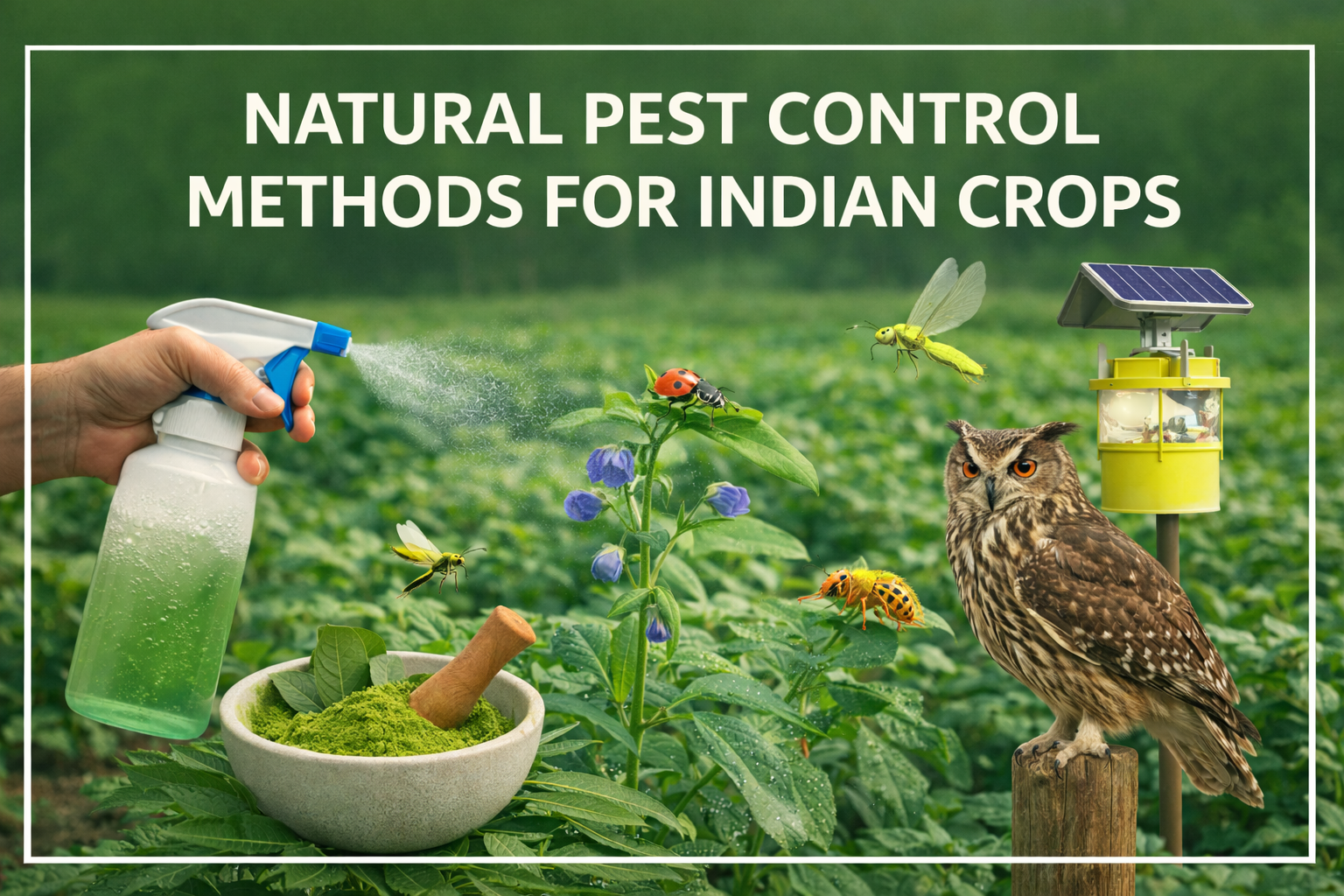
Natural Pest Control Methods for Indian Crops
Posted on February 20, 2026
Natural pest control methods have helped sustainable farming in many ways and have become global priorities. Agriculture’s ability to feed an ever-growing number of people has made natural pest control strategies never as big an industry as it currently is. Different agricultural companies like Invade Agro Global and farmers increasingly employ organic pesticides as a mode of crop protection, environment and sustainable farm harvest. Let us understand more about natural pest control methods:
Advantages of Organic Pesticide Alternatives:
- – Aids Pollinators: Pollinators such as beneficial insects, bees, and butterflies play an important role in ecosystem operation and crop production. Organic pesticides do less damage to species that are not their targets, and pollinators and pest insects thrive. Different health pollinator species are preserved in farmer schemes not only out of inclination to achieve greater yield through improved pollination, but also to help in keeping overall ecological webs under good farming.
- – Long-term effectiveness: Excessive use of chemical insecticides can create resistant pest populations, which are harder to control in the long run. Integrated application of organic pesticide use methods in integrated ways, which help in crop rotation, biological control, and natural repellents that attack pests at different levels. Organic pest management techniques are long-term effective, and farmers can control pests in an effective way without resorting to chemical use or the likelihood of accumulation by nuisance insects, which are hard to control.
- – Healthier crops: Organic alternative pesticides are an important part of cultivating healthier crops. Pesticide management in farming means healthier vegetables and fruits to consumers. It is not only good for animals but also best for farms in which customers are demanding food to be eco-friendly.
- – Environmental Safety: One of the most important benefits is that the pesticides are environmentally friendly. Organic farming practices also enable the conservation of biodiversity as it diminishes the effect of pesticides or non-target organisms such as birds, insects, and microorganisms in the organic soil. Through the development of a more balanced biosphere, organic methods ensure long-term agricultural landscape health and resilience.
Different natural pest control methods:
- – Physical and Mechanical Barriers: Mechanical and physical pest control methods leverage human ingenuity to capture and destroy pests without chemicals. These approaches are useful where economic farming or sensitive environments are involved. Sticky traps capture flying insects, attract pheromone traps, and are important for pest monitoring. Cutting-edge farms make best use of robotic weeders and precision pest killing bots, which helps in reducing labor costs and improving precision.
- – Botanical Pesticides: Botanical pesticides are basically plant-derived substances with pest management properties, which are the main core pillar of control methods in agriculture. Different types of botanical pesticides, such as neem oil, garlic extracts and essential oils have different repellent properties and they act as natural deterrents.
- – Biological control: The first pillar of natural pest control methods in agriculture is biological control which includes natural predators, parasitoids and beneficial pathogens to suppress pest populations on farms. Biological control involves a balance between pests and natural enemies within the farm ecosystem. Different pest control methods prioritize deploying predators and parasitoids at the right time to disrupt the pest outbreaks without chemicals.
- – Mineral-Based Solutions: Some of the minerals are very effective in pest control, providing no damage to the environment. Desiccating abrasive powder hydrates insects and kills their exoskeleton, whereas Kaolin clay forms a protective film over the plant surface, repelling pests. Different natural pesticides are usually used in large-scale farming.
- – Home-made pest control farming recipes: Homemade pest repellents are safely prepared by farmers, such as vinegar traps to control tiny insects, baking soda solutions, and soap sprays to mix with water and to spray on soft-bodied pests like mites and aphids. Such kind of homemade pest control farming activities are cheap to produce, easy to achieve and eco-friendly to use on crops.
Conclusion:
Natural pest control methods in agriculture are raising and helping in a greener and more resilient future. From modern digital innovations to biological and botanical things, these methods are supporting food system sustainability, profitable farming, and environmental stewardship.
As we move deeper into 2025, the pest control methods in agriculture is not just a trend but a vital necessity. With the right knowledge, different strategic applications and advanced platforms farmers can build consumer trust and increase yields and crop quality with healthier, residue free produce preserving biodiversity and pollinator populations. The natural pest control methods in 2025 will define the next generation of planetary health, food production and rural livelihoods.