
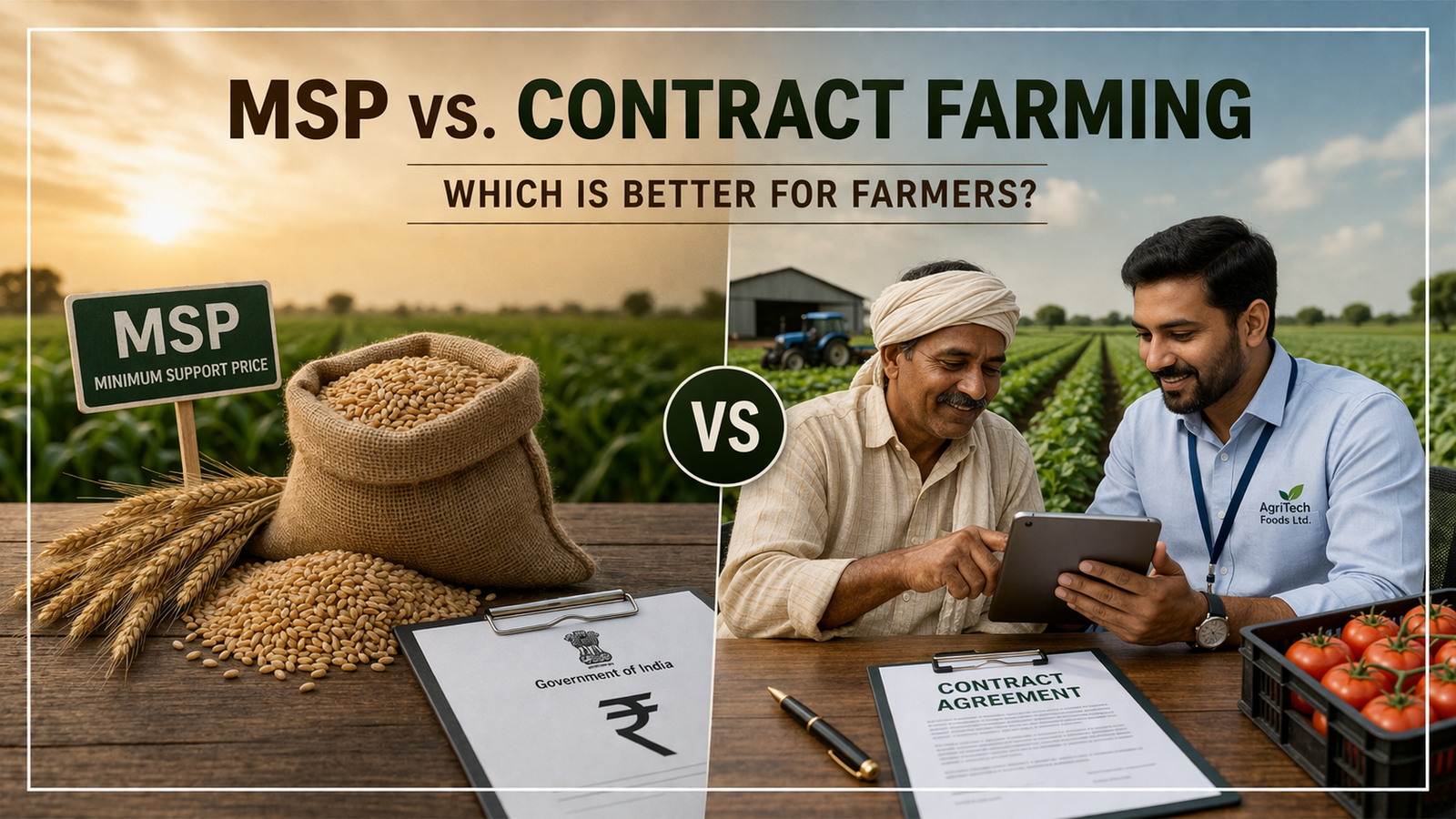
MSP vs. contract farming: Which is better for farmers?
Posted on March 23, 2026
Agriculture in India has always carried a risk of uncertainty. From unpredictable monsoons to fluctuating market prices, farmers have the highest risk in the supply chain. According to the 2017 census, 80% of farmers in India are small-scale farmers, who account for more than 51% of the country’s total agricultural output.
Now the question arises, why do so many farmers in India struggle to secure fair prices for their produce? How can we make farming profitable?
The answer lies in the lack of access to the profit-oriented organization. The challenges are even greater for the smallest-scale farmers, who lack a clear understanding of marketing and supply chains. According to policymakers and researchers, contract farming is one of the best methods to overcome these market barriers as compared to MSP.
Contract farming holds major value in economic liberation reforms in the agriculture sector after independence, which has become a major source of supplying raw materials for the food processing industries like ‘Pepsico India’ for crops like tomato and potato, and arrangements were designed to provide farmers with great support and quality input. Let us understand more about contract farming.
What is contract farming?
Contract farming is an agreement between farmers and marketing firms for the production and supply of agricultural products under forward contracts, often at predetermined prices. The effectiveness depends entirely on three factors: management specifications, resource provision, and market provision.
In India, contract farming was introduced to fulfill the main objectives, which are as follows:
– Diversifying crops and reducing the stress of growing crops through traditional methods.
– Educating more people about agribusiness and the market share of their produce.
– For ease of finding raw materials for the popular processing units.
– Reducing the burden on the government to provide fair prices in any situation.
– Increasing private-sector investment in agricultural progress.
– Awarding the importance of food processing and value addition.
– To generate additional income for small-scale farmers.
– Growing market-focused crops.
Types of Contract Farming
Contract farming takes different forms depending on the product, sponsors’ resources, and the relationship between sponsors and farmers. Some of the major contract farming models are as follows:
Informal Model: The process of the informal model involves seasonal contracts with individual entrepreneurs and small companies, which carry greater marketing risks. Most of these contracts in India are informal model-based.
Multipartite Model: This model is based on the aggregation of multiple parties, such as private firms and governmental statutory bodies. The activities include transportation, production, processing, and management, which different organizations handle at different times. These parties are in partnership and create a proper system to organize the process.
Intermediary Model: The intermediary model involves firms or sponsors subcontracting linkage with farmers to intermediaries, and in such cases, sponsors may risk losing control over production, prices, and the quality of produce.
Centralized Model: A centralized model involves a central processor or sponsor buying from many small farmers for tree crops, annual crops, poultry, and dairy. Products that require extensive processing, such as tea and vegetables, often have quota allocation systems with strict quality control. In this model, most production expectations are controlled by sponsors alone, and it is also known as the vertical model of contract farming because of the proper alignment.
Nucleus Estate Model: This is a variation of the centralized model in which sponsors include plantations and fairly large central estates, with a focus on tree planting. The main focus of this model is processing plants used for breeding in India, which are also commonly used for resettlement or transmigration schemes.
Role of Government in Contract Farming
To enhance farmers’ confidence and incentivize firms, the Model Agriculture Produce and Livestock Contract Farming Act 2018 was introduced, which included unbiased state-level authorities and block-level committees to register contracts, protect land ownership, and provide crop insurance for contracted produce. By 2020, 31 states and union territories had adopted marketing reforms, and contract farming covered 29 commodities across 16 states.
The Farmers Empowerment and Protection Agreement on Price Assurance and Farm Services Act, 2020, part of the three farm laws, simplified contract farming regulations. It assured farmers of inputs, services, and guaranteed prices while transferring market risks to firms. The Act prohibited firms from acquiring land ownership or making permanent modifications. The act further focused on empowering farmers through modern technology, market access, and reduced risk.
Conclusion:
Agriculture is a vast field, and contract farming in India provides more structured support than MSP, helping improve farmers’ income stability by providing assured buyers, technical guidance, and access to better inputs. At the same time, it requires careful evaluation of agreements.
The main key lies in balance, as farmers must enter into agreements with full understanding and proper documentation. For farmers seeking good support, policy updates, and practical guidance, many institutions and governments are helping them identify the right support so that contract farming can become a meaningful step towards a more stable and sustainable agricultural future in India.