
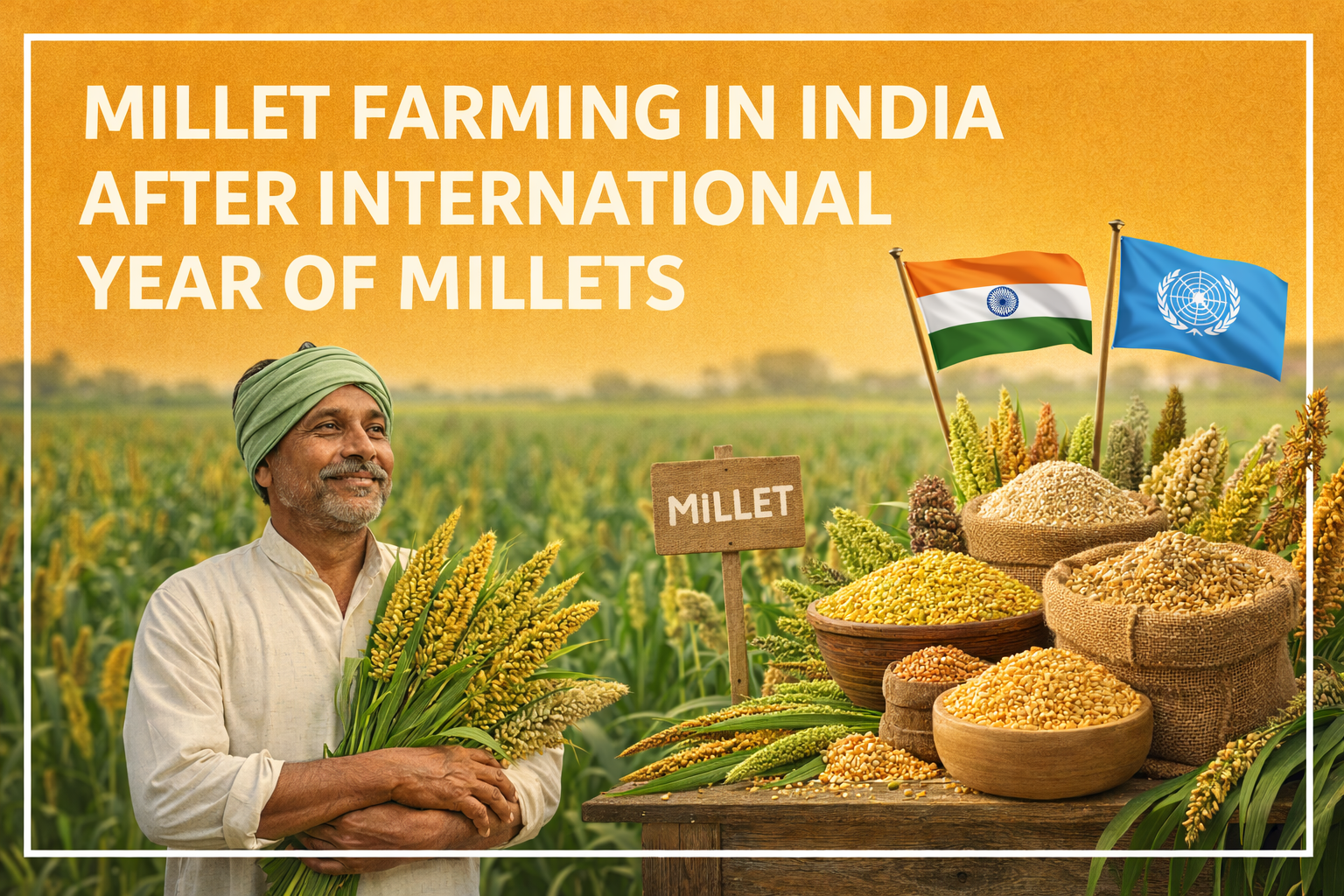
Millet Farming in India After International Year of Millets
Posted on February 27, 2026
Millets are an important part of agriculture, and they are a great source of nutrition, minerals, and protein. These are grown in more than 130 countries and are considered an integral part of the diet for half a billion people all over Africa and Asia. Millets also have health benefits and are also good for the environment, with low water requirements.
Children who are infused with a millet diet often have low occurrences of asthma. Different research studies also state that regular consumption of millets is associated with a reduced risk of type 2 diabetes. Millets are a collective group of small-seeded annual grasses that grow in tropical and subtropical regions. There are several types of millets, but some of them are jowar, bajra, and ragi.
India is the largest exporter and producer of cereal products in the world. The world export of millets increased from $400 million in 2020 to $470 million in 2021. According to the Press Information Bureau report, the production of millets has increased from 14.52 million tons in 2015-16 to 17.96 million tons in 2020-21. India also produces different small millets such as kutki, chenna, and sanwa. Major producers of millets in the country are Rajasthan, Andhra Pradesh, Telangana, Karnataka, Tamil Nadu, Maharashtra, Gujarat, and Haryana. The farmers of these states grow millets both for domestic purposes and international markets, which helps boost the economy of the country.
The United Nations declared 2023 as the International Year of Millets on 5th March, and the proposal was supported by 72 countries. On 6th December 2022, the Food and Agriculture Organization of the United Nations organized an opening ceremony for the International Year of Millets in Rome, Italy. The Department of Agriculture and Farmers Welfare has taken a multi-stakeholder engagement approach, engaging different startups, exporters, retail business and hotels to achieve the main aim of IYM 2023 to carry out different activities and to increase awareness about the benefits of millets.
Efforts to promote millet consumption.
Government of India, on 10 April, 2019, issued a notification termed minor milled and it has been named as ‘Shree Anna’. The union, as well as state governments, are organizing various platforms celebrating and acknowledging the importance of millets. These programmes state the nutritional value of millets and provide new recipes and products to make millets more attractive.
For millet production and consumption to increase and become attractive to all types of customers, not only as supplementary health products but also as a choice of staple grain, it is important to work on ensuring back-end extension services are available to millet producers.
Introduction of Millets in our diet:
Millets are a nutritional powerhouse and are a rich source of vitamins and minerals. It helps in boosting immunity, losing weight, and provides healthy fats and minerals such as calcium, iron, zinc, potassium, and magnesium. Millets have also helped in reducing migraines, asthma symptoms, and pollutants from our systems, allowing organs to function at their best.
Millets are known to be beneficial for people with heart diseases as they contain magnesium, which helps in reducing hyperlipidemia and the risk of heart diseases. In India, consuming millets with legumes creates a mutual supplementation of protein, increases amino acid content, and enhances the overall digestibility of protein.
Suggestion for good food production practices of millets:
To increase the productivity of millet cultivation, different pest management practices need to be provided to farmers who are already growing these crops. Farmers need to be given incentives to increase the area under cultivation. For example, a package of practices needs to be institutionalised so that farmers are supported through the production process.
Millets and Benefit to the Indian Economy:
Millets industry has provided a lot of benefits to the economy, which are as follows:
- – Cultivation, processing, and marketing of millets can help boost the rural economy and help to improve the standard of living for rural communities.
- – The promotion of millet cultivation and consumption can reduce a country’s dependence on imported food products and help to promote self-sufficiency in food production.
- – Increased production and consumption of millets can lead to increased trade both domestically and internationally.
- – Millets are nutritious, which can help to ensure food security for the population, especially in those regions where food shortages are common.
- – The production of millets can increase agricultural production and provide a reliable source of food for the population.
- – The cultivation, processing, and marketing of millets can create new jobs in rural areas, which help to reduce poverty and improve livelihood.
Initiatives taken by the government for the promotion of millets:
Certain initiatives taken by the government for the promotion and consumption of millets in India are as follows:
- -The government has made seed kits and other inputs available to farmers, which are helping in building value chains through Farmer-Producer Organizations.
- – The government is also mobilizing start-ups for export promotion of value-added products in the RTS category, such as breakfast, noodles, and pasta.
- – The government has started making a strategy for a five-year plan for the promotion of millets and value-added products in association with the Indian Council of Agricultural Research, the Indian Council of Medical Research, the Council of Scientific and Industrial Research, and the Central Food Technological Research Institute.
- – The government has set up the National Millet Museum in Hyderabad to promote awareness and understanding of millets.
- – The government has further set up millet parks in various states to promote the production and processing of millets.
- – The National Food Security Mission focuses on increasing the production and productivity of millets in India.
- – The government has included millets in the public distribution system to make them more accessible to the general public.
Conclusion:
India is focusing on economic development by supporting the cultivation, processing, and procurement of millets. For a few millets like sorghum and pearl millets, the Minimum Support Price has been announced. Governments are planning to procure locally grown millets for the Integrated Child Development Scheme, Mid-day meals, government residential schools, and Anganwadis.
Different policies of the government would require cooperation of different Ministries, such as Rural Development and Tribal Development. It would also require different methods for increasing productivity and processing.
Read more such agriculture guides and updates on AgriWorldView.