
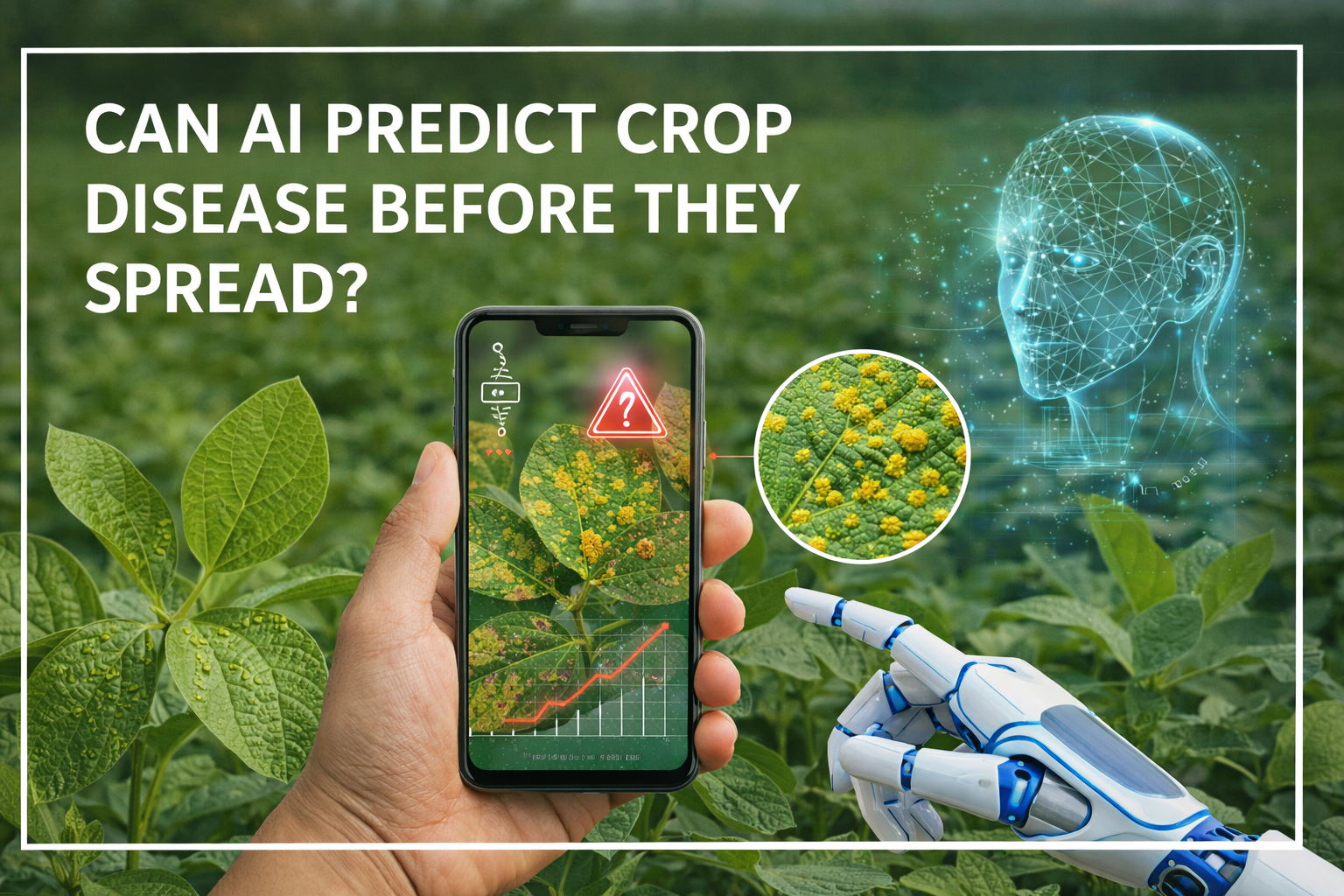
Can AI predict crop disease before they spread?
Posted on February 20, 2026
The modern world of farming and crop management is changing with the advancement of high-tech information. Artificial intelligence combined with image analysis help in the detection of early-stage diseases such as fungal spots or discoloration. This approach can help in protecting the crop at an earlier stage.
By leveraging different AI driven techniques and examining practical case studies, different researchers and practitioners can understand where these technologies excel, especially in those areas that are prone to severe pest outbreaks. Remote sensing technologies such as drones, satellites and hyperspectral cameras play an important role in capturing detailed images of crops to detect potential diseases. Different algorithms, such as convolutional neural networks, are trained on large datasets to enhance the accuracy and adaptability to diverse agricultural scenarios.
Current Applications of AI in Crop Disease Detection:
Different applications used in Crop Disease Detection are as follows:
- – Remote Sensing and Satellite Imagery: Different AI algorithms can analyze multispectral and hyperspectral AI algorithms to detect disease across large agricultural areas. Machine learning models help in identifying patterns that correlate with specific diseases enabling early detection before any visual symptoms become apparent. Remote sensing applications are used for large-scale farming operations, which help in the surveillance of vast agricultural areas, providing early warning systems for potential disease outbreaks.
- – Computer Vision and Image Recognition: One of the most successful applications of AI in crop disease detection is computer vision. Deep learning algorithms, particularly convolutional neural networks, have accuracy in identifying diseases from digital images of stems, plants and fruits. Several commercial platforms and mobile applications are used for disease detection. For example systems have developed different common diseases such as late blight in potatoes and powdery mildew in various crops.
- – IOT sensors and environmental monitoring: Internet of Things sensors help in collecting real-time data which helps in predicting diseases based on environmental factors. Machine learning models can predict fungal infections based on humidity levels and temperature patterns. These predictive models help to implement preventive measures, such as irrigation schedules or modifying environmental conditions in controlled environments.
Benefits of implementing AI for crop disease detection:
There are different benefits in which AI helps for early disease detection. The speed and accuracy of AI systems surpasses the traditional methods used, allowing quick responses. Cost reduction is another advantage that AI systems can optimize resource utilization, reduce unnecessary pesticide applications and minimize labor requirements for field scouting.
AI systems help in improving the overall performance through exposure to new data, adapting to emerging diseases, changing environmental conditions and evolving agricultural practices which makes work easier for everyone.
Challenges and Limitations:
Despite different advantages, the implementation of AI in crop disease detection also faces several challenges. Data quality and availability are main obstacles as many regions lack the infrastructure and resources needed to collect and maintain such datasets.
Major technical challenges include the need of robust algorithms that can perform accurately under varying field conditions, lighting solutions and image qualities. Economic barriers include limited adoption, especially in small farmers who may lack access to smartphones, internet connectivity or financial resources. The lack of standardized protocols and validation procedures for AI-based diagnostic systems raises concerns across different regions and crops.
Future of AI in agriculture:
Different advanced technologies, such as AI and IoT are into agriculture to solve problems for different people. Different new technologies are used to get great results. The future of AI in precision agriculture holds promising areas where use of different AI and ML algorithms inspired by swarm intelligence can monitor various parameters in agriculture.
The integration of AI technology in agriculture includes autonomous systems, UAV swarms, computer vision, offline chatbots and automation from seed sowing to harvesting. These advancements help farmers with technology for optimal outputs, enhancing efficiency through smart irrigation, drones, and robots. Future work in these fields includes further development of generative AI and exploration of sustainable resource management.
Conclusion:
Different deep learning models, such as CNNs and ViTs, are used to detect different crop diseases. Certain technological strategies are used to build lightweight systems that help in low-resource farm settings. Different studies suggest that the development of hybrid AI models combines the efficiency of traditional machines with deep learning.
Another important thing is cost-effective and scalable solutions that can support different smallholder farmers. Artificial intelligence is transforming crop disease management by offering amazing solutions so that farmers can safeguard their crops and reduce waste. With AI, they are able to get ahead and keep their crops disease-free in the next few years.