
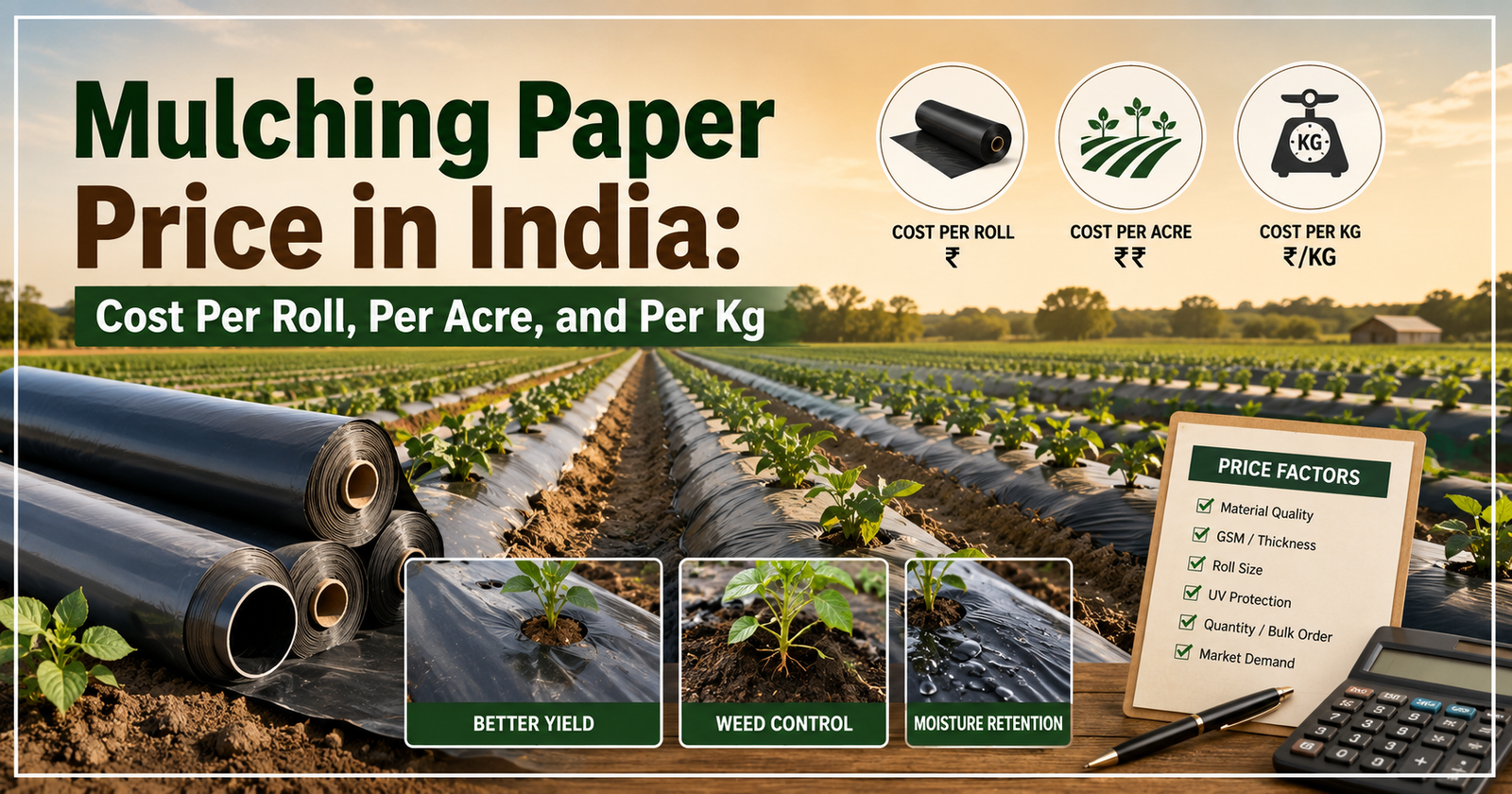
Mulching Paper Price in India: Cost Per Roll, Per Acre, and Per Kg
Posted on July 11, 2026
Every farmer knows the gut-wrenching feeling of watching a perfectly prepared crop bed get completely overrun by aggressive weeds. Manually clearing them out feels like a never-ending battle that drains both your energy and your labor budget. Combine that with the scorching Indian summer drying up precious soil moisture, and farming starts feeling like an uphill struggle.
This is exactly why Mulching Paper (or Mulch Film) has transitioned from an advanced farming luxury to an absolute necessity across India.
Whether you are cultivating high-value chillies in Andhra Pradesh, tomatoes in Maharashtra, or watermelons in Gujarat, mulching sheet technology completely changes the game. It locks moisture directly into the soil, maintains ideal root temperatures, and completely chokes out weeds by blocking sunlight.
If you are planning to upgrade your farm layout, understanding the numbers is crucial. This comprehensive 2026 pricing guide breaks down the cost of mulching paper(per roll, per acre, and per kilogram) across India, helping you maximize every rupee invested.
1. Cost Per Roll: The Standard Buying Metric
Mulching paper is usually sold in rolls at local agro-dealer shops and online agricultural portals. In India, a standard roll is generally around 400 meters long. The width commonly ranges from 3 feet to 4 feet, or about 0.9 to 1.2 meters.
The price per roll is dictated almost entirely by the micron thickness. Think of microns as the durability rating: the higher the micron number, the thicker the sheet, and the longer it lasts under the harsh sun.
Average Price Per Roll (Standard 400 Meter Length)
| Thickness (Microns) | Average Price Range (INR) | Ideal Crop & Lifespan |
| 18 Microns | ₹1,400 to ₹1,650 | Short-duration vegetables (Onion, Garlic) |
| 20 Microns | ₹1,700 to ₹2,500 | Medium vegetable crops (Tomato, Chilli, Brinjal) |
| 25 Microns | ₹2,600 to ₹3,200 | Seasonal fruits & long vegetables (Watermelon, Muskmelon) |
| 30 Microns | ₹3,400 to ₹4,200 | Long-duration or semi-permanent crops (Papaya, Ginger) |
Pro-Tip on Pre-Punched Holes: Many manufacturers offer rolls with pre-punched zig-zag holes for plant placement. These generally cost ₹150 to ₹300 more per roll (compared to plain sheets), but they save you massive amounts of manual labor time during installation.
2. Cost Per Acre: Budgeting for Commercial Farms
Calculating your per-acre investment requires looking at your crop’s row spacing. If you are planting crops that require tightly packed rows, you will naturally need more rolls than a farmer planting wide orchards.
For standard vegetable cultivation (like tomatoes or capsicum), where raised beds are roughly 2.5 to 3 feet wide with a walking path spacing of 4 to 5 feet between rows, you will need approximately 7 to 9 standard rolls (400m each) to cover one acre completely.
The Total Per-Acre Expense Breakdown
- Low-Budget Setup (18-20 Microns): If you require 8 rolls at roughly ₹1,800 per roll, your material cost sits around ₹14,400 to ₹16,000 per acre.
- Premium Durable Setup (25-30 Microns): For heavy-duty operations using 8 rolls at ₹3,000 per roll, expect a material cost (₹24,000 and ₹26,500 per acre).
- Hidden Expenses to Keep in Mind: Do not forget to account for manual labor installation costs or tractor-mounted machine rentals, which typically add an extra ₹2,500 to ₹4,000 per acre.
3. Cost Per Kg: The Wholesale Factory Rate
If you are purchasing in massive bulk directly from plastic manufacturing hubs in Gujarat, Maharashtra, or Tamil Nadu, suppliers drop the retail “per roll” talk and quote rates strictly by weight.
Buying by the kilogram is an excellent choice if you have a massive farm holding or are pooling orders with neighboring village farmers to land a wholesale discount.
- Standard Grade LLDPE Mulch Film: The commercial wholesale price generally ranges from ₹135 to ₹190 per kg.
- Premium UV-Stabilized Branded Sheets: Highly processed mulching papers with advanced heat-blocking properties usually cost between ₹200 and ₹240 per kg.
Quick Check for Bulk Buyers:
Weight of a Standard 20-Micron Roll (1.2m x 400m) ≈ 9 to 10 kg
Factory Price: 10 kg × ₹160/kg = ₹1,600 per roll (Excluding GST & Transport)
Color Schemes: Which Should You Choose?
Walk into any modern farm, and you will see a variety of plastic colors covering the fields. These colors are functional tools designed for specific climates and agricultural goals:
- Silver-Black (The Uncontested King): Easily the most popular choice across India.
The top silver side reflects harsh sunlight to keep the root system cool and disorient flying insect pests. The bottom black side faces the earth, keeping it in absolute darkness to ensure weed seeds cannot germinate. - White-Black: Best suited for high-temperature areas like central or southern India during the peak summer months. White reflects maximum heat to prevent fragile plant roots from literally cooking under the plastic wrapper.
- Pure Black: Commonly utilized in cooler, hilly northern regions. It absorbs sunlight and helps warm cold soil. This supports faster early growth, especially during cooler weather.
Smart Strategies to Avoid Getting Cheated by Sellers
Because the mulching sheet industry is heavily packed with unbranded local suppliers, it is easy to overpay for inferior quality. Protect your hard-earned farming capital by using these simple strategies:
1. Never Buy Without Checking the UV Stabilization Warranty
Unstabilized plastic will become brittle and completely disintegrate into microplastic trash within 45 days under intense Indian sunlight. Always demand UV-stabilized mulch film that offers a written warranty covering the specific life cycle of your crop (typically 3 to 9 months).
2. Verify the Actual Roll Length
A classic trick used by untrustworthy local distributors is selling a roll labeled as 400 meters that actually measures only 300 or 320 meters. Buy from established national brands (such as Global Polyplast, Siddhi Agritech, or Agriplast) or use a basic hanging spring scale to weigh the roll. A lighter roll almost always indicates a shorter length.
3. Take Advantage of Government Subsidies
Many state agricultural departments across India provide substantial financial subsidies (ranging from 50% up to 75% for small-scale holdings) for adopting water-saving mulching technologies under the Per Drop More Crop initiative. Visit your local district Krishi Vigyan Kendra (KVK) or talk to a block agricultural officer to complete your subsidy paperwork before making a major bulk purchase.
The Bottom Line
While spending ₹15,000 to ₹25,000 per acre on plastic film might feel like an expensive upfront investment, the returns speak for themselves. The money saved by eliminating manual weed-pulling labor, combined with a 30% reduction in water pump electricity bills and a noticeable increase in harvest quality, ensures that high-quality mulching paper completely pays for itself within the very first harvest season.