
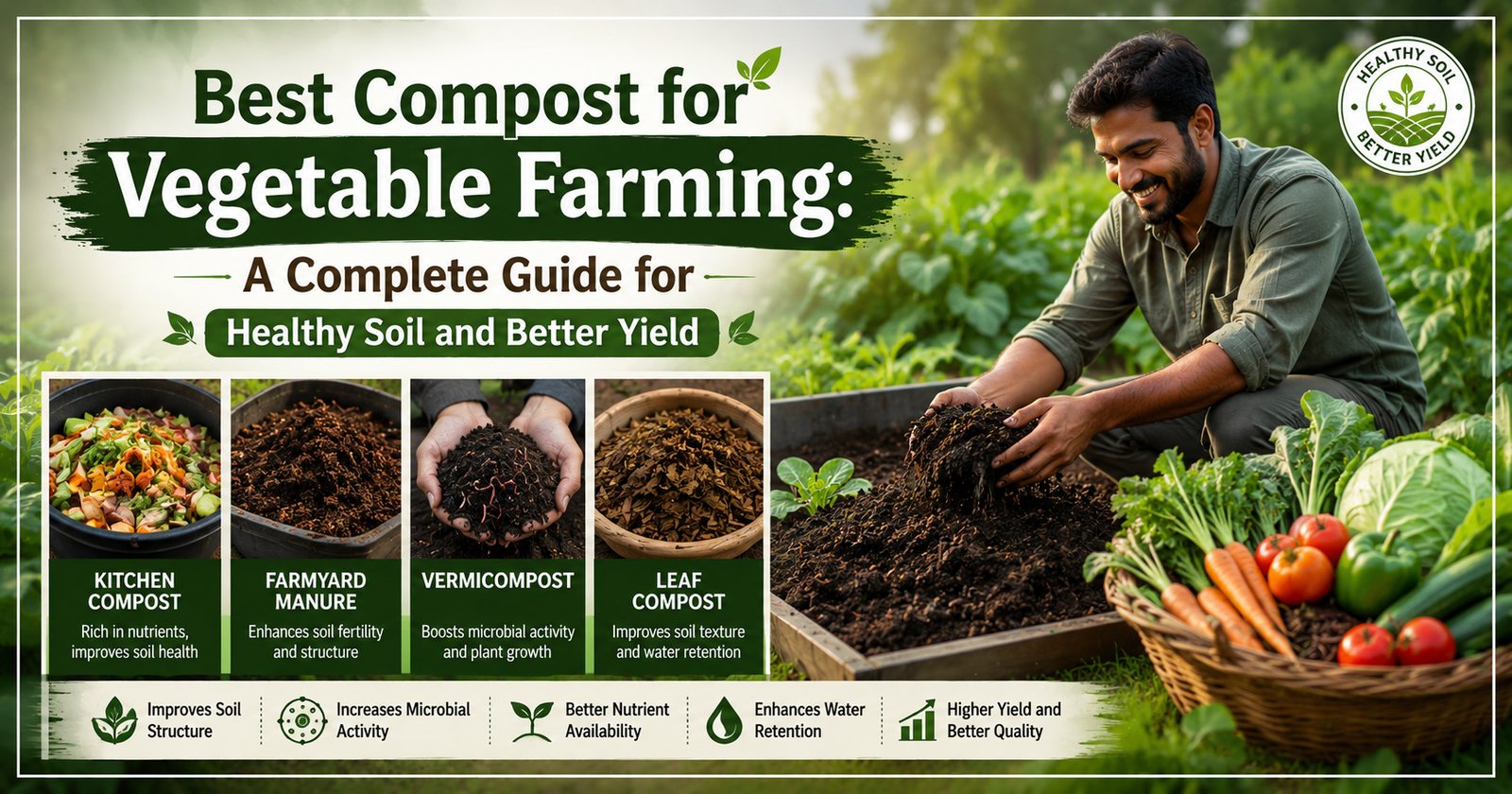
Best Compost for Vegetable Farming
Posted on May 8, 2026
Vegetable farming depends heavily on soil health. Whether you are growing tomatoes, brinjal, chilli, okra, cucumber, cabbage, cauliflower, spinach, coriander, onion, carrot, or leafy greens, the quality of your soil directly affects plant growth, yield, and crop quality. This is where compost becomes very useful. The best compost for vegetable farming improves soil structure, adds organic matter, supports beneficial microbes, and helps plants absorb nutrients naturally.
Many farmers and home gardeners in India are now seeking organic compost, vermicompost, cow dung manure, farmyard manure, and kitchen waste compost because chemical fertilizers alone cannot maintain soil health. Compost not only feeds the plant; it improves the soil system. According to the FAO, composting helps recycle nutrients, reduce fertilizer costs, and return valuable organic matter to the soil.
What Is Compost?
Compost is a natural organic fertilizer made by decomposing plant waste, animal waste, and other biodegradable materials. It can be prepared from dry leaves, crop residues, cow dung, vegetable waste, fruit peels, grass clippings, farm waste, and kitchen waste.
When these materials break down properly, they turn into a dark, crumbly, and earthy-smelling material. This final product is called compost. It is rich in organic matter and useful microorganisms. Compost improves soil texture, moisture-holding capacity, and nutrient availability. The EPA also notes that compost supports plant growth by improving soil health, fertility, and water retention.
Why Compost Is Important for Vegetable Farming
Vegetable crops usually need fertile, loose soil because they grow quickly and require regular nutrients. Compost helps in many ways. It improves soil aeration, which helps roots breathe properly. It increases water-holding capacity, which is useful in hot Indian weather. It also helps reduce soil compaction, especially in heavy clay soil.
Compost slowly releases nutrients into the soil. This means plants receive food over time rather than a sudden nutrient dose. For vegetable farming, this is helpful because crops such as tomatoes, chillies, brinjal, and leafy vegetables require continuous nutrition during their growth cycle.
Another major benefit is microbial activity. Healthy compost contains beneficial bacteria, fungi, and other microorganisms. These microbes help break down organic material and make nutrients more available to plants. Better microbial life also supports natural soil fertility.
Best Types of Compost for Vegetable Farming
There is no single compost that is best for every farm. The right compost depends on your soil type, crop, budget, and availability. However, some compost types are widely used in vegetable farming in India.
1. Vermicompost
Vermicompost is one of the best composts for vegetable farming. It is made with earthworms, which convert organic waste into nutrient-rich compost. Vermicompost is soft, fine, and easy to mix with soil. It improves seed germination, root growth, and overall plant health.
The Ministry of Agriculture’s vermicomposting model describes vermicompost as a beneficial soil amendment produced through earthworm activity and stabilization of organic matter.
Vermicompost is especially useful for tomatoes, chillies, brinjal, capsicum, cucumber, leafy vegetables, and kitchen gardens. It can be mixed in soil before planting or applied around plants during growth. For small vegetable beds, 1-2 kg of vermicompost per square meter is commonly used. For pots, one handful to two handfuls per plant is usually enough, depending on pot size.
2. Farmyard Manure
Farmyard manure, also called FYM, is one of the oldest and most commonly used organic manures in India. It is made from cow dung, urine, animal bedding, and farm waste. Well-decomposed farmyard manure is very useful for vegetable crops because it improves soil fertility and adds organic matter.
However, it should always be fully decomposed before use. Fresh cow dung or fresh manure can burn plant roots, increase weed growth, and attract pests. Good FYM should be dark, crumbly, and free from a strong, bad smell.
Farmyard manure is best applied before sowing or transplanting. Farmers can mix it into the soil during land preparation. It is especially useful for crops like okra, cabbage, cauliflower, brinjal, chilli, pumpkin, and bottle gourd.
3. Cow Dung Compost
Cow dung compost is different from fresh cow dung. It is prepared by decomposing cow dung with dry leaves, crop residues, and other organic materials. Once properly decomposed, it becomes a safe and useful organic fertilizer for vegetable farming.
Cow dung compost improves soil texture and supports long-term fertility. It is affordable and easily available in rural areas. It is a good option for farmers who want low-cost compost for vegetable cultivation.
For best results, cow dung compost should be applied 2 to 3 weeks before planting. This gives it enough time to mix well with the soil.
4. Kitchen Waste Compost
Kitchen waste compost is a good option for home vegetable gardens, terrace gardens, and small organic farms. It is made from vegetable peels, fruit waste, tea leaves, eggshells, and other biodegradable kitchen waste.
However, avoid adding meat, oily food, plastic, glass, cooked spicy food, or dairy waste. These materials can create a bad smell and attract insects or rodents.
Kitchen waste compost is useful for growing coriander, spinach, methi, tomato, chilli, mint, brinjal, and other home garden vegetables. It is also a good way to reduce household waste and create organic fertilizer at home.
5. Leaf Compost
Leaf compost is made from dry leaves. It is very useful for improving soil structure. It may not be as nutrient-rich as vermicompost, but it improves water retention and soil softness.
Leaf compost is especially good for sandy soil because it helps hold moisture. It is also useful for raised beds, nursery beds, and vegetable gardens. Farmers can mix leaf compost with vermicompost or FYM for better results.
6. Green Compost
Green compost is made from fresh plant waste such as grass clippings, crop residue, seed-free weeds, and other green materials. It is rich in nitrogen and helps improve soil fertility. But it should be composted properly before use.
If half-decomposed green material is directly added to vegetable beds, it may heat up and damage plant roots. So, use only mature green compost.
Compost vs Fertilizer: Which Is Better?
Many farmers ask whether compost is better than chemical fertilizer. The simple answer is that both have different roles. Compost improves soil health, organic matter, microbial life, and water retention. Chemical fertilizers provide specific nutrients like nitrogen, phosphorus, and potassium in concentrated form.
For long-term vegetable farming, compost is very important because it builds soil quality. But if the crop has a major nutrient deficiency, farmers may still need balanced fertilizers based on soil testing.
A good approach is integrated nutrient management. This means using compost, organic manure, biofertilizers, and required fertilizers in a balanced way. This supports both crop yield and soil health.
How to Use Compost in Vegetable Farming
The best time to apply compost is before sowing or transplanting. Mix compost into the top 6 to 8 inches of soil during bed preparation. This helps the roots access nutrients easily.
For growing vegetables, compost can also be applied as top dressing. Spread compost around the base of the plant, but keep it slightly away from the stem. After applying compost, lightly mix it with soil and water the plants.
For potted vegetables, mix compost with garden soil and cocopeat. A simple potting mix can include garden soil, compost, and cocopeat in equal parts. This gives good drainage, moisture, and nutrition.
How to Identify Good Quality Compost
Good compost should be dark brown or black in colour. It should smell earthy, not rotten. It should be crumbly and should not contain visible plastic, glass, large undecomposed pieces, or a strong ammonia smell.
Compost is not ready if it smells bad, feels too hot, or still has many undecomposed materials. Using such compost can harm crops and attract pests.
Common Mistakes to Avoid
One common mistake is using fresh manure directly in vegetable beds. This can harm roots and increase pest problems. Another mistake is applying too much compost. Compost is natural, but excess use can still create a nutrient imbalance.
Some farmers also use poor-quality compost that contains weed seeds, plastic, or harmful waste. Always use clean and mature compost. Also, do not rely on compost without checking the soil condition. Soil testing helps understand what your vegetable crop actually needs.
Best Compost for Different Vegetable Crops
For leafy vegetables such as spinach, coriander, methi, and lettuce, vermicompost and kitchen waste compost are good options. For fruiting vegetables like tomato, chilli, brinjal, and capsicum, vermicompost mixed with well-decomposed FYM is a good choice.
For root vegetables such as carrots, radish, and beetroot, use well-decomposed, fine compost. Avoid heavy fresh manure because it can affect root shape. For creeper vegetables like cucumber, pumpkin, bitter gourd, and bottle gourd, farmyard manure and cow dung compost are useful during land preparation.
Final Thoughts
The best compost for vegetable farming is mature, clean, nutrient-rich, and suitable for your soil. Vermicompost is excellent for vegetable growth, farmyard manure is useful for large farms; cow dung compost is affordable, kitchen waste compost is good for home gardens; and leaf compost improves soil structure.
For better results, farmers should focus on soil health, not just plant growth. Compost helps build fertile soil, reduce dependency on chemicals, and improve long-term productivity. Whether you are doing organic vegetable farming, terrace gardening, or commercial vegetable cultivation, using good compost can make your crops healthier, stronger, and more productive.