
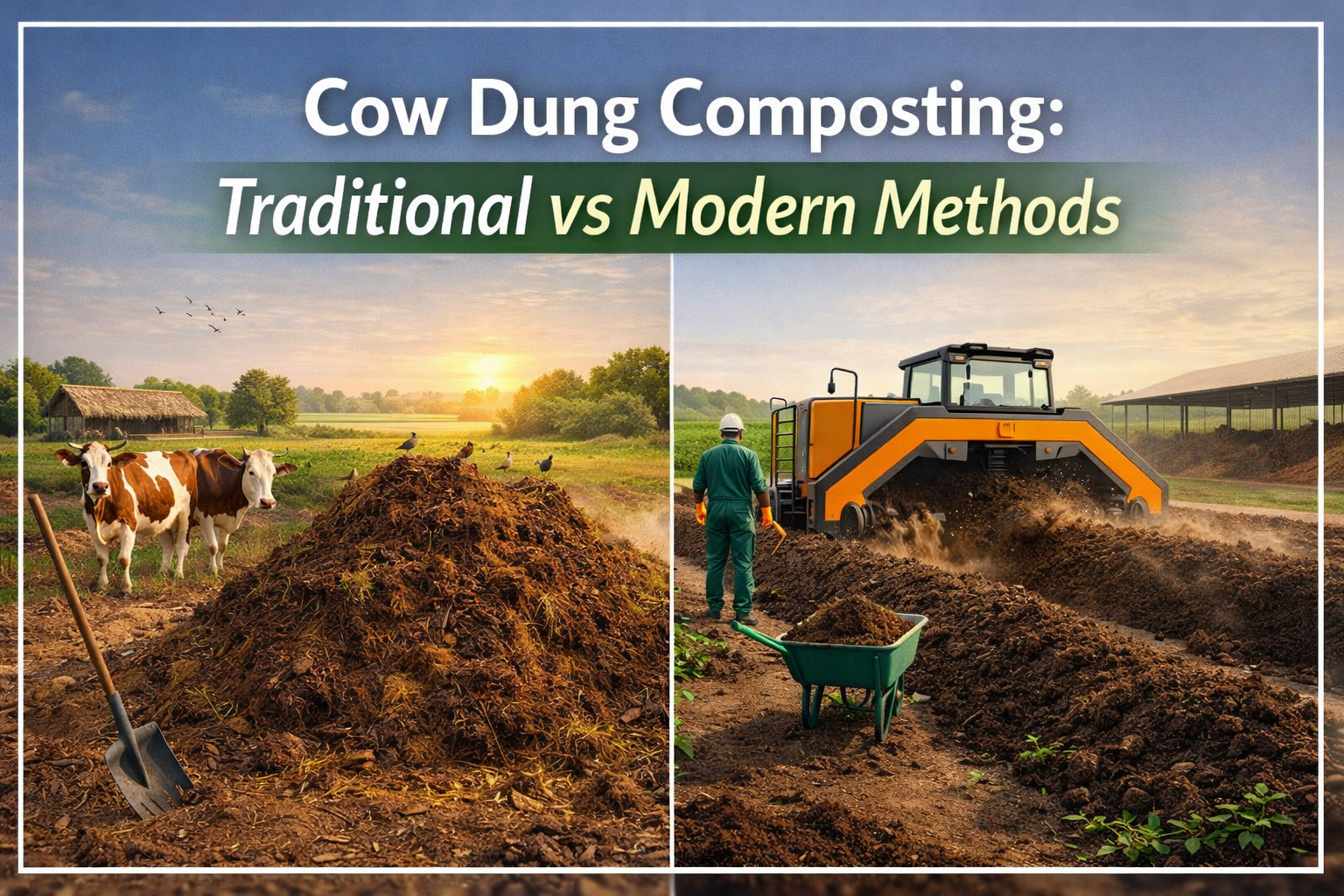
Cow Dung Composting: Traditional vs Modern Methods
Posted on April 7, 2026
Cow dung composting has been a fundamental practice in Indian agriculture for centuries, supporting sustainable farming traditions. Farmers have traditionally relied on cow dung as a natural fertilizer to enrich soil fertility, improve crop yield, and maintain sustainable farming practices. With advancements in agriculture and technology, modern composting methods have also emerged, offering faster and more efficient ways to convert cow dung into high-quality compost.
In this article, we will examine both traditional and modern methods of cow dung composting, compare their advantages and limitations, and guide farmers in selecting the most suitable method.
What is Cow Dung Composting?
Cow dung composting is the process of decomposing cow dung with other organic materials to produce nutrient-rich organic manure. Cow dung contains essential nutrients like nitrogen, phosphorus, and potassium, as well as beneficial microorganisms that enhance soil health.
When properly composted, cow dung turns into a stable, odor-free material that improves soil structure, helps the soil retain water, and supports healthy plant growth.
Importance of Cow Dung in Agriculture
Cow dung has been used for generations in Indian farming due to its multiple benefits:
- – Acts as a natural fertilizer
- – Improves soil fertility
- – Enhances microbial activity in soil
- – Helps retain moisture
- – Reduces dependency on chemical fertilizers
- – Supports organic farming practices
Both small and large-scale farmers use cow dung composting to maintain sustainable agricultural systems.
Traditional Cow Dung Composting Methods
Traditional composting methods have been practiced in rural India for centuries. These methods rely on simple techniques using locally available resources.
1. Pit Composting Method
In this method, a pit is dug in the ground and filled with layers of cow dung and organic waste.
Process:
- – Dig a pit of suitable size
- – Add a layer of cow dung
- – Add crop residues or organic waste
- – Repeat layering
- – Cover with soil or straw
- – Allow decomposition for 3–6 months
Advantages:
- – Low cost
- – Easy to implement
- – Suitable for small farmers
Limitations:
- – Slow decomposition
- – Requires more time
- – Risk of nutrient loss if not managed properly
2. Heap Composting Method
In heap composting, cow dung and organic materials are piled above the ground.
Process:
- – Create a heap of cow dung mixed with dry leaves and waste
- – Maintain moisture by watering regularly
- – Turn the heap occasionally for aeration
- – Compost is ready in 2–4 months
Advantages:
- – No need for digging pits
- – Flexible and simple
- – Suitable for areas with high water tables
Limitations:
- – Exposure to weather conditions
- – Requires regular maintenance
- – Nutrient loss due to rain or heat
3. NADEP Composting Method
NADEP composting is a structured traditional method developed in India that uses brick tanks.
Process:
- – Build a rectangular brick tank with holes for aeration
- – Fill with layers of cow dung slurry, crop residues, and soil
- – Maintain proper moisture
- – Seal the top and allow decomposition
Advantages:
- – Better aeration than the pit method
- – Produces high-quality compost
- – Reduces odor and waste
Limitations:
- – The initial setup cost is higher
- – Requires construction materials
- – Needs technical knowledge
Modern Cow Dung Composting Methods
Modern composting methods use improved techniques and sometimes technology to speed up decomposition and improve compost quality.
1. Vermicomposting Using Cow Dung
Vermicomposting is a modern method that uses earthworms to convert cow dung into nutrient-rich compost.
Process:
- – Prepare a vermi bed with cow dung and organic waste
- – Introduce earthworms (such as Eisenia fetida)
- – Maintain moisture and temperature
- – Worms break down the material into compost within 45–60 days
Advantages:
- – Faster decomposition
- – Produces high-quality vermicompost
- – Rich in nutrients and beneficial microbes
- – Suitable for organic farming
Limitations:
- – Requires a controlled environment
- – Sensitive to temperature and moisture
- – Initial setup and maintenance needed
2. Mechanical Composting Units
Modern farms and agri-businesses use machines to compost cow dung efficiently.
Features:
- – Automated mixing and aeration
- – Temperature and moisture control
- – Faster compost production (weeks instead of months)
Advantages:
- – High efficiency
- – Suitable for large-scale operations
- – Reduces manual labor
Limitations:
- – High investment cost
- – Requires technical expertise
- – Not suitable for small farmers
3. Biogas-Based Composting
Cow dung is used in biogas plants to produce energy, and the leftover slurry is used as compost.
Process:
- – Cow dung is fed into a biogas digester
- – Methane gas is produced for energy
- – The residual slurry is collected as organic fertilizer
Advantages:
- – Dual benefit: energy + compost
- – Environment-friendly
- – Reduces waste
Limitations:
- – Requires setup cost
- – Needs maintenance of the biogas plant
- – Technical knowledge required
Traditional vs Modern Cow Dung Composting: Comparison
| Aspect | Traditional Methods | Modern Methods |
| Cost | Low | Moderate to high |
| Time Required | 3–6 months | 1–2 months |
| Technology | Minimal | Advanced |
| Labor | Manual | Semi-automated or automated |
| Compost Quality | Good | High and consistent |
| Scalability | Limited | High |
| Maintenance | Moderate | Controlled environment required |
Advantages of Cow Dung Composting
Regardless of the method used, cow dung composting offers several benefits:
- – Improves soil fertility and structure
- – Enhances microbial activity
- – Increases water retention capacity
- – Promotes sustainable agriculture
- – Reduces waste and pollution
- – Supports organic farming practices
Challenges in Cow Dung Composting
Farmers may face certain challenges:
- – Odor management
- – Proper moisture control
- – Time-consuming traditional methods
- – Initial investment in modern systems
- – Requirement of technical knowledge for advanced methods
Proper planning and training can help overcome these challenges.
Which Method Should Farmers Choose?
The choice between traditional and modern cow dung composting depends on:
- – Farm size
- – Budget
- – Availability of resources
- – Time constraints
- – Level of technical knowledge
For Small Farmers:
Traditional methods (pit or heap composting) are more practical due to low cost and simplicity.
For Medium to Large Farms:
Modern methods (vermicomposting or mechanical composting) are more efficient and scalable.
For Organic Farming:
Vermicomposting is highly recommended due to its nutrient-rich output and eco-friendly nature.
Best Practices for Cow Dung Composting
- – Maintain proper moisture levels (not too dry or wet)
- – Ensure adequate aeration
- – Use a balanced mix of cow dung and organic materials
- – Avoid contamination with plastics or chemicals
- – Turn or mix compost periodically
- – Protect compost from heavy rain and direct sunlight
Following these practices ensures high-quality compost production.
Conclusion:
Cow dung composting remains a cornerstone of sustainable agriculture in India. Traditional methods have served farmers well for generations due to their simplicity and low cost, while modern methods offer faster, more efficient, and scalable solutions.
By understanding the differences between traditional and modern composting techniques, farmers can choose the method that best suits their needs and resources. Whether using a simple pit method or an advanced vermicomposting system, cow dung composting continues to play a crucial role in improving soil health, reducing environmental impact, and promoting sustainable farming practices.