
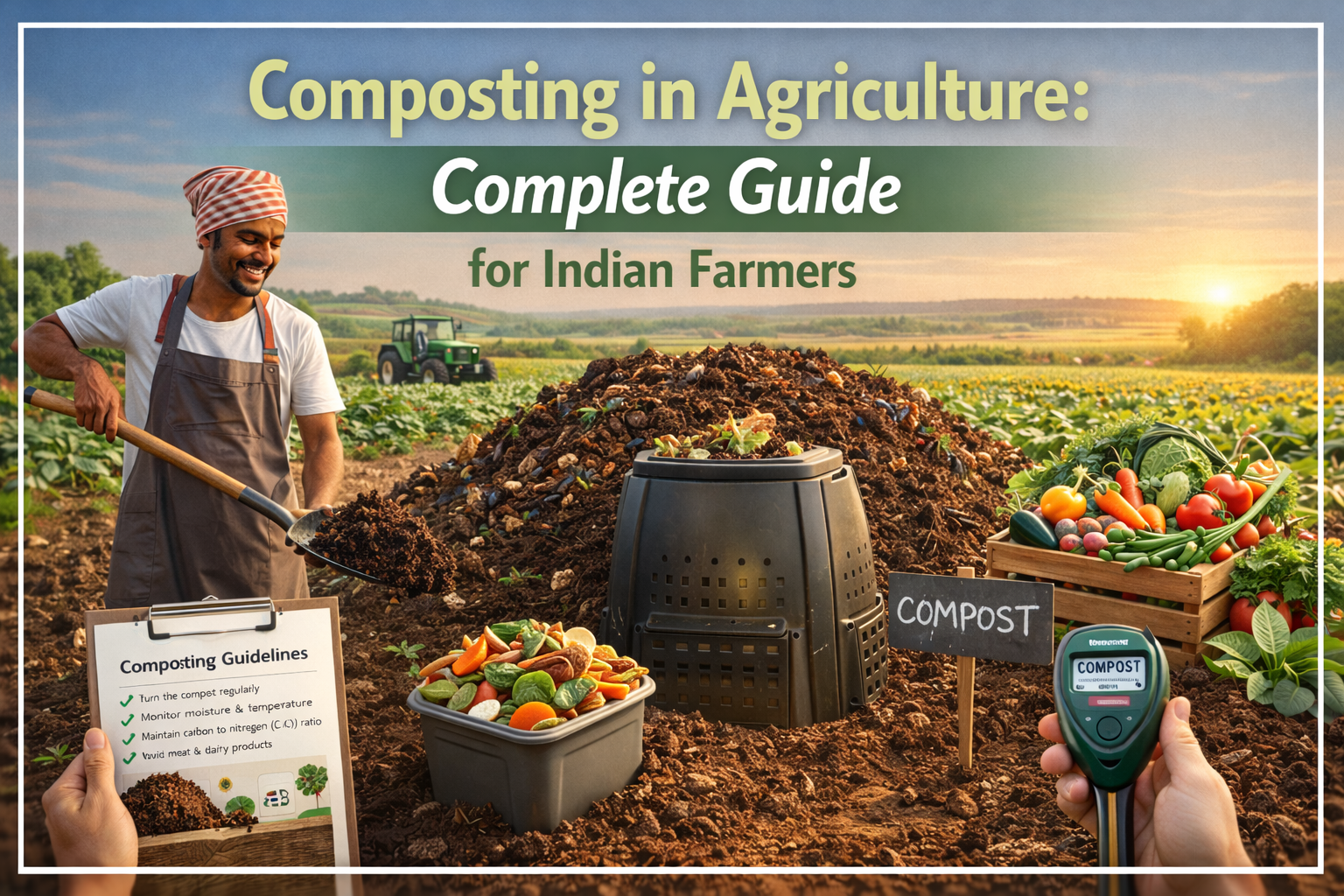
Composting in Agriculture: Complete Guide for Indian Farmers
Posted on April 7, 2026
Composting in agriculture is one of the most effective and sustainable practices for improving soil health, increasing crop productivity, and reducing dependence on chemical fertilizers. For Indian farmers, composting is not only an eco-friendly solution but also a cost-effective method to enhance soil fertility using locally available organic waste.
In this comprehensive guide, we will explore what composting is, its importance in agriculture, composting types and methods, benefits, and how farmers in India can start composting.
What is Composting?
Composting is the natural process of decomposing organic waste materials such as crop residues, animal manure, kitchen waste, and plant matter into nutrient-rich organic fertilizer called compost.
Microorganisms like bacteria and fungi break down organic matter in the presence of oxygen, moisture, and proper temperature. The final product is a dark, crumbly, and nutrient-rich material that improves soil structure and fertility.
Importance of Composting in Agriculture
Composting plays a vital role in sustainable agriculture, especially in India, where soil degradation and overuse of chemical fertilizers are major concerns.
Key Importance:
- – Improves soil fertility
- – Enhances crop yield
- – Reduces chemical fertilizer dependency
- – Promotes sustainable farming practices
- – Improves soil structure and water retention
By adopting composting, farmers can maintain long-term soil productivity while reducing input costs.
Types of Composting
There are several composting methods suitable for Indian farming conditions:
1. Aerobic Composting
- – Requires oxygen
- – Organic waste is turned regularly
- – Faster decomposition
- – Produces high-quality compost
2. Anaerobic Composting
- – Occurs without oxygen
- – Slower process
- – Produces biogas along with compost
3. Vermicomposting
- – Uses earthworms to decompose organic matter
- – Produces nutrient-rich compost called vermicompost
- – Ideal for small-scale and organic farming
4. NADEP Composting
- – Developed in India
- – Uses a brick tank structure
- – Organic waste is layered with cow dung slurry and soil
5. Pit Composting
- – Organic waste is decomposed in pits dug in the ground
- – Suitable for rural farms with sufficient space
Raw Materials for Composting
Farmers can use various organic materials for composting:
- – Crop residues (straw, husk, leaves)
- – Animal manure (cow dung, goat manure)
- – Kitchen waste
- – Green leaves and weeds
- – Agricultural by-products
- – Poultry waste
Avoid using plastics, metals, chemicals, and non-biodegradable materials.
Step-by-Step Composting Process
Step 1: Site Selection
Choose a well-drained area away from water sources. The site should be easily accessible and have partial shade.
Step 2: Collection of Organic Waste
Collect crop residues, animal manure, and other biodegradable materials. Chop larger materials into smaller pieces (for faster decomposition).
Step 3: Layering
Create layers of organic materials in a compost pit or heap:
- – Bottom layer: dry materials (leaves, straw)
- – Middle layer: green waste and manure
- – Top layer: soil or cow dung slurry
Step 4: Moisture Maintenance
Maintain moisture by sprinkling water regularly. The compost should be moist but not waterlogged.
Step 5: Turning the Pile
Turn the compost pile every 10–15 days to ensure proper aeration and uniform decomposition.
Step 6: Decomposition
The composting process usually takes 45–90 days, depending on the method and conditions.
Step 7: Harvesting Compost
The compost is ready when it becomes dark brown, crumbly, and has an earthy smell.
Vermicomposting: A Popular Method in India
Indian farmers widely use vermicomposting because it is efficient and produces high-quality compost.
Process:
- – Organic waste is placed in a vermi bed
- – Earthworms (like Eisenia fetida) are added
- – Worms consume organic matter and produce castings
- – Compost is harvested after 45–60 days
Advantages:
- Faster than traditional composting
- Produces nutrient-rich fertilizer
- Suitable for small and medium farms
Benefits of Composting in Agriculture
1. Improves Soil Health
Compost enhances soil structure, aeration, and microbial activity, making the soil more fertile.
2. Increases Water Retention
Compost improves the soil’s ability to retain moisture, reducing irrigation needs.
3. Reduces Chemical Fertilizer Usage
By using compost, farmers can reduce their dependency on chemical fertilizers, lowering input costs.
4. Enhances Crop Yield
Nutrient-rich compost provides essential nutrients that support healthy plant growth and higher yields.
5. Promotes Sustainable Farming
Composting helps recycle organic waste and supports environmentally friendly farming practices.
6. Prevents Soil Degradation
Continuous use of chemical fertilizers can damage soil structure. Compost restores soil balance and prevents degradation.
Composting Equipment and Tools
Farmers may need basic tools and materials for composting:
- – Shovel or spade
- – Watering system (sprinkler or manual)
- – Compost bins or pits
- – Protective covers (tarpaulin sheets)
- – Thermometer (optional)
Modern composting bins are more organized.
Common Mistakes to Avoid
- – Using too much dry material without moisture
- – Not turning the compost regularly
- – Overwatering or under-watering
- – Adding non-biodegradable waste
- – Poor site selection with waterlogging issues
Avoiding these mistakes ensures efficient compost production.
Composting in Indian Agriculture: Opportunities
Composting has significant potential in India due to:
- – Large availability of agricultural waste
- – Increasing awareness of organic farming
- – Government support for sustainable agriculture
- – Growing demand for organic produce
Farmers can also generate additional income by selling compost locally.
Government Support and Initiatives
The Government of India promotes composting and organic farming through various schemes:
- – Paramparagat Krishi Vikas Yojana (PKVY)
- – National Mission for Sustainable Agriculture (NMSA)
- – Sub-Mission on Agroforestry
- – Subsidies for organic inputs and compost units
These initiatives encourage farmers to adopt eco-friendly practices.
Best Practices for Effective Composting
- – Maintain a balanced carbon-to-nitrogen ratio
- – Ensure proper aeration and moisture
- – Use a mix of green and dry materials
- – Regularly monitor temperature and decomposition
- – Protect compost from heavy rain or extreme weather
Following these practices improves compost quality and efficiency.
Conclusion:
Composting in agriculture is a powerful tool for Indian farmers to improve soil fertility, reduce costs, and adopt sustainable farming methods. With increasing environmental concerns and rising fertilizer prices, composting offers a practical and eco-friendly alternative.
Whether using traditional compost pits or modern methods like vermicomposting, farmers can benefit significantly by integrating composting into their agricultural practices. By recycling organic waste and returning nutrients to the soil, composting helps build healthier farms and a more sustainable agricultural future.