
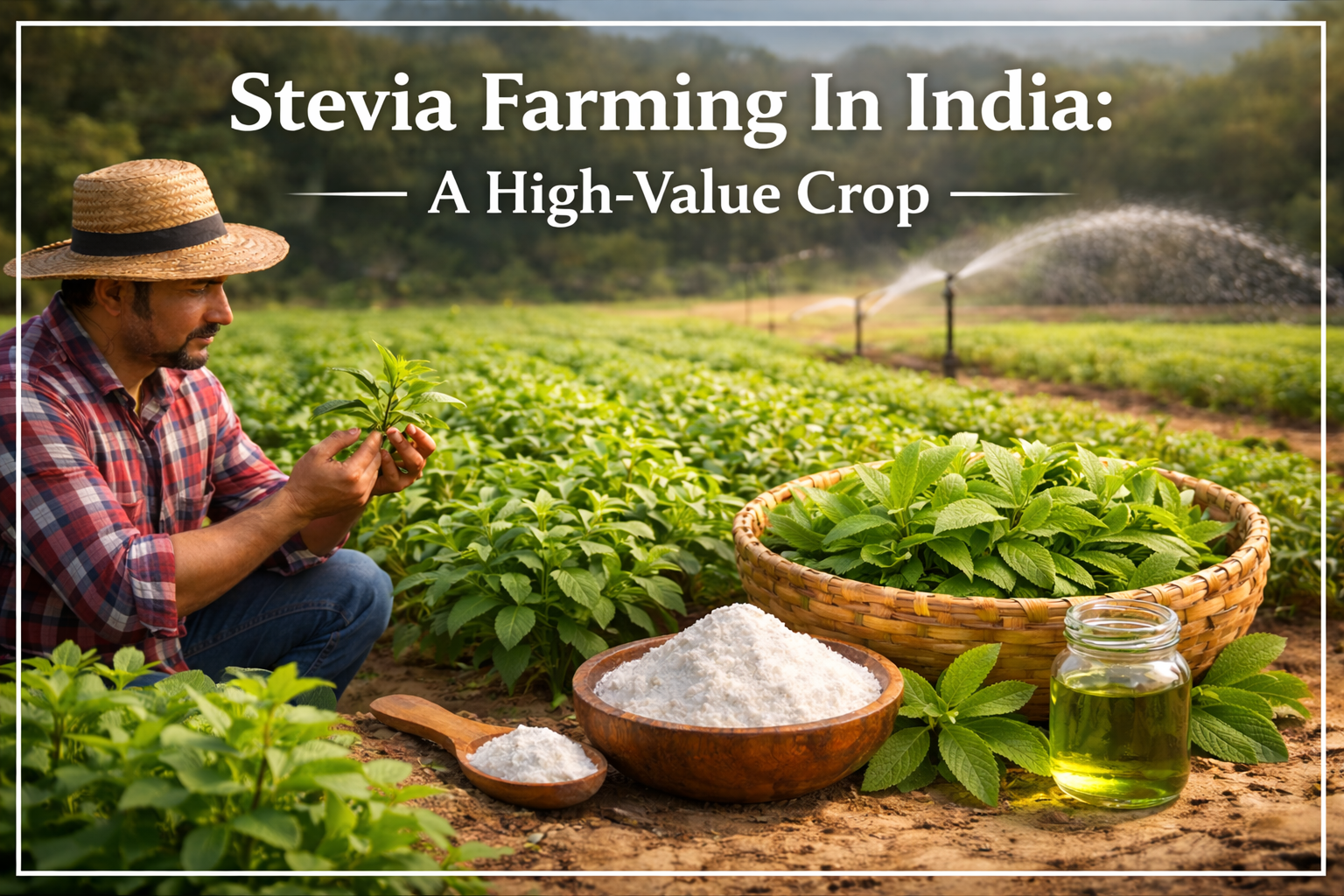
Stevia Farming In India: A High-Value Crop
Posted on March 23, 2026
India is one of the biggest consumers of sugarcane. Stevia rebaudiana Bertoni is a non-caloric natural source alternative to sugarcane. It is recommended for diabetes and has been tested for efficacy in animals and used in animals with no side effects. The main impact is that stevioside passes through the digestive system without chemical breakdown and is considered as “double-strength” sugar.
Stevia grows well in sandy loam soil with a pH range of 5.0-7.5 and requires warm and sunny weather. Some of the major stevia-growing states are Madhya Pradesh, Punjab, Andhra Pradesh, Karnataka, Chhattisgarh, and Maharashtra. The global market size grew from 61.75 billion in 2022 to 67.40 billion in 2024 at a compound annual growth rate at 9.9%.
Production Technology of Stevia
Grown Requirements: Stevia grows in semi-humid temperatures with good light intensity. Rainfall of 1500-1800 mm and temperature up to 46 degrees Celsius are required. Increasing day length and light intensity to 16 hours can boost vegetative growth and stevioside levels in stevia plants. It prefers fertile, well-drained sandy loam that is rich in organic matter. It also requires a constant supply of moisture but not waterlogged fields.
Propagation and planning material development: Due to the extremely small size of the seed, nursery from seeds must be carried out in March and January. The nursery beds should be irrigated for the first five days after sowing during morning and evening hours and then once daily. Stem cuttings 10-15 cm having 4-6 nodes, can be used to grow plants through vegetative means. For faster root development, the cuttings should be raised in high humidity and partial shadow. The root formation takes 10-15 days on an average, and this period requires regular sprinkling of water.
Transplantation: Stevia plantations are normally carried out on raised beds 12-15 cm long and 50-60 cm wide. Row-to-row distance should be 40-45 cm and plant-to-plant 30 cm.
Irrigation: The plants are watered using a drip irrigation system. Stevia plants do not require water in abundance, so moderate water is provided at regular intervals. The first irrigation is given post-transplantation and then at intervals of 3 to 5 days till the plants are established.
Manure and fertilizer: Nutrient management is an important element for stevia’s increased life yield and quality amongst other agronomic practices. To preserve all this soil fertility, organic manures and chemical fertilizers are used. The demand for manure and fertilizer does depend on cultivation methods and soil fertility. While preparing land for stevia cultivation, FYM @200 qtl/acre, cow dung/urine, and vermicompost must be applied and combined and mixed well with soil.
Weed Management: One of the main obstacles in the growth of stevia farming is weed growth, which impacts plant growth and crop yield. Regular weeding at an interval of 20 days is required during the first two months to avoid competition between weeds and crops. Mulching with plastic sheets or plant residues is effective in regulating the germination and growth of the weeds, which also enhances the growth of the stevia plant.
Diseases of Stevia: Fungus Septoria steviae results in the appearance of grey spots on leaves followed by chlorosis. It can be controlled to some extent by providing a controlled water supply to the plants and by spraying borax on the plants. The stems and leaves become necrotic as the symptoms advance. As the symptoms progress, the stem starts to die, and the entire plant ultimately collapses.
Harvesting and storage: The first harvest of the crop is completed after four months of plantation, and subsequently, the crop is harvested once every three months. Time of the harvesting varies with the growing season and region of cultivation, and it could be done manually at a 10-15 cm height from the ground. Stevia is a perennial crop; one plantation can provide produce for 4-5 years. Green stevia should be harvested in the morning when it contains the highest sugar content. Cool temperatures and shorter days intensify the sweetness of stevia. From one plantation cycle, a farmer can produce up to three harvests. For fetching the appropriate market price, the procedure of drying leaves and storing them is important. Hence, the fresh leaves should be dried in the shade or a hot air oven at 40 degrees.
Economic yield: The average fresh biomass yield in the first year from two crops is 2.0-2.5 and increases to 4.0 to 4.5 tons/ha in the subsequent years. The average net revenue obtained from stevia cultivation is around 2.0-2.5 times higher than that of traditional crops.
Conclusion
India is one of the largest consumers of cane sugar and has the largest diabetic population. By the year 2045, it is predicted that India will have 134 million people with diabetes. The best part of stevia is that it is a natural sweetener and an alternative to sugar, replacing chemical sweeteners like sucralose, saccharine, and aspartame, which has made people more inclined toward products with natural, low-calorie ingredients. The product has high demand in both local and international markets, other than gardening, farming, and crop farming.