
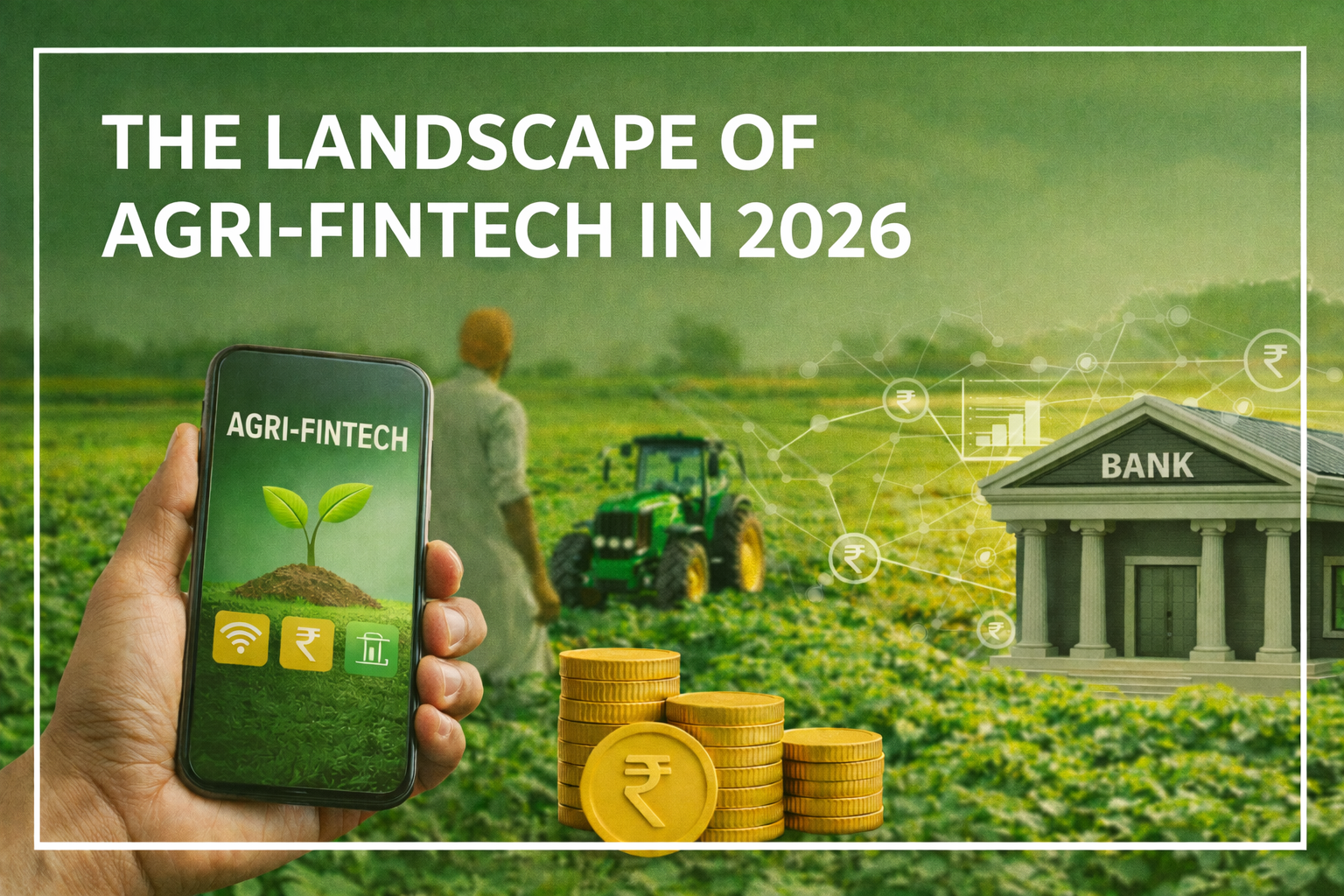
The Landscape of Agri-Fintech in 2026
Posted on December 23, 2025
Recent industry statistics reveal the expected growth of formal institutional credits to above ₹31.5 lakh crores by FY26. Yet, conventional banks operate inefficiently for the “last-mile” financing due to the “absence of farm-level data and cost of transactions.”
Key Drivers of the Agri-Finance Sector
- – AgriStack: AgriStack project of the goRecent industry statistics reveal the expected growth of formal institutional credits to above ₹31.5 lakh crores by FY26. Yet, conventional banks operate inefficiently for the “last-mile” financing due to the “absence of farm-level data and cost of transactions.” Digital platforms play the crucial and intersecting roles of lenders and enablers for farm financing. Government’s aims for the “digital identification of farmers and. integration of land and crop data.
- – Smartphone Infusion: With more than “70% of farmers having access to and owning a smartphone,” the “finance” for the “farm sector” is “literally in the palm of their hands.
- – UPI & AEPS: With the advent and successful establishment of UPI payments, “loans disbursement and repayment have been made imminent and transparent.
Leading Platforms and Their Models
The agri-finance industry in the Indian context doesn’t have a “one-size-fits-all” approach towards the farm phenomenon. Various players target their pain points in the “agrarian value chain.
- – Full-Stack Platforms: Platforms operating under the names of DeHaat, AgroStar, or even Ninjacart have “reduced the value chain beyond the sale of seeds and purchase of farm produce.” They have enabled the “finance” component. “How it works:” They “offer input financing” to the agricultural producer upon purchasing products like “fertilizers and seeds” through the “application software.” “The credit “is free of interest or cyclically linked to “farm harvest.
- – Specialized Credit Underwriters: Companies including Samunnati, Jai Kisan, and agro-wise take the “finances” of the agri-sector to their focus. * “Instant Credit” by the “use of artificial intelligence-powered engines,” for small amounts lending within “48 hours.”* Warehouse Receipt Financing (WRF) by the “accredited warehouses” to “store the produce.” This “instantly” generates “liquidity” and allows the farmer to “wait for better” “prices” for “farm sale” due to the “receipt.
- – Precision-Data Lenders: Companies like CropIn and Fasal use “satellite imagery” and “IOT devices to monitor crops.“Credit Scoring” – With this “Alternative data,” the “lenders” initiate the “approvals” to the “farm producers.” When the satellite image shows a healthy field with proper irrigation, it increases the farmer’s creditworthiness, even if he/she have no credit score.
How Digital Credit Scoring Works?
| Data Source | What it Reveals |
| Geospatial Data | Crop health, soil moisture, and historical yield patterns. |
| Transaction History | Buying patterns (of seeds or fertilizers) and the frequency of sales. |
| Psychometric Tests | Mobile-based quizzes that assess a borrower’s “willingness to pay.” |
| Social Data | Membership in Farmer-Producer Organizations (FPOs) or Self-Help Groups (SHGs). |
The “Instant” Advantage: Impact on the Ground
There’s little doubt that ‘instant’ disbursements’ positive impact has been immediate.” Three kinds of immediate effects:
- – Breaking the Cost of Debt Trap: Digital Lending offers credit at 12% per annum to farmers, saving them from 36-60% charged by moneylenders.
- – Timely Application of Crops: Money in agriculture arrives when crops need protection, too! An early start on pesticides can destroy crops.
- – Consolidating ‘Financial Identity’: Millions of ‘credit invisible’ small-farming families have achieved financial identity with these new digital lending services, paving the way to bigger bank credits in due course.
Roadblocks
The ‘Digital Revolution in Agriculture’ faces tough competition in the following areas:
- – Digital Consciousness: Access to online applications can be difficult, though most agrarians own smartphones with connectivity. Despite 5G availability in most parts of rural India, some ‘dark’ spots remain with inadequate networks to support quick uploads.
- – Data Security: These ‘digitally-enterprised’ services must ensure ‘cybersecurity’ to protect small agricultural communities vulnerable to cyber threats.
Read Also: https://agriworldview.com/vertical-farming-startup-cost-in-india/
Government Action
Digital Agricultural Mission (DAM), with initial funding in excess of ₹2,800 crore, aims to provide a ‘single source’ authority to lenders to eliminate ‘forging.’ By 2026-27, it aims to cover ‘11 crore’ agrarians presenting ‘Single Source’ truth to lenders to prevent ‘forging’.
Conclusion
Digital Farm Finance Platforms cease to be ‘Fintech Fad’; instead, ‘Digital Infrastructure’ has arrived in rural India! By playing ‘soil magic’ to convert soil health to credit scores & ‘satellite magic’ to convert satellite images to collateral, it’s democratizing capital for agrarians! ‘Instant Credit’ to Indian agrarians means something much bigger than just ‘money’ – it stands for ‘dignified’ credit & ‘safe’ crops!